Volcanic eruptions
Why do volcanoes erupt?
Volcanoes erupt because of density and pressure. The lower
density of the magma relative to the surrounding rocks causes it to rise (like
air bubbles in syrup). It will rise to the surface or to a depth that is
determined by the density of the magma and the weight of the rocks above it. As
the magma rises, bubbles start to form from the gas dissolved in the magma. The
gas bubbles exert tremendous pressure. This pressure helps to bring the magma to
the surface and forces it in the air, sometimes to great heights.
It's sort of like the bubbles of gas in a bottle of soda.
Before you open the soda you don't see many bubbles because the pressure in the
bottle keeps the gas dissolved in the soda. When you open the bottle the
pressure is released and the gas bubbles leave the soda. If you shake up the
bottle first, the soda gets pushed out by the bubbles of gas as they rush out.
As the rocks move upward (or have water
added to them), they start to melt a little bit. These little blebs of melt
migrate upward and coalesce into larger volumes that continue to move upward.
They may collect in a magma chamber or they may just come straight up. As they
rise, gas molecules in the magma come out of solution and form bubbles and as
the bubbles rise they expand. Eventually the pressure from these bubbles is
stronger than the surrounding solid rock and this surrounding rock fractures,
allowing the magma to get to the surface.
All
magmas contain dissolved gases, and as they rise to the surface to erupt, the
confining pressures are reduced and the dissolved gases are liberated either
quietly or explosively. If the lava is a thin fluid (not viscous), the gases may
escape easily. But if the lava is thick and pasty (highly viscous), the gases
will not move freely but will build up tremendous pressure, and ultimately
escape with explosive violence. Gases in lava may be compared with the gas in a
bottle of a carbonated soft drink. If you put your thumb over the top of the
bottle and shake it vigorously, the gas separates from the drink and forms
bubbles. When you remove your thumb abruptly, there is a miniature explosion of
gas and liquid. The gases in lava behave in somewhat the same way. Their sudden
expansion causes the terrible explosions that throw out great masses of solid
rock as well as lava, dust, and ashes.
The
diagram on the left shows that heat concentrated in the Earth's upper mantle
raises temperatures sufficiently to melt the rock locally by fusing the
materials with the lowest melting temperatures, resulting in small, isolated
blobs of magma. These blobs then collect, rise through conduits and fractures,
and some ultimately may re-collect in larger pockets or reservoirs
("holding tanks") a few miles beneath the Earth's surface. Mounting
pressure within  the reservoir may drive the magma further
upward through
structurally weak zones to erupt as lava at the surface. In a continental
environment, magmas are generated in the Earth's crust as well as at varying
depths in the upper mantle. The variety of molten rocks in the crust, plus the
possibility of mixing with molten materials from the underlying mantle, leads to
the production of magmas with widely different chemical compositions.
the reservoir may drive the magma further
upward through
structurally weak zones to erupt as lava at the surface. In a continental
environment, magmas are generated in the Earth's crust as well as at varying
depths in the upper mantle. The variety of molten rocks in the crust, plus the
possibility of mixing with molten materials from the underlying mantle, leads to
the production of magmas with widely different chemical compositions.
Types of Volcanic Eruptions
During
an episode of activity, a volcano commonly displays a distinctive pattern of
behavior. Some mild eruptions merely discharge steam and other gases, whereas
other eruptions quietly extrude quantities of lava. The most spectacular
eruptions consist of violent explosions that blast great clouds of gas-laden
debris into the atmosphere.
The
type of volcanic eruption is often labeled with the name of a well-known volcano
where characteristic behavior is similar. Hence, there are use of terms as "Strombolian",
"Vulcanian", "Vesuvian", "Pelean",
"Hawaiian", and others. Some volcanoes may exhibit only one
characteristic type of eruption during an interval of activity--others may
display an entire sequence of types.
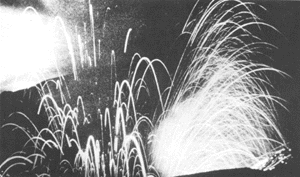 In
a Strombolian-type eruption observed during the 1965 activity of Irazú Volcano in Costa Rica, huge
clots of molten lava burst from the summit crater to form luminous arcs through
the sky. Collecting on the flanks of the cone, lava clots combined to stream
down the slopes in fiery rivulets.
In
a Strombolian-type eruption observed during the 1965 activity of Irazú Volcano in Costa Rica, huge
clots of molten lava burst from the summit crater to form luminous arcs through
the sky. Collecting on the flanks of the cone, lava clots combined to stream
down the slopes in fiery rivulets.
Irazú
Volcano, Costa Rica, 1965.
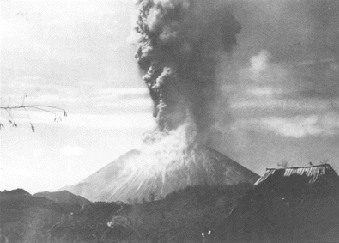 In
contrast, the eruptive activity of Parícutin
Volcano in 1947 demonstrated a "Vulcanian"-type eruption, in which a
dense cloud of ash-laden gas explodes from the crater and rises high above the
peak. Steaming ash forms a whitish cloud near the upper level of the cone.
In
contrast, the eruptive activity of Parícutin
Volcano in 1947 demonstrated a "Vulcanian"-type eruption, in which a
dense cloud of ash-laden gas explodes from the crater and rises high above the
peak. Steaming ash forms a whitish cloud near the upper level of the cone.
Parícutin
Volcano, Mexico, 1947.
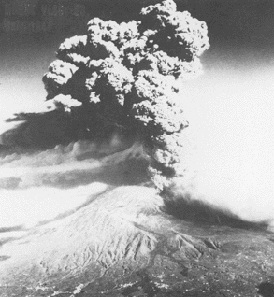 In
a "Vesuvian" eruption, as typified by the eruption of Mount Vesuvius
in Italy in A.D. 79, great quantities of ash-laden gas are violently discharged
to form cauliflower-shaped cloud high above the volcano.
In
a "Vesuvian" eruption, as typified by the eruption of Mount Vesuvius
in Italy in A.D. 79, great quantities of ash-laden gas are violently discharged
to form cauliflower-shaped cloud high above the volcano.
Mount
Vesuvius Volcano, Italy, 1944.
In
a "Peléan"
or "Nuée
Ardente" (glowing cloud) eruption, such as occurred on the Mayon Volcano in the
Philippines in 1968, a large quantity of gas, dust, ash, and incandescent lava
fragments are blown out of a central crater, fall back, and form tongue-like,
glowing avalanches that move downslope at velocities as great as 100 miles per
hour. Such eruptive activity can cause great destruction and loss of life if it
occurs in populated areas, as demonstrated by the devastation of St. Pierre
during the 1902 eruption of Mont Pelée
on Martinique, Lesser Antilles.
"Hawaiian" eruptions may occur
along fissures or fractures that serve as linear vents,
such as during
the
eruption of Mauna Loa 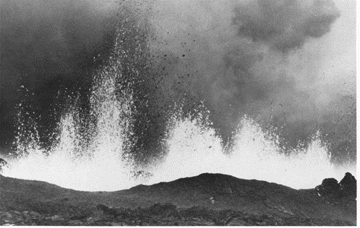 Volcano in Hawaii in 1950; or they may occur at a central
vent such as during the 1959 eruption in Kilauea Iki Crater of Kilauea Volcano,
Hawaii. In fissure-type eruptions, molten, incandescent lava spurts from a
fissure on the volcano's rift zone and feeds lava streams that flow downslope.
In central-vent eruptions, a fountain of fiery lava spurts to a height of
several hundred feet or more. Such lava may collect in old pit craters to form
lava lakes, or form cones, or feed radiating flows.
Volcano in Hawaii in 1950; or they may occur at a central
vent such as during the 1959 eruption in Kilauea Iki Crater of Kilauea Volcano,
Hawaii. In fissure-type eruptions, molten, incandescent lava spurts from a
fissure on the volcano's rift zone and feeds lava streams that flow downslope.
In central-vent eruptions, a fountain of fiery lava spurts to a height of
several hundred feet or more. Such lava may collect in old pit craters to form
lava lakes, or form cones, or feed radiating flows.
Mauna
Loa Volcano, Hawaii, 1950.
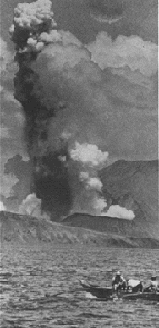 "Phreatic" (or steam-blast)
eruptions are driven by explosive expanding steam resulting from cold ground or
surface water coming into contact with hot rock or magma. The distinguishing
feature of phreatic explosions is that they only blast out fragments of
preexisting solid rock from the volcanic conduit; no new magma is erupted.
Phreatic activity is generally weak, but can be quite violent in some cases,
such as the 1965 eruption of Taal Volcano, Philippines, and the 1975-76 activity
at La Soufrière,
Guadeloupe (Lesser Antilles).
"Phreatic" (or steam-blast)
eruptions are driven by explosive expanding steam resulting from cold ground or
surface water coming into contact with hot rock or magma. The distinguishing
feature of phreatic explosions is that they only blast out fragments of
preexisting solid rock from the volcanic conduit; no new magma is erupted.
Phreatic activity is generally weak, but can be quite violent in some cases,
such as the 1965 eruption of Taal Volcano, Philippines, and the 1975-76 activity
at La Soufrière,
Guadeloupe (Lesser Antilles).
Taal
Volcano, Philippines, 1965.
The
most powerful eruptions are called
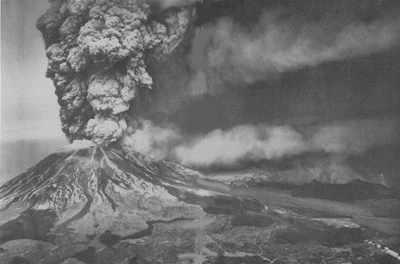 "plinian" and involve the explosive
ejection of relatively viscous lava. Large plinian eruptions--such as during 18
May 1980 at Mount St. Helens or, more recently, during 15 June 1991 at Pinatubo
in the Philippines--can send ash and volcanic gas tens of miles into the air.
The resulting ash fallout can affect large areas hundreds of miles downwind.
Fast-moving deadly pyroclastic flows ("nuées
ardentes") are also commonly associated with plinian eruptions.
"plinian" and involve the explosive
ejection of relatively viscous lava. Large plinian eruptions--such as during 18
May 1980 at Mount St. Helens or, more recently, during 15 June 1991 at Pinatubo
in the Philippines--can send ash and volcanic gas tens of miles into the air.
The resulting ash fallout can affect large areas hundreds of miles downwind.
Fast-moving deadly pyroclastic flows ("nuées
ardentes") are also commonly associated with plinian eruptions.
Mount
St. Helens about noon, May 18, 1980.
There
are many different types of volcanic eruptions. Different types of eruptions
tend to form different types of volcanoes. Most volcanic eruptions are
"builders," adding thin layers of lava or ash to the sides of a
volcano, slowly building the easily recognized cone-shaped volcanoes seen around
the world. Some eruptions, however, are "destructors" knocking off
pieces of a volcano's summit or even destroying the entire mountain. Generally,
small-to-medium eruptions build volcanoes, and large explosive eruptions tend to
destroy them. Let's look at simple animations of some of the different types of
eruptions.
The
first animation shows a "building" or constructive eruption of a
typical strato-volcano like Mount
Rainier or Fujiyama. The volcano itself consists of a pile of successive layers
of ash (light brown) and lava (dark brown) resting on a pre-existing surface.
Prior to the surface eruption, a new mass of lava has surged into the
established vent system deep under the mountain (not shown). Inflation
of the mountain is negligible because the amount of fresh lava is small. The
eruption begins with the invasion of the fresh lava along the old eruption
channel leading to the summit vent. (Successive eruptions do not always occur at
the old summit. Often, the lava works its way through weak rock or fractures
within the cone and bursts out on the side of the mountain as a "flank
eruption"). In this case, the first stage of the eruption begins with a
mildly explosive fire fountain of fragmented liquid rock. The hot particles
blast out of the vent, but since the gas content is low, the particles almost
immediately begin to fall back under the influence of gravity. The particles
coat the sides of the cone and build up a new layer of ash. In this case, the
layer is thick enough to flow slightly after landing, engulfing some of the
neighboring vegetation. Next, there is a short break in activity, during which
the ash layer cools.
The
second stage of the eruption is effusive: a large mass of gas-free lava
percolates to the summit vent, fills it, and flows down the sides of the cone.
The resulting lava flows spread out beyond the original mountain and then cool
to form a hard cap over the weaker ash layers. Summit vents are typically
irregular in shape. For instance, one side is often higher than the other, in
which case the lava flows down only one side of the volcano. Usually it takes
several effusive eruptions to build a complete new lava layer around a volcano's
cone. The illustrated eruption now ends with the cooling of the lava remaining
in the vent.
The
illustrated sequence of explosive activity followed by effusive is fairly
typical. Rising lava usually has some dissolved gas. If the fresh lava slows or
temporarily stops in the subsurface vent system, the dissolved gas tends to
migrate to the top of the mass of lava. Thus the first lava that comes out is
usually more gas-charged and explosive than the lava expelled later during the
same eruption. Of course, lava movements can be complicated, and lava
compositions and gas contents do vary, so no two eruptions are alike.
The next
animation illustrates destructive eruptions of different
types. Although the general impression is that volcanoes "blow up,"
the forces in explosive volcanic eruptions are generally too small to literally
blast large pieces of the existing volcanic cone upward. During violent
eruptions some of the material lining the erupting vent is ripped free and
carried into the explosion cloud with the new lava, but most of the material
lost from the pre-existing cone during a destructive eruption simply breaks free
and rumbles down the volcano's side as a giant rock avalanche or sinks downward
into the earth. Sometimes only small sections of the original cone are lost this
way, but sometimes--depending on the amount and location of the lava inside the
mountain before the eruption--the entire summit of the volcano can be destroyed.
The
1980 eruption of Mount St. Helens is
an excellent example of a destructive eruption. The material that was blasted upward so
spectacularly and blown across eastern Washington and Idaho (about 1/4 cubic
mile of material) was mostly made from the new gas-charged lava that had invaded
the mountain's interior during the few months preceding the eruption. Nearly all
of the rock missing from the pre-eruption cone went sideways down the hill
instead of up into the air.
As
destructive as a Mount St. Helens-type eruption is to the original volcano,
there are some eruptions in which the entire
volcano is annihilated! This happened at Krakatoa
(and several earlier eruptions like Tambora
and Santorini). Before the 1883
eruption, Krakatoa was a majestic cone at least 7000 feet high on an island 3 by
5 miles in size; after the eruption, only a shallow lagoon surrounded by a ring
of small islands remained. Where had the main island gone? Conventional wisdom
said that it had been blown up into the sky. But Krakatoa was the first of this
type of eruption to be studied in detail, and no old volcanic rocks were found
in the ash blasted all over Indonesia. The old rocks were found underneath the
new lagoon--the old volcano had not blown up, it had sunk! Geologic studies at
similar eruption sites have shown the same thing: the center of the mountain in
this type of eruption sinks straight down, leaving behind a large crater called
a "caldera."
Let's look at another
animation that illustrates how
this type of volcano forms. Initially,
we find the dormant (resting) volcano sitting on the earth's surface, but
underlain by a huge underground lake of liquid rock called a magma chamber
(magma is lava that is still underground). A "pipe" or conduit (not
shown) connects the bottom of the magma chamber to the region where the liquid
rock is formed. Occasionally, new masses of magma come up the conduit into the
chamber. The new magma has dissolved gases that migrate to the top of the
chamber. Just like putting air into a tire, adding new magma to the chamber
increases the pressure inside and causes the old volcano on the surface to bulge
upward and crack. Gas-charged magma creeps up the new cracks, causing the
volcano to bulge even more. Eventually, the new magma opens a crack all the way
to the surface, which becomes the exit vent for a new eruption. When that
happens, the pressure in the magma at the top of the vent drops rapidly, causing
the dissolved gas to form bubbles at an explosive rate. The magma in which the
bubbles are forming is fragmented to ash and blown out the top of the vent. As
that magma is blown out, the magma just below it in the vent suddenly has no
rock on top of it, so it forms explosive bubbles and rockets out the vent as
well, followed by the magma below it, and so on down the vent. The zone of
explosive bubble formation and rocketing ash moves downward into the top of the
magma chamber, allowing that magma to fragment and escape up the vent as well.
As the upper part of the magma chamber empties, the overlying rock finds itself
without visible (or any other) means of support, and does what comes
naturally--it sinks. At the end of the eruption, most of the rock of the
original cone has sunk down and left a big hole. Sometimes the hole fills with
volcanic rocks from later, smaller volcanic eruptions (see the Valles
Caldera); sometimes it fills with water forming a volcanic lake, like Crater
Lake in Oregon. If at sea, the caldera fills with sea water, becoming a
lagoon, like Krakatoa.
Magma
chambers can get very large, as much as a hundred miles across. Consequently,
caldera-type eruptions can be very large. The largest known explosive volcanic eruptions are of this kind.
Sizes of Eruptions
Volcanic
eruptions come in all sizes: small, medium, large, extra large, giant economy
size, etc. Giant eruptions can literally affect the whole world. On the other
hand, small eruptions may affect only a single hillside or valley. Let's look at
the characteristics and effects of volcanic eruptions of different sizes,
starting with small and working our way up.
A small
volcanic eruption may consist of a single small burst of steam and volcanic ash,
such as the initial eruption of Mount St. Helens, or a single lava flow like
those that make the local evening news in Hawaii. By exercising some caution,
you can view many small eruptions from a reasonable distance. What is
reasonable? It all depends on the type of eruption. Explosive eruptions
(high-water, high silica), even small ones, are best seen from a distance of
miles. On the other hand, effusive eruptions (low-water, low-silica) can be
viewed from quite close if you position yourself properly. Large flows of very
fluid lavas can attain speeds of 50 to 60 mph. However, with care and proper
clothing, these flows can be observed and even sampled from the side at a
distance of a few feet.
Some
flows are very slow, and even the fastest flows eventually cool, slow, and stop.
"Slow" here means human walking speed or less. You can observe slow
flows from any vantage point - front, side, even on top (in some cases). G. A.
McDonald tells of a volcanologist who had observed a slow-moving
"blocky" flow through a long, hot morning in Hawaii. By noon, the flow
had appeared to stop, and the volcanologist decided to have lunch on the top of
the flow. After sitting and eating for awhile, the volcanologist noticed that
the surrounding scenery was moving past! The flow he was sitting on was still
creeping along and was not "dead" after all.
 There
is no universally accepted scale, comparable to the Richter Scale for
earthquakes, for classifying the sizes of volcanic eruptions. However, one
useful comparison is the volume of new volcanic rock blasted out by an eruption.
Volumes of new volcanic rock are represented on this page in two ways: by the
figure at right, which pictorially compares ejected volumes, and by the table
below, which shows similar, numerical data. The designations of
"small," "large," "major," and "great"
eruptions are simply descriptive and are used only to draw attention to the
enormous range in the sizes of volcanic eruptions.
There
is no universally accepted scale, comparable to the Richter Scale for
earthquakes, for classifying the sizes of volcanic eruptions. However, one
useful comparison is the volume of new volcanic rock blasted out by an eruption.
Volumes of new volcanic rock are represented on this page in two ways: by the
figure at right, which pictorially compares ejected volumes, and by the table
below, which shows similar, numerical data. The designations of
"small," "large," "major," and "great"
eruptions are simply descriptive and are used only to draw attention to the
enormous range in the sizes of volcanic eruptions.
|
Volcano
|
Year
|
Cubic
Miles
|
Cubic
Kilometers
|
|
"Large" Eruptions
|
|
Kilauea,
Hawaii
|
1983
|
0.02
|
0.1
|
|
Mauna
Loa, Hawaii
|
1976
|
0.09
|
0.375
|
|
Mauna
Loa, Hawaii
|
1984
|
0.05
|
0.22
|
|
Mt.
Pelee, Martinique
|
1902
|
0.1
|
0.5
|
|
Mount
St. Helens
|
1980
|
0.2
|
0.7
|
|
Askja,
Iceland
|
1875
|
0.5
|
2
|
|
Vesuvius,
Italy
|
79
|
0.7
|
3
|
|
"Major" Eruptions
|
|
Pinatubo,
Philippines
|
1991
|
2.4
|
10
|
|
Krakatoa,
Indonesia
|
1883
|
4.3
|
18
|
|
Ilopango,
El Salvador
|
300
|
10
|
40
|
|
Santorini,
Greece
|
1450BC
|
14
|
60
|
|
Mazama,
Oregon
|
4000BC
|
18
|
75
|
|
Tambora,
Indonesia
|
1815
|
36
|
150
|
|
"Great" Eruptions
|
|
Valles,
New Mexico
|
1.4
Million BC
|
72
|
300
|
|
Long
Valley, Calif.
|
740,000BC
|
120
|
500
|
|
Yellowstone,
Wyoming:
|
|
Lava Creek Ash
|
600,000BC
|
240
|
1000
|
|
Mesa Falls
|
1.2 Million BC
|
67
|
280
|
|
Huckleberry
|
2.0 Million BC
|
600
|
2500
|
|
Columbia, Washington
|
15 Million BC
|
24,000
|
100,000
|
*
Volumes are approximate. 1 mi3 = 4.168 km3.
The
preceeding table was complied using data from the following sources: R. L. Smith
(1979) GSA Special Paper 180, pp. 5-27; R. B. Smith and L. W. Braile (1994) J.
Volc. Geotherm. Res. 61:121-187; J. J. Dvorak, C. Johnson and R. I. Tilling
(1992) Sci. Am., August, pp. 46-53; J. M. Rhodes (1988) J. Geophys. Res.
93:4453-4466; F. Press and R. Siever (1974) Earth, W. H. Freeman & Co.
Small
volcanic eruptions--
The volume of volcanic material tossed out in the bursts or flows of
small eruptions is relatively small: a few football stadiums full (equal to a
few million cubic feet or a few ten thousandths of a cubic mile). No worries,
mate! After all, the inhabitants of the island of Stromboli in Italy simply
ignore the virtually constant thumps of red-hot lava "bombs" being
tossed out of the vent of their resident volcano. Of course, just how big or
important a particular eruption appears depends largely on how close you are to
it at the time. Even a small steam explosion seems huge if you happen to be
standing right next to the vent when it "blows." And a single lava
flow seems catastrophic if it happens to go right through your bedroom!
Large volcanic
eruptions--
Large eruptions often make national and even international headlines, so you
have probably heard of some of these: El Chichon, Mount Redoubt (which nearly
nailed a passing jetliner!), and Mount St. Helens. Large eruptions affect areas as far as tens of miles away and
typically eject a few tenths of a cubic mile of volcanic rock and lava (figure).
Depending on the local population distribution, large eruptions can be very
destructive of life and property. Potential hazards in these eruptions include
huge blasts of superheated steam and pulverized rock, rock avalanches, massive
clouds of volcanic ash, asphyxiating gases, and, in the cases of volcanoes with
snow-caps or glaciers, giant mudflows. The eruption of Vesuvius
(79 AD) buried the towns of Pompeii and Herculaneum in Italy and killed
thousands of people with falling ash and poisonous gases. The main blast of
steam and rock from the 1902 eruption of Mount Pelee on the Caribbean island of
Martinique destroyed St. Pierre in less than two minutes, killing all but two of
the city's 30,000 inhabitants. Ironically, warnings about the dangers of an
imminent eruption were down-played by public officials anxious to keep the
voting populace in town for an upcoming election. Unfortunately, the volcano
exploded 3 days before the scheduled election, annihilating both electors and
potential electees. Mudflows triggered by a 1985 eruption of Nevado del Ruiz in
Columbia swept through a small town and killed 25,000 people. In contrast, only
57 people were killed in the 1980 Mount St. Helens eruption, largely because of
its remote location and the effectiveness of public warnings.
Major volcanic
eruptions--
Mount Pinatubo in the Philippines in 1991 and Krakatoa in Indonesia in 1883
(Hollywood even made a movie about that one!) were tens to hundreds of times
larger than the eruption of Mount St. Helens and are classified as major
eruptions. These eruptions are often caldera-type
eruptions. They eject many cubic miles of material and affect areas around them up to hundreds of miles away. Everything
about major eruptions must be written in superlatives. Major eruptions are
incredibly destructive. The very islands on which Krakatoa, Tambora (Indonesia,
1815), and Santorini (Greece, about 1500 BC) had stood simply disappeared into
the sea during the eruptions. Tambora spread thick layers of ash and floating
islands of pumice across 2000 miles of Indonesia. Superheated steam and ash from
Krakatoa's main blast killed and burned people 30 to 40 miles away on the
Sumatra coast. Krakatoa also spawned tidal waves over 100 feet high that swept
the coasts of Java and Sumatra, claiming most of the 37,000 lives lost in that
eruption. The destruction is so great and widespread in large and especially
major eruptions that eyewitnesses
often describe the eruptions and their aftermath as "the end of the
world."
Major
eruptions are incredibly loud. Noises from the eruption of Tambora in Indonesia
in 1815 were mistaken for nearby canon fire in European settlements 200 and 750
miles away from the volcano itself. In each community, nervous military leaders
sent out ships and soldiers to investigate what were thought to be attacks on
nearby outposts! If the main eruption of Mount St. Helens had made as much sheer
noise as Tambora, it would have been heard all over the United States.
Major
eruptions can affect weather around the world. Clouds of ash and sulfur-rich
particles thrown into the stratosphere by large volcanic blasts reflect part of
the sunlight reaching Earth, causing cooling of the atmosphere. The larger the
blast, the greater the effect. A global cooling of about 1.5 deg. F (detected by
modern sensors) continued for about two years after the Mount Pinatubo eruption.
Cooling was so severe following the Tambora eruption that 1816 was called
"the year without a summer" or "Eighteen hundred and froze to
death." Cold temperatures and killing frosts in Europe and New England in
America caused extensive crop failures and resulted in famine in post-Napoleonic
France. Many farmers in New England left for the frontier in New York in search
of better weather, swelling the American "Move West."
Major
eruptions have even been responsible at times for literally changing the course
of history. The Mataram empire in Java was apparently destroyed by a major
eruption of Merapi in 1006 AD. The course of Mayan civilization was changed when
a major eruption of Ilopango in El Salvador destroyed the highland Mayas around
300 AD. Subsequent shifts in population, trade routes, and resultant economic
power gave a great boost to the development of the "Classic Maya"
civilization. And the eruption of Santorini in the middle of Bronze-age Europe
apparently caused the destruction of the advanced Minoan civilization on Crete
and the surrounding islands and allowed the expansion of the early Greeks. Ash
clouds and tidal waves from Santorini may also have reached Egypt about the time
the Hebrews were leaving the country and given rise to the stories of the
biblical plagues in Egypt.
Lest we
become complacent thinking that major eruptions only occur in other parts of the
world, just remember that the blast that destroyed Mount Mazama to form the
placid-appearing Crater Lake in Oregon occurred only about 7000 years ago.
Almost any of the Cascade volcanoes could do a repeat performance at any time.
"Great"
Eruptions-- As large and devastating as major eruptions are, they are not the
largest volcanic eruptions known. None of these largest or "great"
eruptions have occurred in historic times (thank goodness!). We have only
gigantic deposits of volcanic rock as eloquent evidence of their reality.
Great
eruptions emerge from two types of volcanoes: fissure eruption and giant
caldera. In both types, the volume of volcanic rock deposited on the surface
of the earth during a single great eruption can be many hundreds of cubic
miles--hundreds of times larger than the major eruptions mankind has known.
Giant
caldera eruptions explode with violence, noise, and destruction that defies
description - try to imagine an eruption ten thousand times larger than Mount
St. Helens! Several giant caldera eruptions are known to have occurred in the
United States. The Valles caldera in New Mexico expelled about 100 cubic miles
of ash that still covers much of the middle of the state. The Long Valley
caldera in southwestern Nevada ejected over 150 cubic miles of ash that now
makes up thick layers of rock in mountains all over the West. But the largest of
these eruptions in the United States came from a fairly recently recognized
giant caldera right in the middle of Yellowstone National Park. This caldera,
some 30 by 50 miles in size, covers about half of the park.
Common
questions about volcanic eruption
Why are some
eruptions gentle and others violent?
Volcanic eruptions could be thought as a continuum between
two end members. At one extreme is the gentle effusion of lava. Most Hawaiian
eruptions would be a examples of this type of eruption. At the other extreme is
the explosive ejection of ash from a vent. The May 18, 1980 Mount St. Helens
eruption would be an example of this type of eruption.
The two main factors that influence how a volcano will
erupt are viscosity and gas content. Both are related to the composition of the
magma. Hawaiian volcanoes tend to erupt basalt, which is low in viscosity and
low in gas content (about 0.5 weight percent). The gas that is present can
readily escape and little pressure builds up in the magma. At the other extreme,
rhyolite magmas are very viscous and can contain a lot of gas (up to 7-8 weight
present). As the magma moves into the vent and the pressure drops, the gas wants
to escape. The magma is very sticky and resists the expansion of the gas
bubbles. Ultimately, enough bubbles grow and expand to blow the magma into ash
size fragments and eject them violently into the atmosphere.
What is the
approxiamate temperature of an eruption cloud?
The cloud that rises above a volcano is surprisingly cold,
probably close to freezing! This is because the gasses are expanding so rapidly.
The temperature of the ash flows that can be erupted, on the other hand, are on
the order of hundreds of degrees Celsius.
What are some
of the more famous volcanic eruptions?
about 1500 B.C. - the destgruction of
Thera in the eastern Mediterranean and the end of the Minoan civilization (which is
the basis for the legend of Atlantics)
A.D. 79 - eruption of Vesuvius buried the Roman cities of Pompeii and Herculeneum
1783 - eruption of Laki,
Iceland, caused a severe faminine, which resulted in the deaths of 20 percent
of the population of Iceland
1815 - Tambora,
Indonesia, the largest historical eruption
1883 - Krakatau,
Indonesia, resulted in a huge tsunmai, which drowned 36,000 people
1912 - Katmai, Alaska, largest eruption of the 20th century
