|
Welcome to Index 9 Laboratories.
| RF and MICROWAVE MEASUREMENTS |
METRICS
 |
POWER -- Measured in watts…………………………………………………………….............................................(W) or (dBm). |
|
GAIN -- Measures the amplification of a signal………………………………………………………...........................…….....(dB). |
|
FREQUENCY -- Measured in Hertz……………………………………………………………………...........................…...…(Hz). |
|
WAVELENGTH -- Measured in meters……………………………………………………………………...........................……(m). |
|
IMPEDANCE -- Measured in Ohms…………………………………………………………………………...........................….(Ω). |
|
PHASE -- The position of a point on a waveform within its period. Measured in degrees……………..............................……...(°). |
|
NOISE FIGURE (NF) -- Quantifies the degradation of the signal-to-noise ratio (SNR) caused by a system. |
|
SIGNAL TO NOISE (SNR) -- A measure that compares the strength of a desired signal to the level of background noise. |
|
3 dB BANDWIDTH (BW) -- The span of frequencies at which the signal power level is above half its maximum value. |
|
OUTPUT 1dB COMPRESSION POINT (OP1dB) -- The input power level at which the output power compression is 1 dB relative to the linear output power. |
|
S-PARAMETERS -- A set of complex numbers that describe the relationship between the input and output signals of a network, characterizing the behavior of RF and microwave systems and devices. IE, Interferometry. |
RADIO WAVES and MICROWAVES
Radio waves span a length of 1 millimeter to 100 kilometers which corresponds to and spans a frequency range from 3 kHz to 300 GHz. Microwaves are a type of radio wave with shorter wavelengths ranging from about 1 mm to 1 m. Corresponding to and spanning a frequency range from 300 MHz to 300 GHz.
Introduction
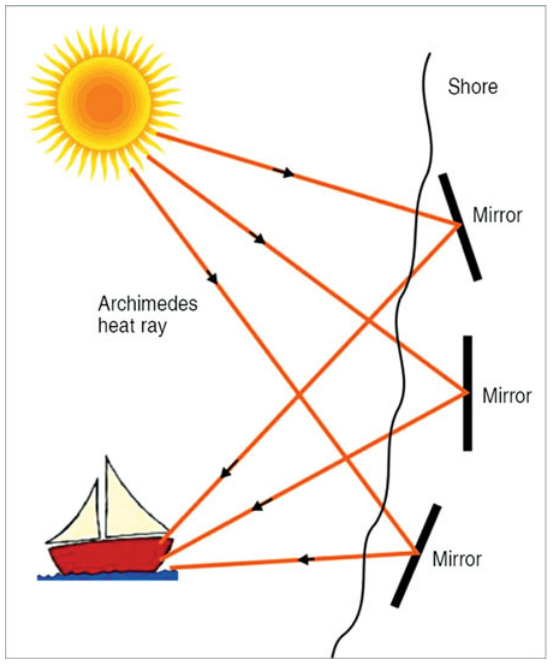
It has been known since prehistory that sunlight can make absorbing surface hot, andin Greek antiquity it was known that concentrated sunlight, having traversed spher-ical water-filled flasks or convex pieces of glass, could kindle fires. Archimedesproposed to concentrate the sun’s rays by means of reflecting the harbor of Syracuse.He hoped to ignite the ropes, sails, and spars of the vessels of enemy’s fleet. SeeFig. 1.1.
Fig. 1.1 Archimedes deathray concept
 |
The power flux density of the sun in zenith on the earth’s surface is about0.13 W/cm2 that leads to the solar furnaces with temperatures near 3000 C. If theirradiated area is large enough, lateral heat conduction may be ignored. The radiativeloss of a black-body surface is given by Stefan–Boltzmann’s law. If the irradiatedarea is large enough, lateral heat conduction may be ignored. The power flux density,σT4, corresponds to 1 kW/cm2 at T 1⁄4 3644 K. Convective cooling by airflow over a3000 K surface at Mach number unity is only a few hundred W/cm2. At pressuresprevailing at booster burnout altitudes, 80–160 km, convective cooling is completelynegligible. From the foregoing, it is clear that the temperature of most materials maybe raised above the melting temperature Tm and the vaporization temperature Tv forCW laser flux densities in the range of 1–100 kW/cm2. In the early days of laserhistory, in 1961, when the pulsed ruby laser was the most powerful available, it wasestablished that a focused ruby laser pulse of about 1 J energy could punch a hole in arazor blade. Two very simple cases serve to establish the order of magnitude of fluxes and fluencies on target required for lethality. Most analyses that we haveshowed so far are applicable for the CW laser type as well. |
Laser is no longer confined to premises of prominent research centers like BellLaboratories, Hughes Research Laboratories, and major academic institutes likeColumbia University, USA, as it was in its early stages of development andevolution. In the last five decades, after Theodore Maiman demonstrated the firstlaser in May 1960 at Hughes Research Laboratories, there has been explosivegrowth in industrial, medical, scientific, and military applications of lasers. Appli-cation areas are continuing to grow with every passing day. Lasers have been used in various military applications since the early days ofdevelopment that followed their invention. There has been large-scale proliferationof lasers and optronic devices and systems for applications like range finding, targetdesignation, target acquisition and tracking, and precision-guided munitions during1970s and 1980s. These devices continue to improve in performance and find increased acceptanceand usage in contemporary battlefield weaponry. Technological advances in optics,optoelectronics, and electronics leading to more rugged, reliable, compact, andefficient laser devices are largely responsible for making these indispensables inmodern warfare.
Last one decade or so has also seen emergence of a new class of weapons knownas directed energy weapons (DEWs) leading to enhanced global interest from scientists and engineers in DEW development. Lasers, high-power microwaves, andhigh-energy particle beams have been exploited for DEW development. Theseweapons, with the exception of particle beam weapons (PBWs) and laser-inducedplasma channel (LIPC) weapons, generate streams of electromagnetic energy thatcan be precisely directed over long distances to disable or destroy intended targets.After decades of research and development, directed energy weapons (DEWs) arenow becoming an operational reality. This has been possible due to their uniquecharacteristics that potentially enable new concepts of military operation and alsobecause there has been considerable progress over the past two decades in develop-ing relevant technologies such as power sources, beam-control concepts, andpointing and tracking techniques. For these applications, lethal energy from ahigh-power laser or a source of high-power microwaves or high-energy particlebeam is delivered to the targets for causing either neutralization of electro-opticsensors onboard the target platform or structural damage to the target itself.
|