| |
:: S.N. Labs Underground -- Index 1 ::
= = =.

|
...::: Dreamscapes :::... |
...:::INFOGRAPHICS :::... |
...::: Figure 1.2 :::... |
|

|
|
|

|
...::: SP3CTRAL N30N LABORATORIEZ :::... |
...::: Figure 2.3 :::... |
...::: Figure 1.4 :::... |

|
Visit the Terminal.
<<-------
|

|
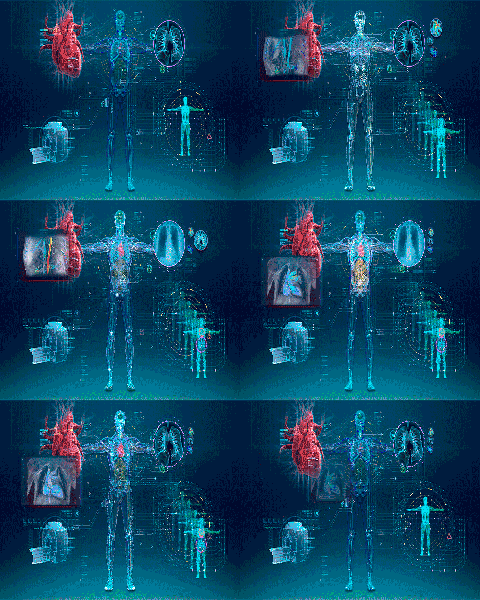
- What are Bionanosensor Nodes? - What is a WBAN system?- What is Energy Harvesting?- What is Optogenetics?- What is WNSN and WiOptND?- What are Nanoparticles?
The answers to these questions can be found in the INFOGRAPHICS section of this website.  |

|
............................................... ............................................... ............................................... |
-- -- BIO-NANO THINGZ -- -- |
 -- -- -- -- -- -- OVERVIEW -- -- -- -- -- -- -- -- -- -- -- -- OVERVIEW -- -- -- -- -- -- |

|
--LINKS--
 |
Molecular Communication ProjectsFuture Molecular Communication NetworksInternet of Nano Things, Intra body communication in WBAN,Mobile Bio Nano Machine, Body area Nano networks,Internet of Bio Nano Things |
 |
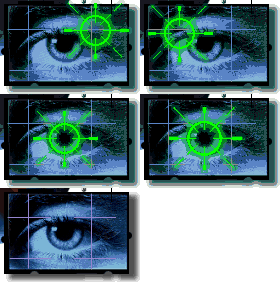
Wireless on-demand Drug Delivery"Wireless on-demand drug delivery systems exploit exogenous stimuli—acoustic waves, electric fields, magnetic fields and electromagnetic radiation—to trigger drug carriers." |
|
 |
Recently, the Internet of Things (IoTs) and biological nano scale technologies have merged to form a promising paradigm, known as the Internet of Bio Nano Things (IoBNT). The IoBNT paradigm, which is based on synthetic biology and nanotechnology, enables the development of a biological embedded computing device, known as bio nano thing (BNT) Furthermore, these BNTs are intelligent machines that are capable of actuation, sensing, processing, and communication. Therefore, the IoBNT is intended to be a paradigm shift for many related disciplines, such as bio nanosensors-based fluorescence inside intra-body area network (IBAN), and control/manage the interconnection among |

|
 |
‘Radiogenetics’ seeks to remotely control cells and genes"The method allows one to wirelessly control the expression of genes in a living animal..." |
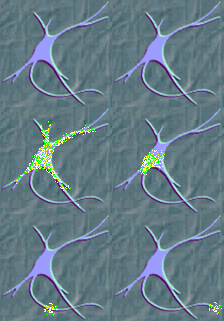 |
Interfacing Graphene-Based Materials With Neural Cells"The key goal of any drug delivery system is to create a smart tool that recognizes specific targets and releases the drug in a controlled way." |
 |
Human body can help power 6G devices as antennas in future, boost signal, shows study"...the human body can safely collect enough electromagnetic energy or RF energy that it can power minor IoT devices" |
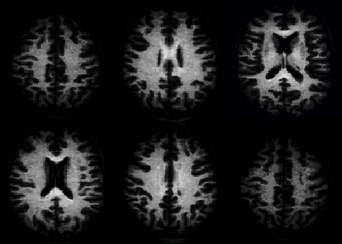 |
The Internet of Bodies: The Human Body as an Efficient and Secure Wireless ChannelThe Internet of Bodies (IoB) is a network of smart objects placed in, on, and around the human body, allowing for intra-and inter-body communications.
|
 |
PANACEA: An Internet of Bio-NanoThings Application for Early Detection and Mitigation of Infectious Diseases"The Internet of Bio-NanoThings (IoBNT) concept envisions the connection between biological cells and the Internet." |
|

|
embedded BNTs via biocyber interface with an external macro network, such as the Internet. In a consequence, various artificial intelligence (AI) algorithms can be used in conjunction with the IoBNT for processing and decision making. As a result, the IoBNT and AI have emerged as promising tools in the field of advanced targeted nanomedicine (ATN), wherein the human body is considered an infrastructure [2]. As a result, IoBNT and AI aid in the design of treatment plans by assisting with drug management or drug discovery. Additionally, the promising IoBNT paradigm, in conjunction with AI, can be used in ehealth monitoring, detection and diagnostics/treatment of diseases. The term "molecular communications" describes the procedure of encoding/decoding and exchanging data in the form of molecules over short distances [3,4]. The information can be encoded on the concentration, on the frequency and/or on the type of released molecules. Forster Resonance Energy Transfer (FRET) is a well-known type of molecular communication. FRET is a non-radiative energy transfer observed between fluorophore molecules in the 10nm communication range. It should be highlighted that, when compared with other molecular communication systems, FRET is clearly a reliable short-range communication system. The information is encoded in the energy (exciton) transferred between molecules, with no photons or chemical signals emitted. As a result, FRET provides highly reliable communication with fascinating metrics, such as high transmission rates "around 1 Gbit/s, " short transmission delays "around 20 ps, " and low bit error rate "around 10-3" at the molecular level [3,4]. |
  |
   |
 
|
  PDF -----> PDF ----->  |
 |
--------------- NEWZ HEADLINEZ ---------
---- THE COMING UNREST:  
 - Xenobots: The Self-Replicating Living Robots - Xenobots: The Self-Replicating Living Robots  - CoVid vaccines basedon graphene, nanonetworkand Internet of Nanothings (IoNT) - CoVid vaccines basedon graphene, nanonetworkand Internet of Nanothings (IoNT) |
|
INTERNET OF NANOTHINGS & BIO-NANOTHINGS:::...
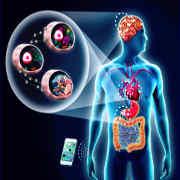
BIO-CYBER INTERFACE: EM NANOMACHINE GATEWAYS- Translates information from biochemical domain to electrical domain. - EM waves emit information to outside the body
A MUST HAVE! --->
|
 |
.:: BRAIN TRANSPARENCY ::. |
--...:..:..:..:..:..:..:..:..:..:..:..:...--
|

|
 |
'What you think, what you feel: It's all just data': WEF event hypes era of 'brain transparency' in which companies will monitor employees' thoughts and emotions
Politicians and technocrats from around the world convened earlier this month at the World Economic Forum in Davos, Switzerland, to discuss how best to orient humanity's future on its behalf. Among the speakers who had their ear was a so-called futurist and ethicist who hyped the adoption of neurotechnology that would afford employers, governments, and others to decode "brain activity in ways we never before thought possible."
|
"What you think, what you feel: It's all just data," said Nita Farahany, professor of law and philosophy at Duke Law School and faculty chair of the Duke MA in bioethics and science policy. "And large patterns can be decoded using artificial intelligence."
Farahany explained in her Jan. 19 presentation, entitled "Ready for Brain Transparency?" that when people think or emote, "neurons are firing in your brain, emitting tiny little electrical discharges.
|
As a particular thought takes form, hundreds of thousands of neurons fire in characteristic patterns that can be decoded with EEG- or electroencephalography- and AI-powered devices."
Once decoded, the resultant data can be used for a multitude of purposes, good and bad.
The ethicist did not dwell long on the resemblances between the possibilities at hand and the dystopian nightmares previously imagined by science fiction writers such as Philip K. Dick and William Gibson.
|
 |
Instead, Farahany focused on what she perceived to be the positive outcomes of monitoring and socially engineering the species, emphasizing that the adoption of these technologies could help address "some of the root causes of human suffering, from neurological disease and degeneration to mental illness, but of also unlocking a lot of the secrets of the human brain."
What would it look like in the field?
The WEF speaker indicated that wearable neurotechnology — contra implanted neurotechnology of the kind Elon Musk's Neuralink deals in — will herald an era wherein "you can have an EEG sensor in each ear as part of your ear pods, where you also take conference calls and you listen to music but you have brainwave activity that is being monitored all day every day." |
Farahany began her talk with a series of hypothetical uses of such wearable neurotechnology, which she likened to "Fitbits for the brain":
- An office employee monitors her stress levels as a deadline approaches and, noticing an unusual trend, sends her readings to her doctor for an update.
- Her technology-inflamed neuroses momentarily dissipate and she begins entertaining romantic thoughts about a male coworker. However, an alert appears on her desktop reminding her to refrain from intra-office romance. The employee focuses back on her work. Her prompt obedience is recognized by her boss — also monitoring the worker's brain waves — who then rewards her with a bonus.
|
- The next day, in an unrelated incident, her coworker is carted off by police, having been deemed guilty of wire fraud on the basis of his mental activity. Police will eventually scrutinize mental wavelengths in the office for possible co-conspirators.
According to Farahany, it won't just be white-collar environments where workers' minds will be policed and tracked in this fashion. With the purported aim of preventing distracted-driving accidents on the road, Farahany suggested that truck drivers could be equipped with hats containing embedded electrode censors that would score what stage of alertness they are at in any given moment. Concerning the prospect of using brain surveillance to know when to preemptively intervene, Farahany underscored, "We as a society should want that." Farahany also championed the use of attention-tracking ear pods, noting that employers are now able to determine whether an employee's distractions are central, peripheral, or unrelated to their assigned task. She did, however, couch her support with the caveat that it should be optional on the part of employees, used to determine benefits as opposed to penalties. Although erring on the side of positivity, Farahany noted that the widespread adoption of these technologies will "change the way that we interact with other people and even how we understand ourselves." |
 |
Furthermore, as technologies improve, she said, "more and more of what's in the brain will become transparent."
The WEF speaker suggested that there will be legal, privacy, and human rights implications, and societies will have to contemplate how they will safeguard or litigate around cognitive liberty protections, and big business will have to adopt best practices concerning how to adopt this technology.
Technologies here, adoption coming
Farahany's sense that this technology will inevitably and widely be adopted is grounded in part in her observation of the meteoric rise in businesses' adoption of employee surveillance tools during the pandemic. It is also grounded in the understanding that the technology involved in the above hypotheticals is already available today.
Presently, there are earbuds, headphones, and tattoos behind the ear that can be used to pick up or decode emotional states as well as a means to yank out mentally pictured faces, shapes, and numbers. |
Neurotechnology company Brain Scientific has produced an ink composed of graphene that, when tattooed upon human flesh, can monitor brain activity.Fast Company noted that Boston-based Neurable developed headphones that read the wearer's brainwaves and adjust noise cancellation levels in response.
Neuroscientists at the University of Toronto Scarborough developed a technique in 2018 by which they could reconstruct images of what people perceive based on their brain activity.
U of T News reported that Dan Nemrodov hooked up human test subjects to EEG equipment and then showed them images of faces. That brain activity was recorded and then used as the basis of a digital recreation of the image with the assistance of machine learning algorithms.
|
Extra to past interest in employee surveillance tools and the present availability of brain-monitoring tools, Farahany noted that 5,000 companies area already tracking their employees' "fatigue levels."
The South China Morning Post reported in 2018 that Hangzhou Zhongheng Electric, like many Chinese companies, had been mining data from workers' brains on an industrial scale to redesign workflows and adjust production speeds.
Sensors were hidden in safety helmets and hats that monitored wearers' brainwaves and streamed the data to computers where AI algorithms would note emotional states. In the Q&A following the presentation, moderator and Atlantic CEO Nicholas Thompson said, "Speaking as a CEO, I'm sure all CEOs will use [this technology] completely responsibly," eliciting laughter from Farahany and the audience. Didi Rankovic, writing for Reclaim the Net, said that with this new technology, for employers, it'll be "just like prodding cattle." (source) |

|
 . .
|

|
 |
  |
   |
  |
   |

|
.................
|

|
DEAGEL REPORT -- SHOCKING 2025 FORECAST Deagel predicted in 2020 that the United States would see its population decline by 68.5 % by the year 2025. In April 2021, the enigmatic intelligence firm Deagel.com quietly erased its staggering 2025 global depopulation forecast, a document forecasting a dramatic decline in populations of key countries like the United Kingdom, United States, Germany etc. This drastic prediction, which vanished from the public eye after garnering huge attention during the alleged COVID-19 pandemic, has since been shrouded in whispers and theories, only to resurface amidst startling new health data. |

|
One could imagine a global computer system where everybody has devices on them all the time and the device was giving them feedback based on what they did and the whole population is subject to a degree of behavior modification.. Such a society would be insane. Could not survive. Could not face its’ problems. But this is only a thought experiment and such a future is technologically infeasible.
– The Human Use of Human Beings by Norbert Wiener
|
 |
 
|
  |
   |
  |
   |


|
|




