Desert Fathers and Mothers: -- main page --
St. Moses the Black (A. D. 405)
Moses was an Ethiopian and the most picturesque figure among those remarkable men who are known as the Fathers of the Desert. At first he was a servant, or slave, in the house of an Egyptian official. The general immorality of his life, but particularly his continual thefts, caused his dismissal--in those days he was lucky to have got off with his life--and he took to brigandage. He was a man of huge stature, with corresponding strength and ferocity, and he soon gathered a gang about him that was a terror to the district. Once some contemplated villainy was spoiled by the barking of a sheep-dog giving the alarm, and Moses swore to kill the shepherd. To get at him he had to swim across the Nile with his sword in his teeth, but the shepherd had hidden himself by furrowing into the sand; Moses could not find him, so he made up for it by killing four rams, tying them together and towing them back across the river. Then he flayed the rams, cooked and ate the best parts, sold the skins for wine, and walked fifty miles to join his fellows. That was the sort of man Moses was.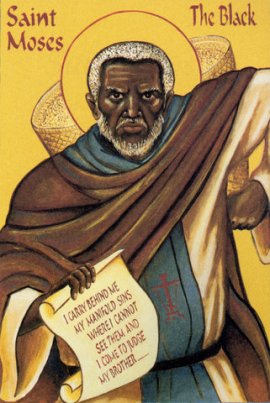 Unfortunately the circumstances of his conversion are not known; it is possible that he hid himself among the solitaries to avoid the law and was touched and conquered by their example, for when next heard of he was at the monastery of Petra in the desert of Skete. Here he was attacked in his cell by four robbers. Moses fought and overpowered them, then tied them together, slung them across his back, and went to the church, where he dumped them on the floor, saying to the astonished monks, "I am not allowed to hurt anybody, so what do you want me to do with these?" They are said to have reformed their ways and become monks themselves. But Moses did not become well-behaved in a day and, despairing of overcoming his violent passions, he consulted St. Isidore. The abbot took him up to the roof of the house at dawn: "See!" he said, "the light only gradually drives away the darkness. So it is with the soul." Eventually by hard physical labor, especially in waiting on his brethren, hard physical mortification, and persevering prayer, he so conquered himself that Theophilus, Archbishop of Alexandria, heard of his virtues and ordained him priest. Afterwards as he stood in the basilica, anointed and vested in white, the archbishop said, "Now, Father Moses, the black man is made white." St. Moses smiled ruefully. "Only outside! God knows that inwardly I am yet dark," he replied.
When a raid on the monastery by Berbers was threatened, Moses refused to allow his monks to defend themselves, but made them run away before it was too late: "All that take the sword shall perish with the sword." He remained, and seven with him, and all save one were murdered by the infidels. St. Moses was then 75 years old, and he was buried at the monastery called Dair al-Baramus, which still exists.
Biography of Moses the Black --
Moses the Black: article in Wikipedia
Online Version of Lives of Desert Fathers
Life of Anthony, first desert father.
Notes about your extended family in heaven
Book of Saints -- Antony -- January 17. The cloud of witnesses, Heb. 12:1.
Meeting of Anthony [first desert father] with Paul [first hermit], with centaur in background.
The Temptation of St. Anthony
More facts about Anthony the Great
Velazquez: Painting of Antony and Paul, with raven and two lions. --Velasquez
Saint Anthony Abbot and St. Paul the Hermit
c. 1642
Oil on canvas, 257 x 188 cm
Museo del Prado, Madrid
Anthony is on the left in the black habit of the Hospitallers of St. Anthony. The raven above him is carrying a double loaf of bread to feed the two saints. In the lower left corner is the next episode in the story: Anthony returns and finds Paul dead; then two lions (here we see only part of the head of the second one) dig a grave for the saint. Behind Paul is the cave that is his shelter.
Gallery of Antony
Marriage and Celibacy
Therefore marriage and fornication are not two evils, whereof the second is worse: but marriage and continence are two goods, whereof the second is better, even as this temporal health and sickness are not two evils, whereof the second is worse; but that health and immortality are two goods, whereof the second is better. Also knowledge and vanity are not two evils, whereof vanity is the worse: but knowledge and charity are two goods, whereof charity is the better. For "knowledge shall be destroyed," says the Apostle: and yet it is necessary for this time: but "charity shall never fail." Thus also this mortal begetting, on account of which marriage takes place, shall be destroyed: but freedom from all sexual intercourse is both angelic exercise here, and continues for ever. But as the repasts of the Just are better than the fasts of the sacrilegious, so the marriage of the faithful is to be set before the virginity of the impious. However neither in that case is repast preferred to fasting, but righteousness to sacrilege; nor in this, marriage to virginity, but faith to impiety. For for this end the righteous, when need is, take their repast, that, as good masters,
Read More Here
Jonah Augustin's Homepage -- Ethiopian Christianity * * * * Christianity in Ethiopia (7 min. video)
Desert Fathers in Egypt. 2 minute video
2,000 years in African Christian history. -- 38 min. talk by university professor in Edinburgh, Scotland, Dr. Andrew Walls.
The first Christian revival movement. Radical discipleship. Mobilizing Christian energy. African Christianity today; rural, vernacular, lived in community.
The Life-Changing "Life of Antony" -- Athanasius' biography was not only a bestseller in its day, but a book that made people stop and think--and act. --article by David Wright. 1999.
News of Antony of Egypt, especially his sacrificial solitude, spread widely long before he died. At Rome, Marcella, a wealthy noblewoman already widowed at age 17, heard about him around 340, and in response, turned her mansion into an ascetic community devoted to prayer and Bible study. Other Roman matrons followed her pioneering example.
But when Athanasius, who had been one of those who told Marcella about Antony, put Antony's story down in writing, Antony's influence became greater still. As Athanasius told his readers at the beginning of his Life of Antony, "I feel that, once you have heard the story, you will not merely admire the man but will wish to emulate his commitment as well." ---- Read More Here.
15 articles from Christian History.net about Desert Fathers
The Sayings of the Desert Fathers (book in PDF format) * * * * * * * * * * * * * Videos about Desert Fathers
Learn about the Catholic Faith
Read the Catechism of the Catholic Church
Gregorian Chant: Music to find inner peace. 72 min. (Gloria.tv) . . • Imitation of Christ, by Kempis
Athanasius: Canon of 27 Books of New Testament
Athanasius is the first person to identify the same 27 books of the New Testament that are in use today. Up until then, various similar lists of works to be read in churches were in use. A milestone in the evolution of the canon of New Testament books is his Easter letter from Alexandria, written in 367, usually referred to as his 39th Festal Letter. Pope Damasus I, the Bishop of Rome in 382, promulgated a list of books which contained a New Testament canon identical to that of Athanasius. A synod in Hippo [North Africa] in 393 repeated Athanasius' and Damasus' New Testament list (without the Epistle to the Hebrews), and a synod in Carthage in 397 repeated Athanasius' and Damasus' complete New Testament list.
Scholars debate whether Athanasius' list in 367 was the basis for the later lists. Because Athanasius' canon is the closest canon of any of the Church Fathers to the canon used by Protestant churches today, many Protestants point to Athanasius as the father of the canon. They are identical except that Athanasius includes the Book of Baruch and the Letter of Jeremiah and places the Book of Esther among the "7 books not in the canon but to be read" along with the Wisdom of Solomon, Sirach (Ecclesiasticus), Judith, Tobit, the Didache, and the Shepherd of Hermas. See the article, Biblical canon, for more details.
How Old Is Your Church?
How Dark Were the Dark Ages?
![Meeting of Anthony [first desert father] with Paul [first hermit]](https://geocities.ws/desertfathers/a/anthonypaul.jpg)