Kr
Krypton83.798 (2)
AKrypton was discovered in 1898 by Sir William Ramsay and his student Morris Travers in the residue left after liquid air had nearly boiled away. Krypton was left in the residue after boiling away water, oxygen, nitrogen, helium, and argon from the sample of air. Krypton is present in the air at about 1 ppm. Neon was discovered by a similar procedure by the same workers just a few weeks later.
- Name:Krypton
- Symbol: Kr
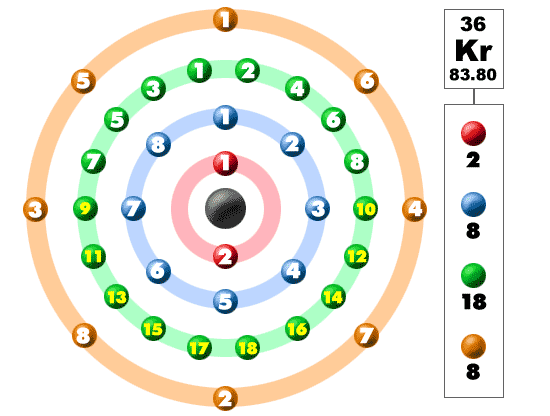
- Atomic number: 36
- Atomic weight:83.798 (2)
- Standard state: gas at 298 K
- Group in periodic table: 18
- Group name:Noble gas
- Period in periodic table: 4
- Block in periodic table: p-block
- Classification: Non-metallic
- used in some photographic flash lamps for high-speed photography, lamps, UV-laser spectral line used for international measurement of a metre
Under normal conditions krypton is colourless, odourless, fairly expensive gas. Solid krypton is a white crystalline substance with a face-centered cubic structure which is common to all the "rare gases".