|
Last update Dec. 29th. 2014 |
Gauges and
Measuring
Tools
Used in Horology |
|
The FKS Feintaster, or just Bench Dial Micrometer made before the WWII by Friedrich R. Keilpart of Suhl, Germany.
Device uses mechanical comparator with a dial indicator, permanently mounted on small stand with specially formed jaws for use by watchmakers for taking measurements of very small components. Resolution of measurement 0.01 mm (0.000394"), range of measurement 0 - 15 mm (0 to 0.6") . |

|
| Yet
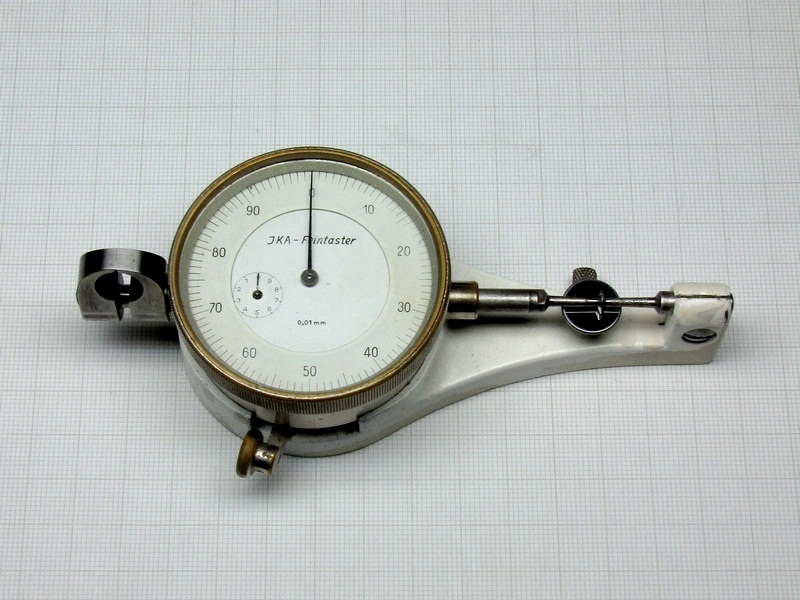
another measuring tool, JKA Feintaster, Bench Dial Micrometer, just as precise and just as accurate.
This one, newer and with an extra pair of jaws which allow easy measurements of the recessed diameter like found in winding stems. Resolution of measurement 0.01 mm (0.000394"), range of measurement 0 - 15 mm (0 to 0.6") .
|
 |
| Here we can see all the measurements that are possible with the bench dial gauges, including winding stem measurements. | 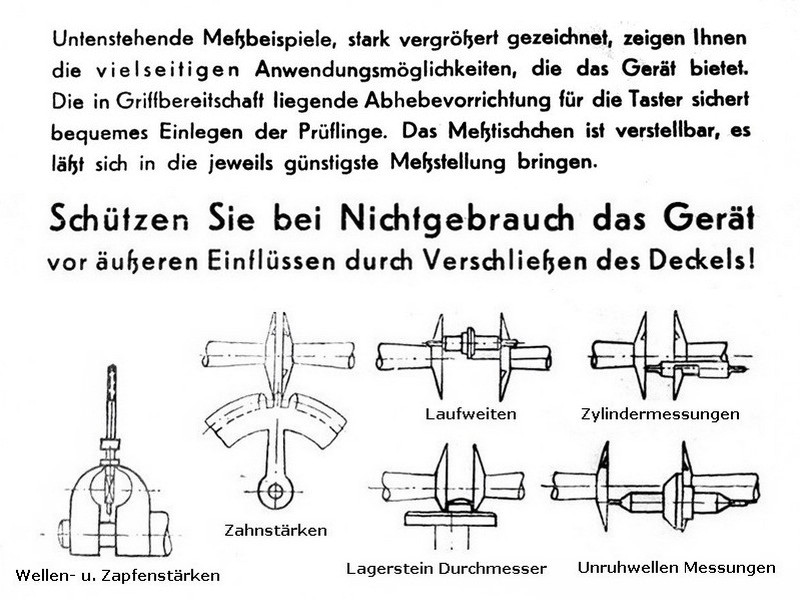 |
|
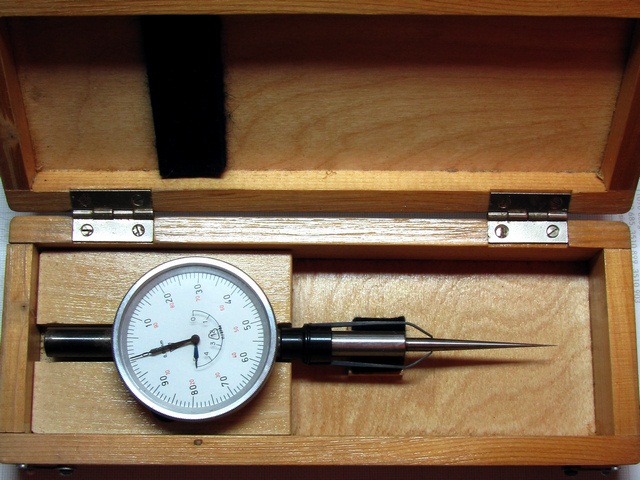
FKS Hole Dial Gauges are high precision tools, used to measure hole diameter from 0.20 - 5.00 mm and from 3.00 - 8.00 mm, with resolution of 0.01 mm.
Use is very simple, the tapered plunger is placed into the hole, dial gauge is pushed in until the two prongs firmly touch the reference surface, the hole diameter is read off dial to the nearest 1/100 mm.
Before taking measurement, hole edge and reference surface must be de-burred and cleaned, if countersunk the measurement will not be accurate |
 |
| There
is need to check the calibration of hole gauges before use.
Such a task requires use of a precision ring gauge, these come in sets. Unfortunately I was not able to procure such a set, so I decided to make my own. |
 |
| I
examined the sizes and tolerances of some SKF ball bearings that I had
in stock.
The bore deviation of a 4 mm bearing proved to be precise enough for making calibration ring gauge. As shown in the chart the bore diameter deviation in a single plane is less than 4µm, more than enough for the hole gauge that has 10 µm resolution. |
 |
| SKF Ball bearing used as a donor of a ring used to manufacture the Calibration 4 mm Gauge Ring. | 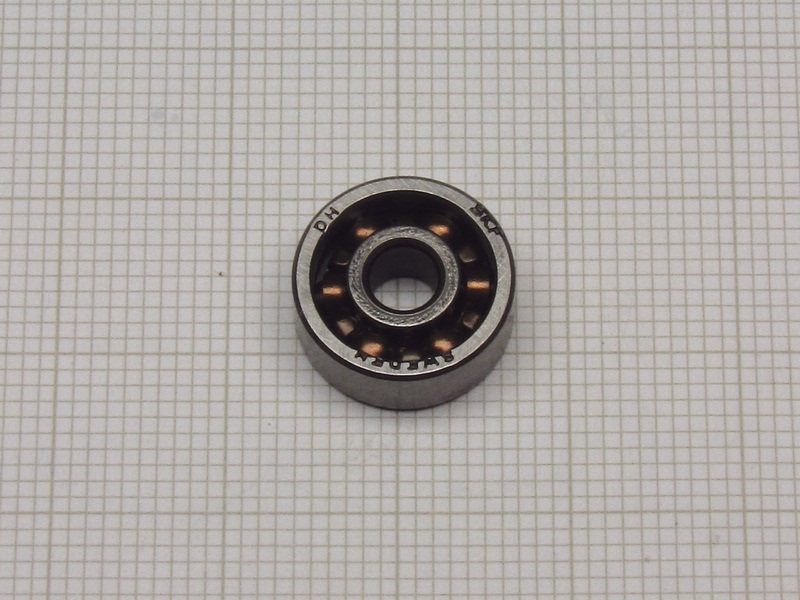 |
| Thus
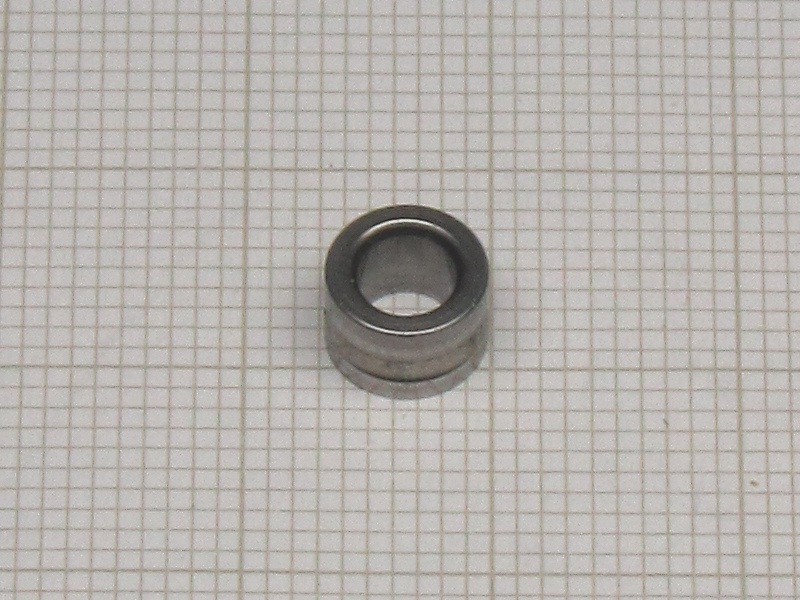
I dismantled one of the bearings removing the inner ring.
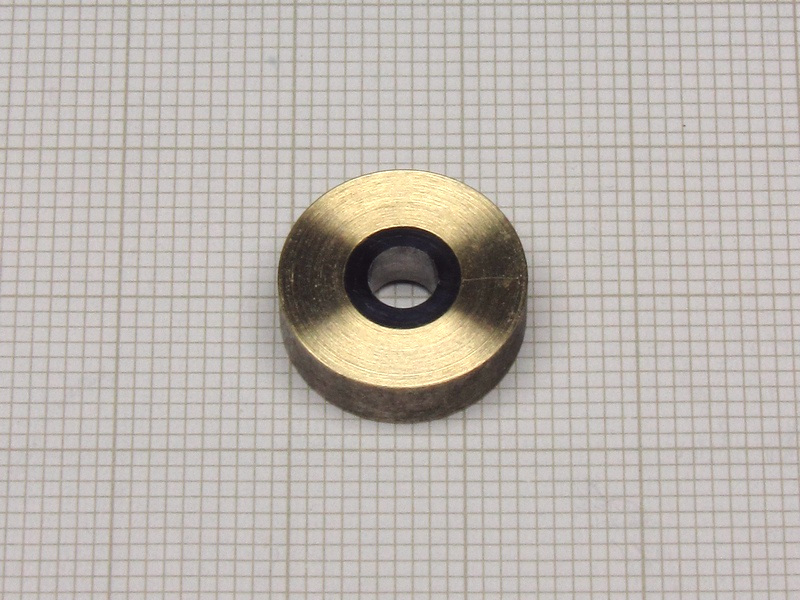
It was necessary to grind one side in order to remove the chamfer to enable accurate calibration. The rest was easy, to make handling of a newly made gauge I embedded it in a brass disk 14.0 mm in diameter.
|
 |
|
Hole Gauge Tool, shown with its protective sleeve cover and box. The tool is used to measure diameter of the through holes in the range of 0.3 mm to 5.0 mm. (0.012" - 0.200") Measurement resolution of 0.01 mm (0.0004") is achieved using precision ground tapered steel plunger. The tool is rested against the flat of the hole to be measured and the tapered plunger is pushed in to close the hole, thus enabling the reading to be taken off a vernier scale. |
 |
|
Vernier scale, allowing one to read measurements to the nearest 1/100 mm. Of course, before taking the measurement, all the burrs must be removed carefully and the edges of the opening must not be chamfered. For improved accuracy and for the repeatability of the measurements some makers are producing gauges with narrower range of gauge measurement, thus having four or five gauges within the same range as this one. |

|
| Standard
mechanical comparator mounted in holder for measuring thickness of
sheet metal or small parts in watch or clock making.
Resolution of 0.01 mm (0.0004") and with a direct range of measurement from 0 to 10 mm (0 to 0.4") |
 |
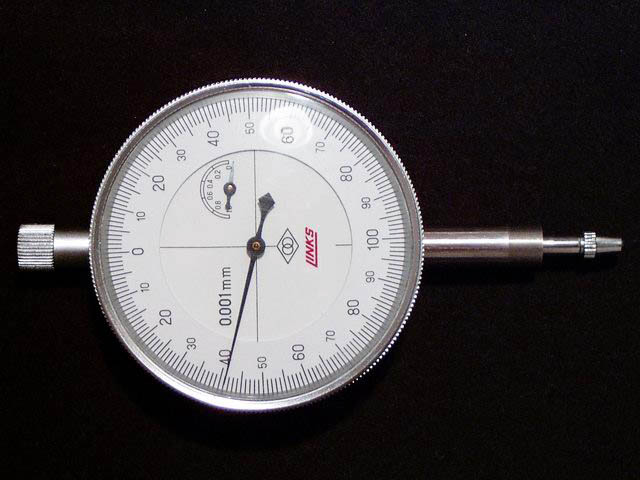
| High
precision Mechanical comparator for use in stand with gauge blocks
stack as the reference to the actual measurement.
Resolution of 0.001 mm (0.00004") and with a direct range of measurement from 0 to 1.000 mm (0 to 0.03937") |
|
|
Small size high precision dial indicator for general use, dove tailed on three sides to enable a very easy mounting. Small enough to be mounted in T-rest of a WW style lathe. 36 mm diameter and 60 mm overall length. Resolution of 0.002 mm (0.00008") and with a direct range of measurement from 0 to ± 0.1 mm (0" to ± 0.004")
|
 |
| Mechanical
comparator stand of fairly heavy CI construction for use with gauge
blocks stack as the reference to the actual measurement. Range of
measurement from 0 to 10 mm directly and 0-110mm with help of gauge
block stack.
Typical measurement calibration shown with a 10 mm gauge block and a standard mechanical comparator with a dial of 60 mm diameter and resolution of 0.01 mm (.0004") To view a detailed image move cursor on top of this image and wait for detailed image to appear. |
 |
| A
very comprehensive set of high precision gauge blocks that is
traceable to the National Standards Office that is in turn directly
referenced to European Standards Institute.
Resolution of 0.005mm (0.0002") and stable over a very wide temperature range. Blocks cover range from 0.5 to 100 mm incrementing by 0.01 mm from 1 to 1.5 mm by 0.1 mm from 1.5 to 2 mm by 0.5 mm from 2 to 10 mm and by 10 mm from 10 to 100 mm |
 |
| Universal
Dial Test Indicator with resolution of 0.001" (0.025mm) and
measuring range of 0.2" (5mm)
This type of UDTI has been recommended by several Clocksmiths NOT to be used in clock making for the reason of inaccuracy. |
 |
|
Images of Starrett UDTI by courtesy of Tom Faragher |
|
| Micrometer for taking direct measurements in lathe with resolution of 0.01 mm, and range of 12 mm (0.5"), unfortunately not small enough for use in WW style lathe. |  |
| Standard watchmakers desktop micrometer with adjustable anvil and resolution of 0.01 mm and range of 0 to 25 mm. |  |
| A very high precision Swiss micrometer with resolution of 0.001 mm (0.00004") and range of 0 to 25 mm (0 to 1"). Often used in stand to allow precise measuring. |  |
| A general purpose protractor resolving 2' of arc and a range of measurement from 0° to 180° of arc with attachment to allow a range from 0° to 90° of arc. |  |
| A
special purpose protractor for checking the rake and clearance angles
of lathe cutting tools, resolving 1º of arc and a range of
measurement from 0° to 25° of arc rake angle - Gamma and 0°
to 30° for clearance angle - Alpha
With attachments to allow easier access. |
 |
| Classic
watchmaker's measuring tool called "Douzième" Gauge
or to be more precise the "Dixième" as this one is Metric.
The tool measures with a resolution of 0.1 mm (0.004") and a range from 0 to 12 mm (0 to 0.5") |
 |
|
Pivot gauge for checking size of a watch balance staff's pivots usually supplied with a Jacot Lathe 0.01 mm (0.0004") resolution and range from 0 to 0.50 mm (0 to 0.020") |
 |
|
|
|
|
Jewel Hole Plug Gauges for checking size of jewel holes, calibrated to very tight tolerance. The test is simple go/no go. Allows testing the size of a jewel hole from the balance staff through to wheel train. Plug gauges range in size from 0.07 to 0.50 mm (0.003" to 0.020"), the step size is 0.01 mm (0.0004") Also available in step size of 0.002 mm (0.00008") |
 |
|
Jewelled Pivot Gauge for checking the pivot size and roundness, sized from balance staff pivots to wheel train pivots. The use is simple, pivot is fit tested to the jewels until one is reached that will accommodate it. The Jewel that fits the pivot being the correct size, just like with conventional ring gauges. Jewel holes are in the range from 0.07 to 0.50 mm (0.003" to 0.020"), the step size is 0.01 mm (0.0004"). Also available in step size of 0.005 mm (0.0002") |
 |
| Jewelled Pivot Gauge similar to the above but with the extended range of jewel sizes, 0.07-0.20 mm in steps of 0.01 mm and 0.22-0.78 mm in steps of 2/100 mm | 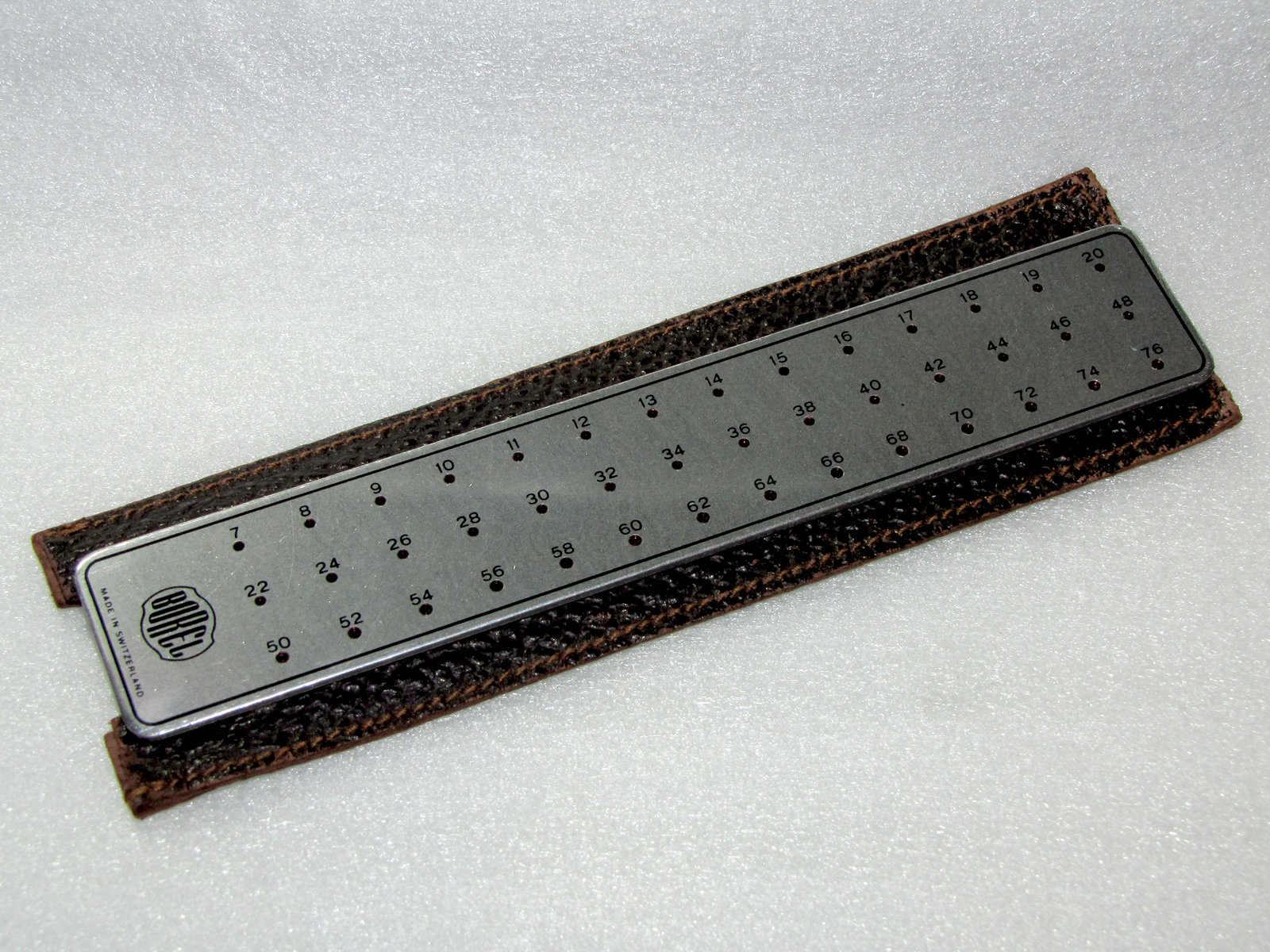 |
|
A Set of High Precision Jewelled Pivot Gauges for checking the pivot size and roundness, sized from balance staff pivots to wheel train pivots. Jewel holes are in the range from 0.07 to 0.50 mm (0.003" to 0.020"), the step size is 0.0025 mm (~0.0001"). |
 |
| Digital Dial Gauge in Stand
A modern gauge used for taking height measurements in horology work. It is a standard digital gauge with resolution of 0.01mm (.0004") and 13 mm travel (0.5"), mounted in a Star staking frame which has vertical bore of 8.0 mm. Just the right diameter for mounting a digital gauge. Staking frame has a table with a 4.0 mm bore and will accept various jewelling tool stumps and thus permit taking measurements of many varying shapes. Advantage over the standard mechanical dial gauge is in its ability to adjust zero at any point during the process of measurements. |

|
| Image showing a typical set of jewelling tool stumps, which I use in the base of the stand for taking height measurements. |

|
| Tesa Precision Micrometer
An interesting and useful measuring tool. Standard micrometer combined with a precision dial indicator to allow fast and accurate test measurement in a small series production of small parts as it nowadays does happen in a watchmaker's workshop. This measuring tool is used with gauge blocks to set initial value. |
 |
| The same
measuring tool mounted in a small bench stand to facilitate easy
manipulation with both hands.
Any part sized up to 25 mm can be tested for the compliance to the required size with the accuracy of 1 micrometer (~0.0000394") |
 |