Fermat's Last Theorem
x n + y n = z n has no positive integer solution if n > 2.
For 350 years, hundreds of mathematicians had tried to prove the Fermat's Last Theorem. But none succeed. For the past couple hundred years, this theorem has inspired thousands of people to study mathematics. New braches of mathematics were generated from the attempts to prove it. It remained unsolved until 1994.
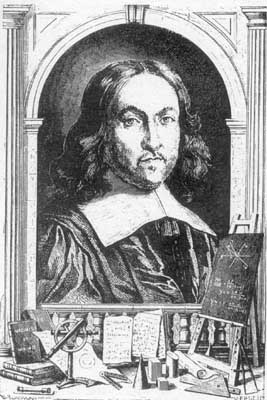
Pierre de Fermat
The story began with Pierre de Fermat (1601-1665), a French lawyer by profession. However he spent most of his spare time doing mathematics. In fact he is remembered today for his mathematical accomplishments. He is "the Prince of Amateur Mathematicians". He was one of the founders of probability and calculus. Not to mention his numerous contribution to number theory. While studying Diophantus's Arithmetica, he came across the well known Pythagorean theorem, x 2 + y 2 = z 2. He wrote down the most enigmatic margin note in the history of mathematics. "It is impossible for a cube to be written as a sum of two cubes, or a fourth power as the sum of two fourth powers, or in general, for any number which is a power greater than the second to be written as the sum of two like powers. I have a truly marvelous demonstration of this proposition but this margin is too narrow to contain it." (Of course, the original note was in Latin.)
Well, Fermat was a man who did mathematics for the joy of it and never had any intention of having fame with his many brilliant observations. He never published anything himself. After his death, his son collected his margin notes and observations and published them. One by one, most of his observations were proven to be correct, with a few proven to be erroneous. And the last one remained to be proven or disproved is the above observation, and thus its name, the Last Theorem. For the next few centuries, people believed he was correct. Yet no one could prove his statement. Nor could anyone find a counterexample to disprove it. Proving or disproving the theorem would bring someone instant fame.
From his notes, using a method called infinite descent, Fermat himself proved the case of n = 4. In 1753, Leonhard Euler using imaginary numbers, proved the case n = 3. Then Sophie Germain using a probabilistic approach to show that Fermat's Last Theorem was unlikely to have any solution if n = p, where p is prime and (2p+1) is also prime. Based on her argument, in 1825, Gustav Lejuenune-Dirichlet and Adrien-Marie Legendre each independently proved the case n = 5. Then fourteen years later, Gabriel Lame proved the case n = 7. Lame and Augustin Cauchy each independently tried to generalize the proof to all primes (which is sufficient to prove the Theorem). Yet they had made a fatal mistake, which was discovered by Ernst Kummer. Their proof had relied on a unique factorization domain. However, in the domain of complex numbers, numbers are not uniquely factored.
Thereafter, people kept proving more and more individual cases. Progress was being made, but at a extremely slow pace. As you know, Fermat's Last Theorem says it is true for any natural number n > 2. Even proving a million individual cases does not prove the theorem correct. What we need is a general proof. After three hundred years, mathematicians are frustrated with this problem. As a matter of fact, when Kurt Godel proved his famous Incompleteness Theorem in 1931, namely, with any mathematical system, there is always something that would remain true but impossible to prove, Fermat's Last Theorem was suggested as one of them.
There were no major development in proving the Last Theorem until 1955. Yutaka Taniyama and Goro Shimura had a bold idea while studying modular functions. They conjectured that every rational elliptical curve is a modular function in disguise. At that time, no one could prove this conjecture nor could anyone see the link between the Taniyama-Shimura conjecture and Fermat's Last Theorem. Then in 1984, Gerhard Frey outlined that if Fermat's Last Theorem were false, then there is a elliptical curve that is not modular. This is called the epsilon conjecture and Frey himself made a fundamental mistake in his proof. A year and a half later, Ken Ribet proved the epsilon conjecture. Now the link between the Last Theorem and the Taniyama-Shimura conjecture is clear. If we could prove the Taniyama-Shimura conjecture, then Fermat's Last Theorem would be a corollary.
After hearing Ribet's proof, Andrew Wiles, a British mathematician working at Princeton University, worked on the Taniyama-Shimura conjecture in secrecy. After 7 years of struggle, he shocked the world by announcing that he had proved the Taniyama-Shimura conjecture at the Isaac Newton Institute in Cambridge on June 23, 1993. However, a gap was found in the 200 page proof, a gap that would destroy the whole argument. After another year or so, together with Richard Taylor, one of Andrew Wiles' students, they finally fixed the gap in September 1994. Of course, his proof on the Taniyama-Shimura conjecture has far more implications in mathematics than just proving the Last Theorem.
After almost 350 years, it is definitely good to hear that the Last Theorem is finally settled. However it is also sad to hear this. After all, think about the impact it had on mathematics, the thousands of people attracted to mathematics because of the Last Theorem and the mathematics generated during the process of proving it. Is there another problem that is going to take its place?
Whether Fermat had proven his theorem or not is still a mystery. Wiles' proof involves twentieth century mathematics. It is unlikely that Fermat had proven it. However, thousands of amateur mathematicians still remain optimistic about Fermat's margin note and continue to pursue an elementary proof to the theorem.
Landmarks in the history of Fermat's Last Theorem
1659 Fermat true for n = 4
1753 Euler true for n = 3
1825 Dirichlet, Legendre true for n = 5
1839 Lame true for n = 7
1847 Kummer true for n < 37, Last Theorem is true if the exponent is a "regular prime"
1857 Kummer true if n < 1001930-7 Vandiver true for n < 617, with the assistance of a calculator and an improved Kummer's criteria
1953 Inkeri If (x, y, z) is a primitive counterexample to the Last Theorem with exponent p, then x > [(2p3 + p)/log(3p)] p .
1954 DH Lehmer, E Lehmer and Vandiver true for n < 2500 by using a computer.
1976 Wagstaff true for n < 125,000.
1983 Faltings Fermat's Last Theorem has only finitely many primitive solutions if n > 2.
1984 Frey If there is an counterexample to the Last Theorem, then there is an elliptical curve that is not modular.
1985 Granville, Heath-Brown The Last Theorem is true for "almost all" exponents n.
1987 Tanner and Wagstaff true for n < 150,000.
1991 Buhler, Crandall and Sompolski true for n < 1,000,000.
1994 Wiles put QED at the end of the proof.