Model Airplane Page
A Really Good Hobby
Jim's Goldberg Zipper Free Flight Model Airplane
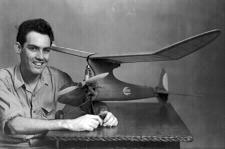
Jim began his model airplane
hobby while in Aircraft Mechanic School at Duncan Field, San Antonio, Texas
in 1942 where he was a fellow student with Victor Stanzel, inventor of the "U-line Control
System". In 1947 when this picture was taken glow plugs had not yet
become popular and as a matter of fact were scarce. The engine on the
Zipper is a Brown 60 with a miniture single electrode spark plug; it ran
on white gasoline mixed with oil and the setting of the spark advance
and the mixture determined the speed of the two cycle engine. It swung
a 14 inch wooden propeller and would pull the airplane vertically in a left
hand spiral until it ran out of fuel. The airplane was trimed so that it
would start a slow circle to the right and if a thermal was encountered it
could sore to amazing heights. On one occassion after launching a free flight
at the airport in Teague the free flight (not this Zipper) hooked a thermal
and Lois drove to Freestone which is about 8 miles South of Teague with Jim
on the running board watching it until it went out of sight going up. It
was returned to Jim about a month later after being found by a farmer near
Newby which is some 25 miles South of Teague.
Radio Controlled J-3 Cub>
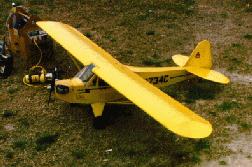
The J3 Cub was, and is,
one of the most popular radio controlled model airplanes. The pictured Cub
is the second one Jim has built. The first one hangs on the wall of the Ham Shack
and was built in 1959. It was flown last in 1992 at New Waverly, Texas.
It is powered by an OS MAX 35 2 cycle trottle controlled Engine. The pictured
J3 was finished and first flown on June 7, 1988. This J3 is equipt with a
Saito 45 which is a 4 cycle engine and controlled by a throttle body.
Most modelers build their airplanes with far larger than scale engines. This one is almost actual scale with it being necessary to get "a good run" to get the 6 pound, 6 foot wingspan model off the ground. The tail will come up and then a gentle back pressure on the elevator control will produce a very realistic climb to a safe altitude for a loop which can be completed by pointing the nose of the down at about 20 or 30 degrees to build up enough speed to get through the loop. It has been flown at Ruidoso, New Mexico which is 7000 feet above sea level, but it is a hand full at that altitude.
Camping - A Way of Life
Ham Radio
 Get your own Free Home Page