|


Queen Victoria |
|
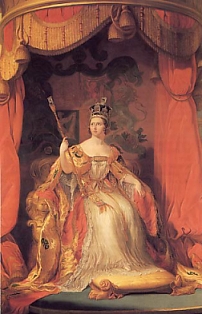
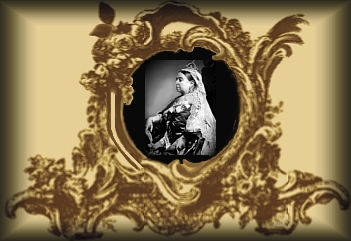
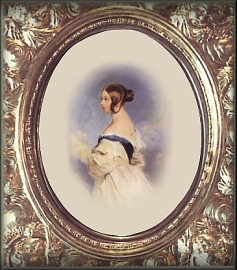
Queen
Victoria was the daughter of Edward, the Duke of Kent and
Princess Victoria of Saxe-Coburg. She was born in Kensington
Palace in London on May 24th, 1819.
Edward
died when Victoria was but eight months old, upon which her
mother enacted a strict regimen that shunned the courts of
Victoria's uncles, George IV and William IV.
In
1837 Queen Victoria took the throne after the death of her uncle
William IV. Due to her secluded childhood, she displayed a
personality marked by strong prejudices and a willful
stubbornness.
Barely
eighteen, she refused any further influence from her domineering
mother and ruled in her own stead. Popular respect for the Crown
was at a low point at her coronation, but the modest and
straightforward young Queen won the hearts of her subjects. She
wished to be informed of political matters, although she had no
direct input in policy decisions. The Reform Act of 1832 had set
the standard of legislative authority residing in the House of
Lords, with executive authority resting within a cabinet formed
of members of the House of Commons; the monarch was essentially
removed from the loop. She respected and worked well with Lord
Melbourne (Prime Minister in the early years of her reign) and
England grew both socially and economically. |
|
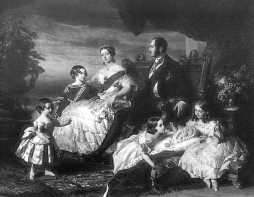
On
Feb 10th, 1840, only three years after taking the throne,
Victoria took her first vow and married her cousin, Prince
Albert of Saxe-Coburg-Gotha. Their relationship was one of great
love and admiration. Together they bore nine children - four
sons and five daughters: Victoria, Bertie, Alice, Alfred,
Helena, Louise, Arthur, Leopold, and Beatrice Prince Albert
replaced Melbourne as the dominant male influence in Victoria's
life. She was thoroughly devoted to him, and completely
submitted to his will. Victoria did nothing without her
husband's approval. Albert assisted in her royal duties. He
introduced a strict decorum in court and made a point of
straitlaced behavior. Albert also gave a more conservative tinge
to Victoria's politics. If Victoria was to insistently interject
her opinions and make her views felt in the cabinet, it was only
because of Albert's teachings of hard work. |
|
The
general public, however, was not enamored with the German
prince; he was excluded from holding any official political
position, was never granted a title of peerage and was named
Prince Consort only after seventeen years of marriage. His
interests in art, science, and industry spurred him to organize
the Crystal Palace Exhibition in 1851, a highly profitable
industrial convention. He used the proceeds, some £186,000, to
purchase lands in Kensington for the establishment of several
cultural and industrial museums.
Reflecting
back into her childhood, Victoria was always prone to self pity.
On Dec. 14th 1861 Albert died from typhoid fever at Windsor
Castle. Victoria remained in self-imposed seclusion for ten
years. This genuine, but obsessive mourning kept her occupied
for the rest of her life and played an important role in the
evolution of what would become the Victorian mentality. |
|
Her
popularity was at its lowest by 1870, but it steadily increased
thereafter until her death. In 1876 she was crowned Empress of
India by Disraeli. In 1887 Victoria's Golden Jubilee was a grand
national celebration of her 50th year as Queen. The Golden
Jubilee brought her out of her shell, and she once again
embraced public life. She toured English possessions and even
visited France (the first English monarch to do so since the
coronation of Henry VI in 1431). |
|
Victoria's
long reign witnessed an evolution in English politics and the
expansion of the British Empire, as well as political and social
reforms on the continent. France had known two dynasties and
embraced Republicanism, Spain had seen three monarchs and both
Italy and Germany had united their separate principalities into
national coalitions. Even in her dotage, she maintained a
youthful energy and optimism that infected the English
population as a whole. |
|
The
national pride connected with the name of Victoria - the term
Victorian England, for example, stemmed from the Queen's ethics
and personal tastes, which generally reflected those of the
middle class. |


|
Please
choose where you want to go and have a very Victorian visit!
|
If
you want to send me an e-mail,
just click on the button bellow:

|
The
outstanding background set and coordinated
graphics displayed on this page were provided by:

|
Want
beauty, good taste, talent and original designs
for your backgrounds? Then go to "Victorian Elegance".
Their art work is just plain breathtaking!! |
Some of the
images that I used on this page
are creations of my dearest friend Lady Dj.

Lady Dj is taking a break from the Internet
and her graphics have been missed very much.
This
page was created by Lady
Sylvia Ann.
© 1997, 2007 - All Rights Reserved.
Created: October 20, 1999. Last Update: 11/05/07. |
This page hosted by  Get your own, Free
Homepage.
Get your own, Free
Homepage.
|