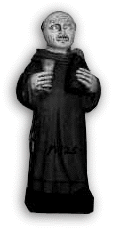
A TOAST TO DOM PÉRIGNON
|
It is said that, because of marauding barbarians, monks hid their liquid
provisions in barrels in underground rooms, thus giving us the wine cellar.
Most European monasteries had a clos, an enclosed vineyard, for producing
wine. Monks were the major contributors to viticulture. Martinmas is the
feast day of Saint Martin, a monk of the Middle Ages, one of the first viticulturist. In 1638 the Pérignon family had a child they named Pierre. When Pierre turned 20 he took the vows of the Benedictine monk. History was soon to be made. Pierre, known for his brilliant mind, was made administrator of the monastery of Hautvillers. With the assistance of Brother Phillipe (Pierre had lost his eyesight) he caused the vineyard to put forth a rich yield. Their wine was in high demand. Blanc de blancs, a white dry fruity wine from white grapes, only turned out if there was enough sunshine during the summer months. Profits would drop if Dom Pérignon failed to produce this wine so he set about to make the same quality white wine from black grapes. Now Dom Pérignon was endowed with a keen sense of smell and palate. Says Dom Groussard, 'he could tell at once what grapes came from which vineyards, and that the wine of one could be mixed with the wine of another, and he was never mistaken.' Dom Pérignon knew of the particular characteristic of the white wine of A˙, the wine of Champagne. It became effervescent with a second, short-lived fermentation. It still contained some yeasts which remained dormant in cold weather. Under the influence of the warmth of spring, when the sap begins to work in the vine, the yeasts wake and proliferate. There is as much fermentation as the sugar present in the wine will produce. Dom Pérignon sought to induce this second, accidental fermentation of the wine of Champagne at a given time, regulate it and keep its effervescence in the wine. When 60 years old he succeeded, producing Champagne as we know it today. It was wildly successful. A very small amount of sugar is added to the wine in cask to feed it and start the second fermentation. Then it is bottled. The bottles are left stacked for months or years. When fermentation occurs a sediment of yeasts collects along the lower side of the bottle. To remove the sediment without letting the gas escape the bottles are laid on the diagonal. Every day for a season each bottle is gently shaken by hand in the technique of remuage, so that the sediment will slip towards the neck, whence it will be expelled by the process of dégorgement, now performed at a very low temperature which freezes the deposit. The frozen sediment shoots out when the bottle is very briefly opened. The dryness of the wine depends on the amount of syrup, old wine and eau-de-vie that is added before the bottle is stoppered with the mushroom-shaped cork. The syrup is crystallized sugar. 0 to less than 1.5 per cent is brut, sec if 2 to 4 per cent, and doux if 8 to 12 percent. Then, fashion was for champagne doux. Dom Pérignon died in 1715 and was buried among his vines. During the Revolution the abbey of Hautvillers was destroyed, but the church and Dom Pérignon's tomb remain. Today, Moët et Chandon, the firm which bought the walls and vineyards of Hautvillers in 1794, gave the name of Dom Pérignon to their best wine. Go out and buy a bottle. Celebrate something! Enjoy! |
Mon Dieu! This page hosted by  Get your own Free Home Page!