|
 In 1976, NASA sent two probes, Viking 1 and 2, a lander and an orbiter, to Mars. These probes trailblazed humankind's exploration of the planet Mars giving scientists pictures of its varying surface terrains as well as determining the composition of its atmosphere and soil. There was much discussion about the orbiter revealing that there was a possibility that there may have once been flowing water on the surface of Mars. With this being the case the question presented itself of whether or not there may have actually been life on Mars. If there had been, every indication pointed to it being completely non-existant in our era. The lander proved that there was no organic material in the samples it took. Although little evidence was collected from the surface of the planet, NASA scientists consented that most likely the entire planet was like this due to its inhospitable atmosphere, yet there was another clue. In 1976, NASA sent two probes, Viking 1 and 2, a lander and an orbiter, to Mars. These probes trailblazed humankind's exploration of the planet Mars giving scientists pictures of its varying surface terrains as well as determining the composition of its atmosphere and soil. There was much discussion about the orbiter revealing that there was a possibility that there may have once been flowing water on the surface of Mars. With this being the case the question presented itself of whether or not there may have actually been life on Mars. If there had been, every indication pointed to it being completely non-existant in our era. The lander proved that there was no organic material in the samples it took. Although little evidence was collected from the surface of the planet, NASA scientists consented that most likely the entire planet was like this due to its inhospitable atmosphere, yet there was another clue.
|
|
View the Viking Image of Cydonia
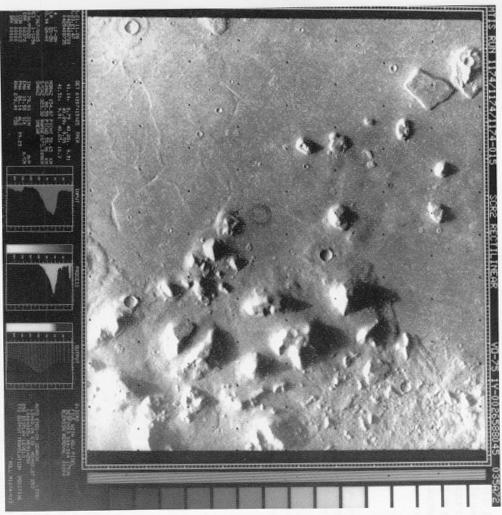
On its many passes of the planet Mars the Viking probe captured the image of a plateau region in the northern hemisphere called Cydonia. In the frames from that area there appeared to be an interesting formation that looked undoubtably like a face. When the images taken by Viking were publically released, the media displayed the picture of the face. NASA denied that the structure was a face and claimed that it was a trick of light, shadow, and angle of viewing. Over the years that passed the face was filed away in NASA archives with the intent to never be taken seriously again. It wasn't until, astronomer and former science consultant to Walter Cronkite, CBS News, CNN and NASA, Richard C. Hoagland, decided to dust off the Viking program files and reinvestigate it was the face again under scrutiny.
|
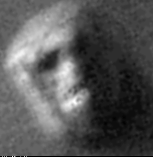
With digital enhancement the bizarre formation did prove to have features quite like a human's, but in actuality it was closer to that of a proto-human, perhaps even Australopithicus. This fact alone would suggest that the builders of this artifact were perhaps aware of human beings, or for that matter primative human beings, and were trying to send a message. The fossil record has shown that primate remains of homo habilis and homo erectus date back to many thousands or years before the birth of civilization as we know it so with this in mind it was safe to conclude that perhaps the face and the builders of it existed simultaneously to or even before early man. This was only the one of very first discoveries Hoagland made over the course of his investigation Cydonia.
|
The face wasn't the only object of Cydonia that drew Hoagland's attention. Upon careful scientific observation there proved to be other artifacts scattered across this Martian plateau that did not appear to be natural. Located perpendicular to the line of symmetry of the face there seemed to be a group of pyramidal structures he nicknamed "the city" as well as a large five-sided pyramid in the general area that he later called the "D & M," and a small domed hill that he dubbed the "tholus." Together these structures painted a more profound picture than anyone had ever realized.
|