ZELDA II: THE ADVENTURES OF LINK REVIEW BY VIDEO GAMER X
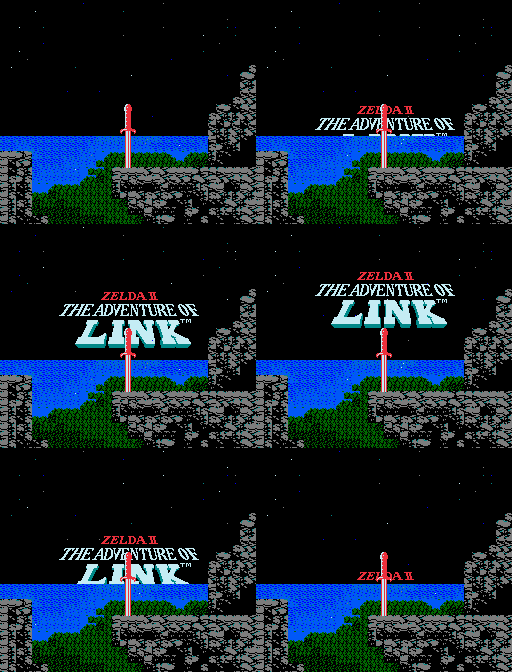
Zelda II: The Adventures of Link was a very anticipated game after the success of The Legend of Zelda. Kids snapped up Nintendo Newsletters and it became the topic of discussion between boys in many elementary school PE fields. I remember the first time I played this game and I became mesmerized by the what then was incredible graphics and music. I truly felt as though I was travelling on an adventure, and in my imagination's eye I could see the deserts, the palaces, the forests, and the the towns as I explored Hyrule. There was such a high demand for Zelda II in 1988 that Nintendo was unable to meet demand and the game was one of the hottest items to have for Christmas in that year. Zelda II actually taxed the supply of necessary components in Japan to make the game, and it was in very limited supply at launch causing a lot of angry parents. The game was the second Nintendo game to come in a golden cartridge. The popularity of The Legend of Zelda, and Zelda II: The Adventures of Link spawned numerous products like lunchboxes, cereal, and action figures. Futhermore it was those two NES Zelda games that spawned the Cartoon series that appeared on Friday episodes of the Super Mario Brothers Super Show.
At the time Zelda II's graphics were quite phenomenal. Originally released in 1987 in Japan, and then 1988 in the US, most games of the time were rather rudimentary occupying one screen of play at a time, however Zelda II incorporated a vast overworld for Link to explore and it immediately switched to a sidescrolling view when Link was attacked by Moblins out in the field. You'll probably notice that there are similar sprite based graphic elements that were used in Super Mario Bros. and Super Mario Brothers 2. A common practace during the early years of the NES was to recycle previously used sprites, considering it was easier and less expensive in development costs to do this. The overworld map was quite different then The Legend of Zelda in that it could scroll in any direction and you could move without tiling the background. The enemies were much more detailed, and towns were occupied by several residents. Instead of the stalwort cave dwellers of the previous game, people roamed the streets of bustling towns and villages. Although some people were in fact under a spell and would turn into monsters if you talked to them.
Compared to the music of The Legend of Zelda, Zelda II's music was something impressive to say the least. When I first heard that overworld theme I had become enchanted with the game as a child. Even though the NES was very primitive by today's standards the composers managed to eek out very memorable tunes from the NES's sound chip. One of the most impressive pieces of music I ever heard come from the NES era was the music to The Great Palace, the 7th Palace of the Game. That was absolutely phenomenal at the time and to this day I consider it legendary in the Zelda discography. I have a Techno Trance rendition available on this site via the music bar which I suggest you should check out, as well as a version very similar to what appeared on the NES.
Zelda II: The Adventures of Link managed to incorporate RPG elements into the gameplay, and allowed link to level up and become stronger as he defeated more and tougher enemies. As well Link could learn spells and this was the first Zelda game to give link a Magic Bar. Your Health and Magic could be upgraded by finding containers hidden across the map in various locations. If Link stayed on the road he would avoid being attacked by monsters. If he strayed off the road he was attacked by either a bot or a Moblin. One redeeming feature of this RPG element was that you could actually walk away from the monsters and avoid being put into a random battle, unlike other RPG's (many of which came after Zelda II like Dragon Warrior, Crystalis, and Final Fantasy) which automatically placed you into numerous random battles and you could not avoid them or see any enemies on the screen. When you were attacked the game would automatically switch to a sidescrolling mode. Attack was accomplished with the B button on the NES controller, and jump was A. The control was very responsive and you had to have timing and reflexes to react to the enemies on screen. One feature I always enjoyed about Zelda II, was the inclusion of something that's never been done since (except Soul Calibur II for GameCube), Link's upslash and downslash. Basically when Link learned this ability from other Knights in the towns of Hyrule. He could then attack enemies in the air above him or be able to point the sword toward the ground and impale enemies beneath him. The game did require Link to sometimes make diversions to go find items like a kidnapped child and healing water, but primarily Link's focus was to find 6 Palaces defeat the Boss Monsters and then place a magic crystal into a statue at the end of the Palace. Then the seal on The Great Palace (aka Thunderbird Palace) was released and he would have to fight and defeat a doppleganger of himself called Dark Link controlled by a wizard to obtain the Triforce to release the curse on Zelda. Zelda II abandoned the collection of rupees and the purchasing of items from stores like the previous game. Rather items were often found after defeating bosses in each of the 6 palaces or in towns. Link's magic spells were learned from magicians also living in towns spread across the map. One interesting spell of note was the one that allowed Link to turn into a fairy and bestowed upon him the ability to fly. Like most RPG's you could prevail over the enemies rather easily by leveling up. The maximum EXP you could obtain was 9000 for each category, LIFE, MAGIC, and ATTACK. Extra heart containers were not earned at the completion of a palace dungeon like the previous Zelda, rather they were found in hidden locations on the overworld map. Zelda II's gameplay deviated from both the previous game in the series, and its successor A Link to the Past for the Super Nintendo in 1992, however, there are many reasons why this game deserves as much merit as any of the Zelda games in the series considering the innovations it put forth in trailblazing RPG and Action based gameplay.
You know, I've heard disparraging remarks on certain Zelda sites about this game, and I can't see why it's been put down so much. I always found Zelda II: The Adventures of Link to be a fun game, even more fun than the original one, The Legend of Zelda, which had been released almost two years earlier. I liked the fact that there was an overworld and it included RPG elements, although at the time when I first played this game as a child I had never played any other RPGs. The overworld seemed so vast, and Hyrule was truly like a kingdom. There wasn't much storyline to go on in the game itself, rather a lot of that was told in the instruction manual. Your goal simply was to basically save princess Zelda from her Sleeping Beauty like slumber, and I'm quite sure that that story and Disney film may have been influencial in Nintendo and Miyamoto choosing this plot device.
The Ocarina of Time and Zelda II share a lot of common bonds, and the phantoms of the NES game haunt the first N64 Zelda game. As mentioned previously, when Link deviates from the road he would be attacked by monsters, same too in The Ocarina of Time in Hyrule Field if Link left the road at night he was attacked by skeletons. All the names of towns in Zelda II are identical to the names of the 5 sages in The Ocarina of Time, Saria, Ruto, Darunia, Nabooru, Rauru. As well the name Mido the head Kokiri of his village is the name of a Town in Zelda II. In the final battle after defeating the Thunderbird, Link encounters his anti-self or "Dark Link" the same Dark Link that he faces at the Water Temple in The Ocarina of Time. There are similarites to A Link to the Past because in essense Ganon wasn't around, rather a Wizard was trying to ressurrect Ganon with theTriforce piece in a similar way to how Agahnim was trying to restore Ganon's power in the Light World by casting spells on the 7 maidens in the Light World.
Zelda II is a very worthwhile game from the classic NES era and a true milestone and event in gaming history. To play this game is to play a piece of the past, you are living in retrograde what it was like to be a kid in the 1980's with NES hysteria sweeping every corner of American suburbia. Nintendo has re-released this classic along with the original Zelda for the GameBoy Advance, however nothing's like playing it old school, hooking up an NES, getting the cartridge set in the unit just right so it boots after 10 tries and living "The Adventures of Link." For adult gamers it's a huge nostalgia rush back to being a kid again, you remember the friends you hung out with, the stuff you did after school, the mischief you did and didn't tell your parents about. Games like The Legend of Zelda and Zelda II: The Adventures of Link are the epitome of childhood acknowledgement, and a place when life was simpler and full of imagination.

THE ODYSSEY OF HYRULE

|