THE LEGEND OF ZELDA (NES) REVIEW BY VIDEO GAMER X
 _____ _____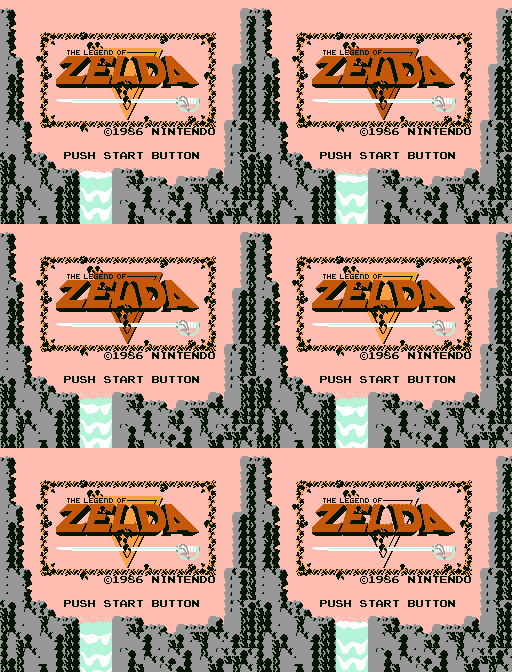 _____ _____
The Legend of Zelda was the first game to appear in the series. In the truest sense of the word it was a milestone. It was the first decent adventure game and the very dawn of the precepts of a console based RPG. The Legend of Zelda is approaching two decades in age, currently 19 years, since release in Japan on the Famicom Disk System (The Japanese Version of the Nintendo Entertainment System) as Zeruda no Densetsu: The Hyrule Fantasy on February 21st, 1986. The Legend of Zelda later appeared on the NES in America the following year in 1987. The Legend of Zelda paved the way for the entire series setting the standards and devices that would be carried on throughout the rest of the games and still remain to this day almost twenty years later. Shigeru Miyamoto designed Zelda based upon his memories of his childhood growing up and exploring the fields and caves near his home. Miyamoto commented about Zelda, "With Zelda we wanted a good name for the female character and we wanted something eternal, timeless. I was talking with a lot of writers and staff and the idea came from the American author F. Scott Fitzgerald's wife who was named Zelda. She was a famous woman who was kind of strong, so we decided to go with her name." The Legend of Zelda was the very first console video game of all time to utilize the "SAVE" ability via an extra battery that allowed that save data to be stored in RAM memory on the cartridge's motherboard. The Legend of Zelda came in a Golden Box, and was a shiny golden cartridge, the first game cartridge to ever appear this way. It even weighed slightly more than a standard NES cart. The Manual was the thickest to be included with a game of that era and contained the backstory of Hyrule that could not have been included in text in the game.

In the Legend of zelda you are vaguely advised that Ganon has captured princess Zelda, and the Triforce of Wisdom has been shattered into 8 pieces which Link must obtain, then enter the 9th Dungeon to defeat Ganon. It is interesting to note that in the introduction Ganon is spelled as, "GANNON." It has been confirmed that this is in fact a misspelling and error in translation from the original Japanese. If you have a very old version of NES Zelda, you'll also notice other forms of bad grammar and misspellings in the game and the intro screen, such as "ALL OF TREASURES" and so forth. This gives you an idea of how far back into Video Game history this game stretches. Due to the limited ROM memory allocations in cartridges back any character dialogue consisted of very blunt almost vague responses. The Legend of Zelda introduced players to the concept of the Triforce a relic of great power that held magicial properies, similar to how the Ring of Sauron was an object that bestowed unnatural powers on it's bearer.
The level design of The Legend of Zelda was something that was very new. Link was viewed from an overhead perspective, and all the gameplay occured on one screen at a time. When Link moved between screens it would scroll to the next screen. Enemies appeared on the screen and in some cases inside dungeons Link could not progress to the next screen unless all the enemies were defeated. The game boasted a large overworld for the time, and 9 dungeon maps for each of the two quests. Sometimes secrets were so difficult to find, players spent days just looking for what area of a wall to bomb to open up a cave entrance, or which gravestone contained the secret passage or room to obtain an upgraded sword. Link could obtain items that have come to be absolute staples of the series like bombs, the boomerang, bows and arrows, whistle (the predecessor to the Ocarina), heart containers, the dungeon map, the compass, and keys. Link would swing the sword with the A button, and use a secondary Item with the B button. When Link has maximum hearts he would shoot a beam from the end of the sword, this became known as the blade beam attack. The blade beam attack continued to be used in Zelda II: The Adventure of LInk, Then in A Link to the Past as well. Originally it was intended for Link to be able to perform the blade beam attack in The Ocarina of Time, however prior to release of that game late in development, the designers removed that ability. Upon completion of the game, players were granted the opportunity to play it again with new dungeons and a new overworld as a second Quest. Similarly Nintendo re-released The Ocarina of Time in 2003 in conjunction with The Wind Waker that included a Master Quest, which was basically a similar idea.
The game introduced the now legendary Hyrule Overworld Theme, that in video gaming history is probably the 2nd most recognizable piece of music next to the Super Mario Brothers theme. The Legend of Zelda didn't contain a large variety of music scores, however it set the tone and mood of the game at the time. Sound effects were rather basic, like the sound of LInk swinging the sword, collecting items like rupies, or keys, and the sounds of growling boss monsters. One sound effect that has been carried through all the Zelda games since the first game was the sound of when Link obtains an item or finds something, this chime has been forever the indication of success upon completing a puzzle in the zelda games.
The Legend of Zelda introduced all the standard rudimentary aspects that we come to know as being part of the Zelda Experience and put Nintendo squarely on the gaming landscape, and was a major step on their ladder to world domination of the video game industry by the late 80's. The Legend of Zelda was a huge success and was one of the key ingredients in ending what is considered the great video game crash after the demise of the Atari, Collecovision, and Intellivision by 1984. From this one game there have been countless games to follow on all of Nintendo's consoles, including of course the Nintendo Entertainment System, the Super Nintendo, the GameBoy, The GameBoy Color, The Nintendo 64, GameBoy Advance, the GameCube, and even an ill-fated non Nintendo console, The Phillips CDInteractive. Zelda, next to Mario has been one of Nintendo's most lucrative franchises worth billions of dollars in revenue for the company, and it's unlikely that it will ever be retired, so fans of the series can be assured as long as the Nintendo exists, there will be a Zelda game in some fashion.
I actually played Zelda II, before I had the opportunity to play the first Zelda game. When I was a child I preferred the seemingly vast world of Zelda II to the what appeared to be moody and repetative world of the first game. Having of course grown and played countless video games since then, today I accept the first Zelda game for what it represents, the game that started everything and made the series possible today. I truly recommend that you find an NES and play this game. They've even gone and rereleased it for the GameBoy Advance. Although you can probably pick this game up for a Nintendo for about $10.00 on Ebay. There's nothing like playing it old school on the TV. If you really want to relive the 80's, boot the game up on an old 25 inch RCA wood cabinet tv, the kind that only had the antenna leads to connect to and you had to had an adapter to connect the NES's RF switch to the leads. My parents had a TV almost identical to this, and I played all those classic games for all the 8 and 16 bit systems on that set.

THE ODYSSEY OF HYRULE

|