BIOGRAPHY OF SHIGERU MIYAMOTO
Excerpted from "Press Start: The Artform, Culture, and History of Video Games"
by (Video Gamer X)
© 2005 Video Gamer X Publications
|
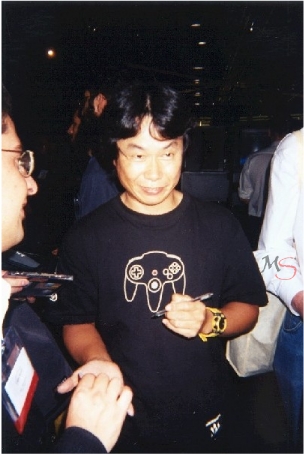
One name that towers above many of his contemporary peers is that of Shigeru Miyamoto. He has achieved a revered status and today is considered one of the founding fathers of the video game industry, the creator of now legendary games and franchises such as Donkey Kong, The Super Mario Brothers games, The Legend of Zelda, Metroid, StarFox, Kirby, and Pikmin to name a few. Many of these characters have become as recognizable as Mickey Mouse and McDonalds throughout the world. These characters are Nintendo. Miyamoto has been honored with numerous awards and accolades over the decades, and his work is considered the paragon to which many game creators and designers compare themselves to or aspire to emulate. His name evokes reverance for the artform and culture of video games.
|
Shigeru Miyamoto was born November 16, 1952, in Kyoto Japan. As a child Miyamoto enjoyed activities like drawing, painting, and being enchanted by the rural surroundings of his home and the adventures he went on as a young boy. This natural world inspired his imagination. His family lacked a television, and there is a good possiblitity this aided in nurturing it. Some stories say, that one day while exploring Miyamoto discovered a concealed entrance to a cave and that he came to be so fascinated with it that it became one of the core fundementals of his later work, the discovery of hidden areas where secrets could be revealed. As he grew older, Miyamoto wanted to create something that would impress people. He thought about working with puppets or being a painter, and he later made toys.
His parents were both teachers and he has admitted that his household was strict and regimental. Although it was his mother who valued the importance of technology and how it affects society and encouraged his creativity, which allowed Miyamoto to write comic books and draw pictures, however once he got into development of video games, they felt that these games took away from children's time spent studying.
In 1970, he enrolled in the Kanazawa Munici College of Industrial Arts and Crafts, and graduated five years later, though he would later remark that he had a preferance for drawing rather than adherance to the curriculum, and it ended up taking him 5 years to graduate, primarily because he ditched class on a regular basis. In 1977, Miyamoto, with a degree in industrial design, was granted a meeting with a friend of his father's, Hiroshi Yamauchi who was the chairman of Nintendo of Japan. At the time Nintendo was working on toys, and Yamauchi hired Miyamoto to be a "staff artist," and assigned him to apprentice in the planning department after he saw the things he had made.
At that time, Nintendo was expanding its reach to America and established Nintendo of America, and initially failed to reach appeal with the arcade game, "Radar Scope." Hiroshi Yamauchi gave Miyamoto the task of of designing a game that would be successful and have wide appeal to players. Although Miyamoto had no prior experience programming, he consulted with engineers, composed a bit of music himself on a small electronic keyboard, and created the characters of Donkey Kong, a character named Jumpman who later was to be called Mario, and Pauline, his girlfriend in peril.
Miyamoto's Mario character as well as Mario's brother Luigi, debuted on his own game in 1985, for the Famicom Disk System in Japan, and the Nintendo Entertainment System a year later in America, called Super Mario Brothers. When interviewed, Mario's creator Shigeru Miyamoto commented that Mario wears a cap because he found it rather difficult to draw hair. Mario would grow large by absorbing a mushroom an idea derived from the "Eat me" and "Drink me" potions in the Lewis Carroll story, Alice in Wonderland. Furthermore, the usage of the term Warp Zone was borrowed from the TV show Star Trek.
There is speculation that The Legend of Zelda was based off of a Movie by the name of "Legend" that appeared around 1985, in which a character dressed in green must go on a quest, through dungeons and over land, and rescue a woman from the clutches of an evil monster. (sound familiar...?) There are claims that both refute and support this alleged notion, although it is an interesting controversy existing at the dawn of Zelda series irregardless whether or not it is actually true.
Shigeru Miyamoto fell in love with a woman named Yasuko who worked in Nintendo's general administration department. After they were married, they purchased a small house near Nintendo headquarters. He was often seen either walking to work or riding his bike during his early years working for the company.
Today, he is Director and General Manager of Nintendo Entertainment Analysis and Development (EAD), the corporate sector of Nintendo of Japan, overseeing many of Nintendo's current projects in hardware and software. In 1998, Miyamoto became the first person to be inducted into the Academy of Interactive Arts and Sciences' Hall of Fame, a recognition of his grand accomplishments for two decades of work in the field. His most recent game is Pikmin, based on his own garden, outside his home. He is still married to Yosuka nd has both a son and daughter who are 19, and 17. He likes to play the guitar and spend time in his garden. He doesn't own a cell phone or wants to own one.

The Miyamoto equation is so successful because it captures the imagination of those who play his games, it makes the rich world in which the player explores both magical and interactive. There is always another secret behind a door. There is that innocent childlike curiousity that permeates all of his games, and in that expression of innocence we all gain a sense of freedom. His work speaks to the notion that the entire world is an adventure, and there are so many wonderful hidden things left unseen waiting to be discovered, behind another door, inside a cave, out in space, and within our own imaginations. These are the rewards gained for adventure. There is no end to the possiblities that exist in this world and beyond, and these games are a testimony to that profound concept.
QUOTES FROM MIYAMOTO:
"What if, on a crowded street, you look up and see something appear that should not, given what we know, be there. You either shake your head and dismiss it, or you accept that there is much more to the world than we think. Perhaps it really is a doorway to another place. If you choose to go inside you may find many unexpected things."
"What if everything you see is more than what you see - the person next to you is a warrior and the space that appears empty is a secret door to another world? What if something appears that shouldn't? You either dismiss it, or you accept that there is much more to the world than you think. Perhaps it is really a doorway, and if you choose to go inside, you'll find many unexpected things."
"Video Games are bad for you? That's what they said about Rock 'N' Roll. "
"A delayed game is eventually good, a bad game is bad forever"
"Challenge for the player is the most important thing. In the Mario games for example, the player can go back and try to finish the game without collecting a single coin. I think great video games are like favorite playgrounds, places you become attached to and go back to again and again. Wouldn't it be great to have a whole drawer full of "playgrounds" right at your finger tips?"
"What role does realism play in videogames I ask myself. Is this image more interesting? Sometimes.. however, what if a "detailed" hand with 5 fingers is catching a bottle but the fingers pass right through it? Is this still realistic? Rather than to show each meticulous and tiny detail of a finger, it is more important to make the end action look more credible by working on the movement and functionality of the arms and the hand in relation to the object."
"The money which I earn is mainly dedicated to video games and I am very content."
"You know, I joined Nintendo to make products that use ideas and intelligence, and they just turned out to be video games."

THE ODYSSEY OF HYRULE

|