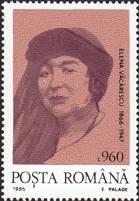
Vacarescu Elena
21.9.1864 - 17.2.1947
romunsko
- francoska pisateljica.
Elena
was a poet and novelist who wrote in French. A maid of honour of Queen
Elizabeth of Romania, she had a love affair with the Crown Prince (afterward
King) Ferdinand; the marriage was opposed by King Carol I, and Elena was
exiled to Paris, where she spent the rest of her life. She published many
volumes of lyrical verse: Chants d'aurore (1886, Dawn Songs), for which
she was awarded the prize of the French Academy; L'Âme sereine (1896,
The Serene Soul); Lueurs et flammes (1903, Gleams and Flames); and
Dans l'or du soir (1928, In the Gold of the Evening). She also wrote a few
novels. In 1925 she was elected an honorary member of the Romanian Academy.
RO - 5139
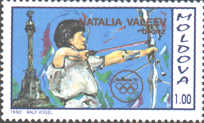
Valeev Natalia
15.11.1969 -
romunska športnica - lokostrelka, večkratna prvakinja in rekorderka
Moldavije.
Sportswoman from Republica Moldova, master of sport in archery.
Multiple Champion and recordman of the Republic of Moldova. She won
bronze medal in individual and team archery at 1992 OG.
MD - 36
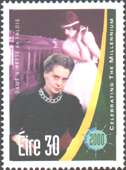
Valois Ninette de 6.6.1898 -
8.3.2001
je britanska baletna koreografinja.
Through a combination of vision and singlemindedness, Ninette de Valois, created Britain's national ballet. The company she founded in 1931 at Sadler's Wells Theatre is now the Royal Ballet. A student of Enrico Cecchetti, de Valois was a member of the Ballets Russes de Serge Diaghilev from 1923 to 1926. She then joined the London Old Vic Theatre to teach movement to its actors and to arrange dances for plays and operas at that theater. As a choreographer she created
Job (1931), The Rake's Progress (1935), and Checkmate (1937). She resigned as director of the Royal Ballet in 1963 but maintained ties to the company and school. Her books include
Invitation to the Ballet (1937) and Step by Step (1977). She was created a Dame of the British Empire in 1951.
IE - 1232
Valtonen Vera
4.12.1914 - 17.12.1997,
Marie
17.6.1916 - 14.1.1995,
Raija
27.3.1918 - 23.2.1997
Pevski trio Harmony Sisters je najbolj
popularna finska pevska skupina vseh časov. Sestavljale so ga sestre: Vera - mozosopran,
Marie - alt, Raija - sopran.
The trio
Harmony Sisters (1934-56) was the most beloved Finnish singing group of all
time. They personified the spirit of the struggle of WWII. The group toured
Nazi Germany as Geschwister Waltonen in 1942-43, sent there officially by
the National Finnish Broadcasting Company. They made recordings in Berlin,
but those were mostly destroyed in bombings. They visited military hospitals
and were entertained by Nazi leaders.
Vera song mezzosopran, Marie alt and Raija soprano.
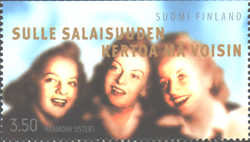
FI - 1485
VANDECAVEYE Gella
5.6.1973 -
je belgijskla judoistka, ki je na OI 1996
osvojila srebrno medaljo v pol težki kategoriji, leta 2004 v Atenah pa še
bronasto medaljo v isti kategoriji.
Belgian
competitor for judo. At the 1996 Summer Olympics she won the silver medal in
the women's half-middleweight category. Four years later, at the 2004 Summer
Olympics in Athens, she captured a second medal: a bronze one in the same
category.
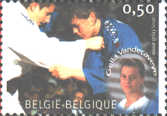
B -
3458
Vansova Terezia 18.4.1857 - 10.10.1942
je slovaška pisateljica
predstavnica prve generacije slovaškega realizma, prva urednica ženskega časopisa
Dennica(1897 - 1907), etnografinja.
She
helped create the cultural and social life of Slovakia at the close of
the 19th century. She attended school in her hometown of Zvolenská
Slatina, as well as Banská Bystrica, and Rimavská Sobota. The years she
spent in Lomnička and later in Rimavská Píla, her new homes after her
marriage to Ján Vansa – a protestant priest – were the background to the
realistic memoirs of life in village schools and vicarages. Vansová’s
novel Sirota Podhradských (Podhradská, The Orphan), published in
1889, represents the first novel by a Slovak female author. In 1927,
Vansová was awarded the national prize for her novel Kliatba (The
Curse). Terézia Vansová wrote short stories, drama, translated the
writings of Božena Němcová, and compiled a new cookbook (Nová
kuchárska kniha) where she published 900 collected recipes. She was
also the founder and editor of Dennica (Daily), the first magazine for
women ever published in Slovakia, and she was the vice-chairwoman of
Živena – the Society of Slovak Women.
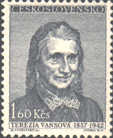
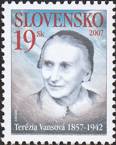
CZ - 1001 SK - 548
Varming Hanne
13.5.1939 -
je danska kiparka.
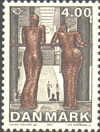
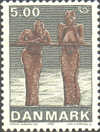
Na znamkah
DK-1303/4: Dekleti na letališču.
Hanna Varming realised at an early age that she wanted to apply her creative abilities in artistic direction. She modelled her first small pictures at age of six and still keeps a small biblical piece modelled when she was 13-14. Armed with her lower secondary leaving certificate, she found a job at the Royal Porcelain Factory in 1955 where she spent most of her time working on the popular porcelain figures. Hanne attended the Academy of Fine Arts from 1958-65. She learned the naturalist tradition of sculpting based on the techniques of Antiquity and the use of human motifs, a path that has also taken her on journeys to Greece, Egypt and Italy, where she has found herself surrounded by inspiration. Hanne is also in demand as portrait sculptor.
On stamps DK-1303/4:
The girls in the Airport.
DK - 1303/4
VASCONCELOS Joana
8.11.1971 -
portugalska slikarka
"Nektar"
Portugal
painter.
P - 3206
Vassiliadou Georgia
1897 - 1980
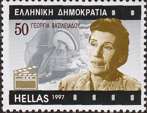
je grška filmska igralka. Greek actress
made her debut in 1923 as a chorister in Emani. She played with
Kyveli in many plays. Her first film was A Sculptor`s Dream from
1930. She also played in The Grouch (1961), The Midwife (1961), Aunt From Chicago (1959)...
GR - 1962
Vata Shkurte
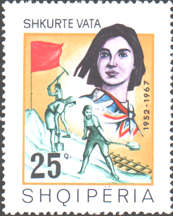
albanska junakinja, čuvajka proge.
Albanian hero, woman-railroad guard.
AL - 1332
VATOLINA Nina
1915 - 2002
Na znamki
RU-806 je njen
plakat: Zmagali bomo.
She was Soviet poster artist. After the break of War Vatolina along with
other artists started making artworks, which covered the most acute
topics both of battle front and home front.
She studied
at “Association of State Books and Magazines Publishing Houses” Art
Vocational School in1932-1936 and at the Moscow Institute of Fine Arts
in 1937-1942. In 1935-1939 studied at V.N. Deni’s studio.
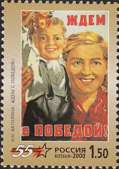
RU - 806
VerfaillIe Catherine
1957 -
belgijska biologinja
Na znamki
B-3288 je tudi
Christine van Broeckhoven.
Professor
of Medicine in the Division of Hematology, Oncology and Transplantation,
director of the Stem Cell Institute. Her major research interest is stem cell
biology.
On stamp
B-3288 is
also
Christine van Broeckhoven.
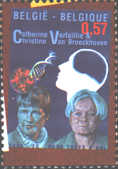
B - 3288
VIALAR Emilie de sv.
(st.)
12.9.1797 - 24.8.1856
She was
French nun founder the Missionary Congregation of the Sisters of St Joseph
in France in 1832. In Malta she opened a children`s asylum for poor children.
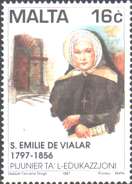
MT - 1021
Vieira da Silva Maria Elena 13.6.1908 - 6.3.1992
Maria Helena Vieira da Silva is a Portuguese painter of abstractions working in Paris; her canvases can be characterized as grids of vivid colors that sparkle like mosaics. Vieira da Silva studied sculpture with Emile Antoine Bourdelle and Charles Despiau and painting with Achille Emile Orthon Friesz and Fernand Leger. She has won international recognition for her paintings. Since her first postwar exhibition in New York City in 1946 she has exhibited regularly in Paris and throughout Europe. Her work was included in the 1950 and 1954 Venice Biennales and in the 1954 Sao Paulo Bienal. In 1966 the French government gave her its highest artistic award, the Grand Prix National des Arts.
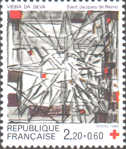
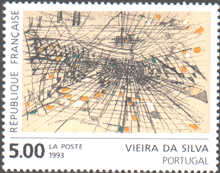 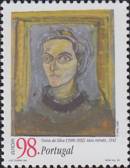
F - 2582 F - 2999
P - 2132
Vigee-Lebrun Elisabeth
16.4.1755 - 30.3.1842
Louise Elisabeth Vigee-Lebrun achieved an international reputation as a portraitist during her lifetime. She served as painter to Queen Marie Antoinette until the French Revolution forced her into an exile that lasted 12 years. Having escaped with her daughter to Italy, she continued to receive commissions as she traveled and was warmly welcomed in Europe's major capitals. Vigee-Lebrun was introduced to painting by her father, a pastel portraitist who recognized her talent and supported her training. In 1783 she was admitted to the Academie Royale. Her style of portraiture catches her sitters looking alert; they are generally placed within their typical surroundings. For example,
Marie Antoinette and Her Children (1787, Versailles Palace) is set in a room of the palace, and the painter in
Hubert Robert (1788, Louvre, Paris) is seen at work, holding his palette and brushes. According to her own memoirs, Vigee-Lebrun painted about 900 works, of which more than 200 were landscapes and the remainder mainly portraits.
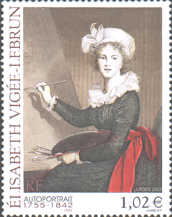
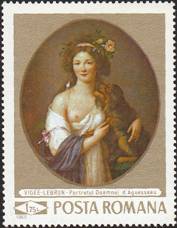
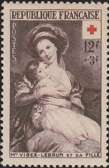
F - 3663
RO - 2800
F - 984
Vilhena Guiomar
1705 - 1789
She was
wealthy woman from Madeira. She was owner of last sugar mill on Madeira
and owner of huge farm. With her two ships she exported vine to Europa
and America.
Vincent Arlette
1932 -
Coming into television as an
announcer, Arlette Vincent quickly became its most popular presenter. She
participated in numerous programmes such as Contraste, Magazine F,
La preuve par quatre (Proof By Four) and Cinescope. Since
1964, she became the presenter of animal programmes such as Histoires
naturelles (Natural Stories) and then of Le jardin extraordinaire
(The Extraordinary Garden) (on stamp
B-3262), one of
Belgian television's most famous programmes, still produced at the present
time.
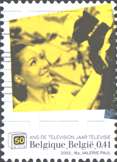
B - 3262
VLAŠIĆ Blanka 8.11.1983 -
je hrvaška atletinja in trenutna
svetovna prvakinja v skoku v višino, ko je z rezultatom 205 cm zmagala
na svetovnem prvenstvu 2007 v Osaki. Njen osebni rekord je 207 cm.
Croatian athlete won at the World Championships in Athletics in Osaka in
2007 in the high jump (205 cm) and became world champion. Her personal
record is 207 cm.
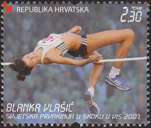
HR - 825
Vogt Cecile 27.3.1875 - 4.5.1962
French-German neuropathologist. She studied medicine in Paris where she met her husband, Oskar Vogt.
They married and in 1899 moved to Berlin. where they founded a Neurologische Zentralstation which they supported through private practice. Cécile Vogt did much of pioneering work on the neuro-anatomy of the thalamus and together with Hermann Oppenheim (1858-1919) published on hereditary (pseudo-bulbar) palsy, athetose double, in which she noted the mottled appearance of the striatum which was acknowledged by Kinnier Wilson. She made early and most important contributions to disease states of the basal ganglia. In their later years the Vogts turned also to genetic mutations, using as their specimens the bumblebees and beetles they had collected by the hundreds of thousands on their holiday trips.
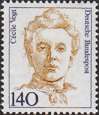
D - 1432
gor - up |