Following is the article titled "Notes and Queries: Shri Vishnu Temple, Pietermaritzburg " pages from Magazine of Natal Society Foundation 2018
Prologue
 THE SHRI Vishnu Temple at the lower end of Langalibalele Street (formerly Longmarket Street), almost directly opposite the Sri Siva Soobramoniar and Marriamen (Mariamman) Tamil Temple complex, has traditionally had a north Indian, Hindi orientation. It is a typical example of a simple north Indian temple style with a central dome above the rectangular shrine room, surrounded by a veranda, allowing devotees to circumambulate the shrine as part of their devotions.
This main interior space contains marble images of the principal deities, imported from India and consecrated in 1924: the great god Vishnu, his consort Lakshmi, and his two most important incarnations (avataras), Krishna and Rama. These are all deities particular to the north Indian Hindu tradition. But, in addition, the temple also houses images (murtis) from the Shiva tradition, very well represented and popular in the local south Indian Tamil community; namely the great god Shiva himself, as well as Shiva’s son Ganesha, the elephant-headed god, and Hanuman, the monkey god (also a staunch supporter of Rama).
Origin
In 1907, approximately 47 years after the arrival of the first indentured labourers who came to Natal from India, the land on which this temple stands was purchased for £170 by a recently established group which called itself The Shri Vishnu Temple, formed to preside over the building of a temple.
This religious building was required to accommodate the devotional needs of many recently freed labourers who had begun settling in Pietermaritzburg from about 1866 onwards in the lower Longmarket Street area, then on the outskirts of the town. Many found work with the Corporation, while others became involved in market gardening and hawking vegetables and fruit round the city. Some Corporation workers were housed in the Knipe Street Barracks just off Longmarket Street, further up towards the centre of town.
In 1921 the tender for building the Vishnu temple was awarded to Lutchman Singh for the sum of £153. This was completed in 1922, the most difficult part of the structure proving to be the construction of the large Islamic-styled dome, the cast of which was made of mealie stalks and bamboo, then covered with white plaster. This was accomplished under the masterly supervision of a Gujarati builder named Mistree (or Mithri). A few years later, in 1930, the temple committee purchased an adjoining plot of land to extend its premises, bordering on Williams Street.
The School
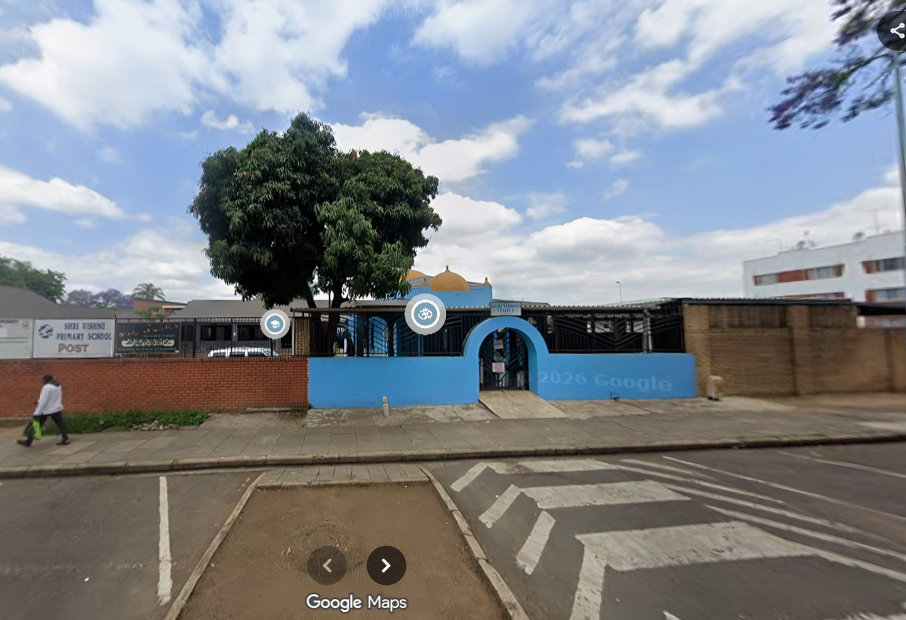 The school, started in 1924, was originally held on the temple veranda, mainly to teach the Hindi language to children in a concerted effort to preserve the mother tongue. Later, in 1950, three classrooms were constructed on the land next door to the temple, and the primary school was officially opened in 1952. Further extensions were built in 1965, and recently three extra prefabricated classrooms were added, bringing the total to nine. The premises are now loaned to the Department of Education, and the school caters for grades R–7, with thirteen teachers, and a present enrolment of 366 pupils. The current principal, L.T. Moodley, has taught at the school since 1988, and held the position of principal since 1996, preserving an important continuity and a commitment to fostering the values of respect and tolerance towards others.
Listed as historic building by Pietermaritzburg City Council
In June 1988 the Pietermaritzburg City Council recommended that this temple be listed – along with a number of other historic buildings – because of its historical and architectural significance. However, 1989 saw additions to the temple which doubled the size of the original space in order to accommodate a larger worshiping community. This extension broke the typical north Indian dimensions of the structure, somewhat compromising its integrity, so that the large dome is no longer the centre-piece of the temple.
Recent activities
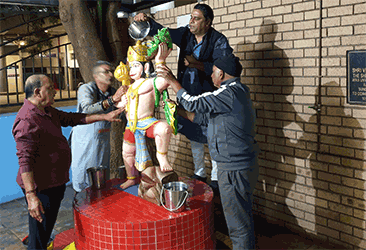
Recently, the paved area between the gate and the entrance to the temple has also been covered to provide yet more space for devotions, with a shrine to Hanuman dominated by a large colourful murti.
A permanent priest from Delhi, Pundit Lalit Mohan Pandey, has presided over prayers and public worship for fifteen years, celebrating the major festivals of Ram Naumee, Krishna Asthmee, Shiva Rathree, Deepavali and Navarathri.
The temple celebrated its centenary in October 2008 with prayers of thanksgiving, a street procession, and numerous cultural events. This temple and its worshippers have made a significant contribution to the Pietermaritzburg community over the years, arranging lectures on a variety of religious topics, allowing its premises to be used for Katha and Jhanda ceremonies (the erecting of triangular-shaped flags – Jhanda – and telling of a sacred story – Katha), Hawan ceremonies (fire offerings of pleasant smelling petals, ghee and grains), weddings, bazaars, and many other cultural and social gatherings, so conveying knowledge of the Hindu tradition to continuing generations of loyal devotees.
During the popular and well-attended Tamil Draupadi firewalking festival held annually at the Soobramoniar and Mariamman temples across the road, the lower block of Langalibalele Street is closed to traffic and taken over by stalls selling traditional food and religious items, the Vishnu temple becoming involved in the lively atmosphere of celebration and devotion.
Epilogue
The ancient heritage of the Hindu tradition, reaching further back into history than any other living religion and brought by these immigrants from India, offers an encounter with their vibrant temple architecture and glimpses into colourful religious and cultural ceremonies – music, dance, clothing, foodstuffs – far removed from the familiar, more Westernised world views of many local citizens, contributing to the rich mix of peoples who make up our dynamic South African society.
NOTES
1. Diesel, Alleyn and Maxwell, Patrick, Hinduism in Natal: A Brief Guide (Pietermaritzburg, University of Natal Press, 1993).
2. Mikula, Paul, Kearney, Brian and Harber, Rodney, Traditional Hindu Temples in South Africa (Durban, Hindu Temple Publications, 1982).
3. Shri Vishnu Temple Centenary Souvenir Brochure, October 2008. ‘Temple centenary’, Witness, 9 October 2008.
I salute Thee to give me inspiration, magnanimity, and Santhi.
Shri Vishnu Temple,
556 Langalibalele St
Pietermaritzburg
3201, South Africa
Phone : +27333421962
Working Hours of Temple :
Evening Working Hours :