

If you said "yes" or better still a loud "YES!", read on. There are many who feel the same way as you do - not just in India, but the world over. After years of doing research, writing articles and books, and political lobbying to further their point of view, they have found a sneaky and subversive way of getting back. It may not be well known here in India, but in the advanced countries, it's a burgeoning movement that sends shivers up the spines of the biggest corporations. It's called by many names-anti-advertising, ad-busting, subvertising… or simply, 'reactive advertising'.
The approach behind 'reactive advertising' is to critique advertising using its own devices. This ingenious twist came about when a number of people who used to actually create advertising voiced their disenchantment with their profession:
"We, the undersigned, are graphic designers, art directors and visual communicators who have been raised in a world in which the techniques and apparatus of advertising have persistently been presented to us as the most lucrative, effective and desirable use of our talents. Many design teachers and mentors promote this belief; the market rewards it; a tide of books and publications reinforces it.
"Encouraged in this direction, designers then apply their skill and imagination to sell dog biscuits, designer coffee, diamonds, detergents, hair gel, cigarettes, credit cards, sneakers, butt toners, light beer and heavy-duty recreational vehicles. Commercial work has always paid the bills, but many graphic designers have now let it become, in large measure, what graphic designers do. This, in turn, is how the world perceives design. The profession's time and energy is used up manufacturing demand for things that are inessential at best."
They went on to say:
"Many of us have grown increasingly uncomfortable with this view of design. Designers who devote their efforts primarily to advertising, marketing and brand development are supporting, and implicitly endorsing, a mental environment so saturated with commercial messages that it is changing the very way citizen-consumers speak, think, feel, respond and interact. To some extent we are all helping draft a reductive and immeasurably harmful code of public discourse."
They concluded:
"We propose a reversal of priorities in favor of more useful, lasting and democratic forms of communication - a mindshift away from product marketing and toward the exploration and production of a new kind of meaning. The scope of debate is shrinking; it must expand. Consumerism is running uncontested; it must be challenged by other perspectives expressed, in part, through the visual languages and resources of design."
This article was called the 'First Things First Manifesto' and was signed by a group of graphic designers, art directors, visual communicators and academics in the year 2000. Interestingly, it was actually a revision of a similar manifesto signed in 1964 by another group of 22 creative communicators.
Around 1970 too, came a book called 'Design for the Real World: Human Ecology and Social Change' by Industrial Designer Victor Papanek, who began with the following blistering statement:
"There are professions more harmful than industrial design, but only a very few of them. And possibly only one profession is phonier. Advertising design, in persuading people to buy things they don't need, with money they don't have, in order to impress others who don't care, is probably the phoniest field in existence today…"
Papanek's book created a storm in design faculties and colleges around the world, and it forms an essential reading in many curricula to this day.
The 'First Things First' group of 2000 went on to create some memorable 'subvertising' campaigns under the name 'Adbusters' that has become flag bearer of various alternative subcultures and lifestyles around the world. These alternative communities comprise largely the youth, disaffected by what they perceive as unfairness, inequality and injustice practiced by the leadership in their own as well as other countries. If this reminds you of similar youth movements back in the 1960s, you could be easily forgiven. But what stands them apart is their post-modern use of the media - gone are the clunky, heavy-handed treatises against consumerism and capitalism, no pop psychedelia or Marxist icons. Here is a sample:
In the summer of 2003, the citizens of Prague - one of Europe's loveliest cities, now "besotted with supermarket shopping" (as the Economist puts it) - were witness to a massive promotion campaign comprising billboards, pamphlets, a TV ad and a radio jingle for what promised to be the city's biggest and cheapest hypermarket, called "Ceský Sen" or "The Czech Dream". More than a thousand shoppers queued up for the "grand opening" on May 31, only to find that what appeared to be a huge building was nothing but a canvas façade backed by scaffolding installed in a large open field.
Soon, they realized that this was no more than a gigantic practical joke, but the scale at which it had been perpetrated triggered intense debate amongst people as well as media on the prevailing obsession with advertising and consumerism. And that was the intent of the two 'visionaries' of this joke, two film students called Filip Remunda and Vit Klusak, who were inspired by a 2002 study that reported 30 percent of Czechs shop mainly at hypermarkets.
The language of these new-age 'revolutionaries' (to use an obsolete term) is deception to the point of being surreal. Rather than advertising their alternative point of view, they actually camouflage it using the very same styling of that which they want to critique. Their range varies from crude graffiti used to subvert an existing advertising message, to elaborately-staged and immaculately-crafted fake events and campaigns that verge on the surreal. However, like the revolutionaries of the '60s, they have a few heroes too.
"I had… begun to notice that many of the (university) students I was meeting were preoccupied with the inroads private corporations were making into their public schools. They were angry that ads were creeping into cafeterias, common rooms, even washrooms; that their schools were diving into exclusive distribution deals with soft-drink companies and computer manufacturers, and that academic studies were starting to look more and more like market research."
This is how Naomi Klein introduces her book 'No Logo', published in 2000. Starting by spotlighting corporate presence and influence in academia, she probes the insidious role played by branding in contemporary culture, and goes on to critique 'globalisation'. Arguing that this is causing a widening gulf between rich and poor in country after country around the world, she traces how it is also simultaneously igniting many forms of local backlash. The second half of 'No Logo' is like a reader on "anticorporate activism" and celebrates the humour, irreverence and "jujitsu" strategies they have innovated - the key principle being to use the opponent's own weight and momentum to 'throw' him. For those who have seen Michael Moore's 'Bowling for Columbine' or the recent 'Fahrenheit 9/11', his work exemplifies these tactics - for example, asking American Senators to enlist their own children to serve at the Iraq battlefront, or filming outside the Saudi Arabian embassy to prove his point about their degree of influence in the American political economy.
Most of the material shown here is featured at www.adbusters.org and www.subvertise.org.
Possibly one of the earliest examples of subversive advertising is this one:
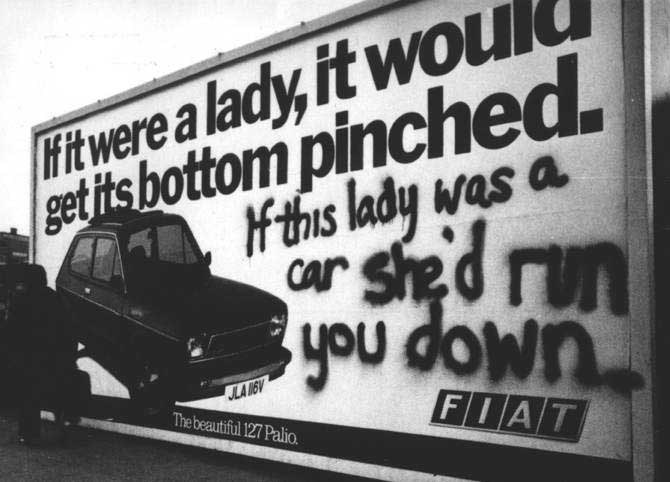
The sheer brilliance of wit instantly subverts the Palio ad, and turns it into a promotion of her/his values - at Fiat's cost - truly "jujitsu" at its most elegant and effective.
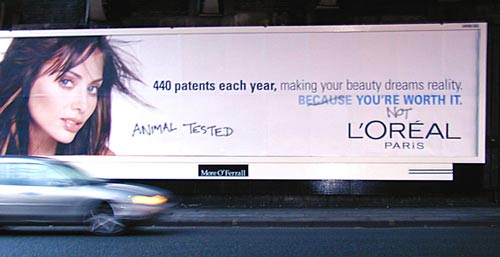
Graffiti, usually added covertly by a 'hacktivist' using a paint spray can in a 'hit-and-run' operation, was the earliest mode of reactive advertising. Its first 'victims' were ads that were in outright bad taste (such as the Palio ad above) or that glamourised products or behaviours known to be harmful to people, or that
commodified women and made feel inadequate about their bodies.
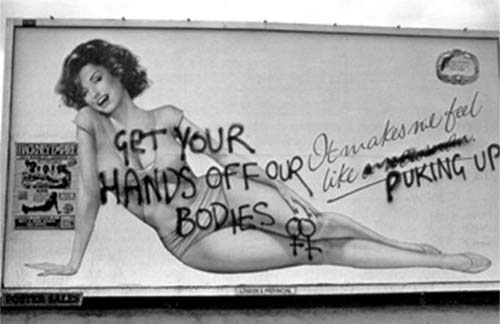
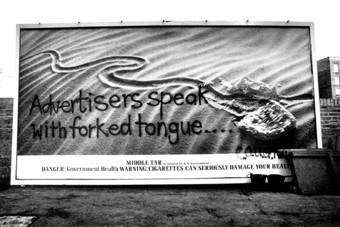
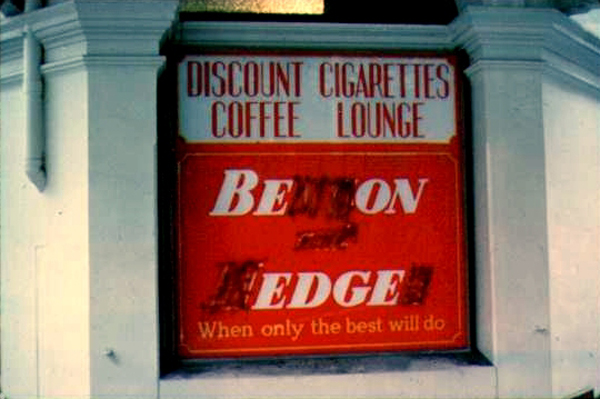
Soon, they began to target specific brands and corporations that were known to follow unethical practices whilst enjoying a glamourous image and cult branding.
The incredible effectiveness and simplicity of graffiti-subverted advertising soon led to slightly more elaborate forms of subversion, which made it harder to distinguish the 'vandalised' portion from the original. This Orange spoof mimics the look and feel of the original, whilst substituting the standard copy with one that bluntly proclaims "Brain Cancer":

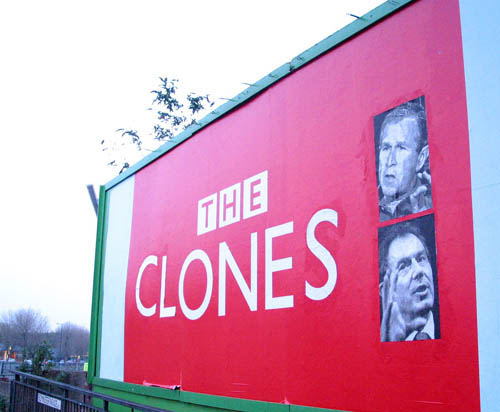
This elegant subversion merely added the letters CL and S around the original title "ONE" - and further underlined its message with the pictures of George Bush and Tony Blair.
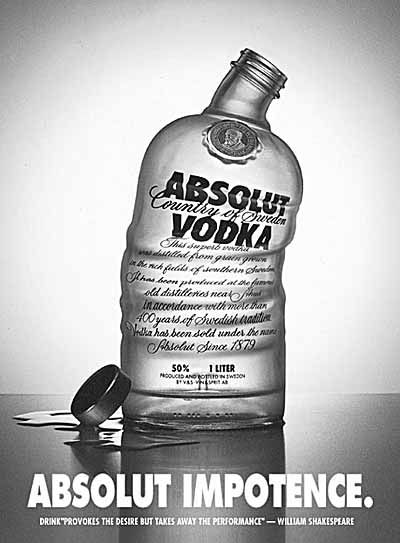
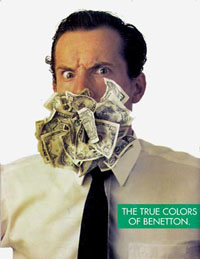
From spraying graffiti and modifying existing ads on billboards, activists began publishing their own reactive ads in popular magazines, produced with the same degree of sophistication and slickness, like these:
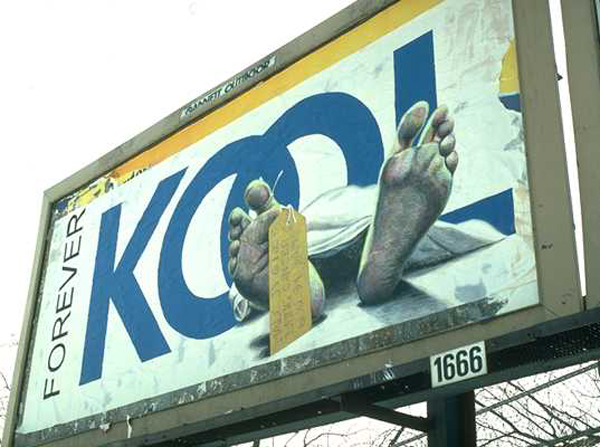
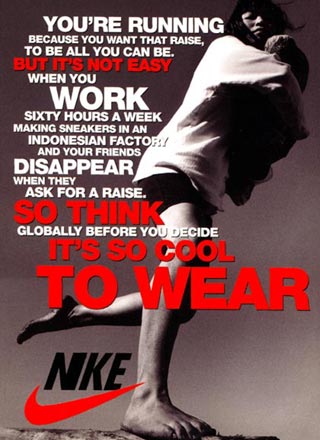
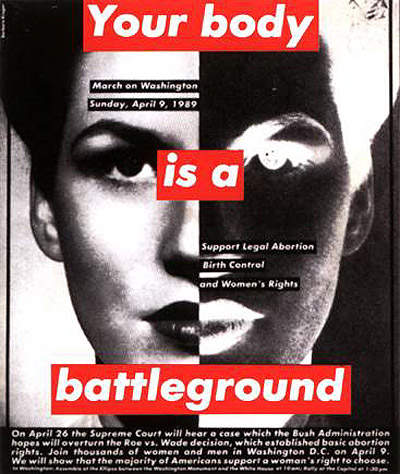
This new form of aesthetic has also inspired many contemporary artists, who use its imagery and techniques for purely formal purposes or even to express their personal politics. An example of the latter kind of artist is Barbara Kruger, whose work refers to 'tabloid' aesthetics, as exemplified in this poster artwork:
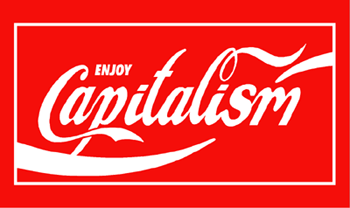
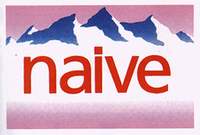
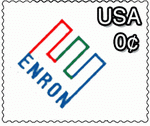
Perhaps inspired by 'No Logo', a number of activists have started targeting logos specifically, besides subverting advertisements. Again, their targets are giant multinational corporations that use questionable methods in 'distant' places in order to fuel consumerism in their main markets:

Sometimes, it may seem as if the subversion is inspired purely from the gaping opportunity afforded by some logos or ads…! This 'alternative' logo, however, was part of a serious protest against what was perceived as Intel's monopolistic business practices:

With the advent of the internet as a unique 'mass medium' where any individual can publish, this movement got a tremendous surge of creativity. Today, there are thousands of websites where all kinds of people are expressing their protest and creativity with their own 'takes' on entities they object to, as well as replicate others' works - thus spreading the 'contagion' in a 'viral' manner.
This is not strictly a logo, but a graphic cartoon that uses one, to make a powerful political comment:
Finally, reactive advertising is also beginning to disguise itself very well, that it's only on a closer look that you can actually see the subversion at work:
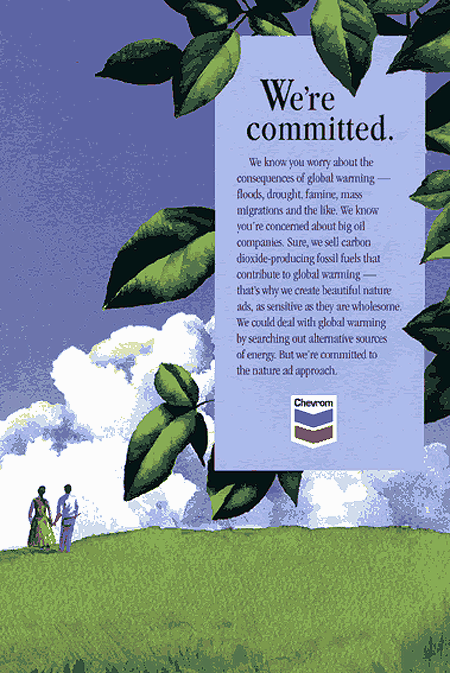


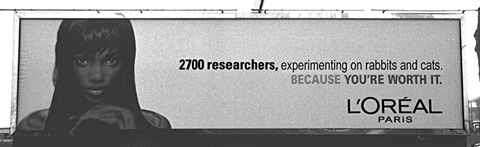
And it's no longer confined to print or billboard advertising. It's soon coming to a shelf near you…

Or in your favourite mall…
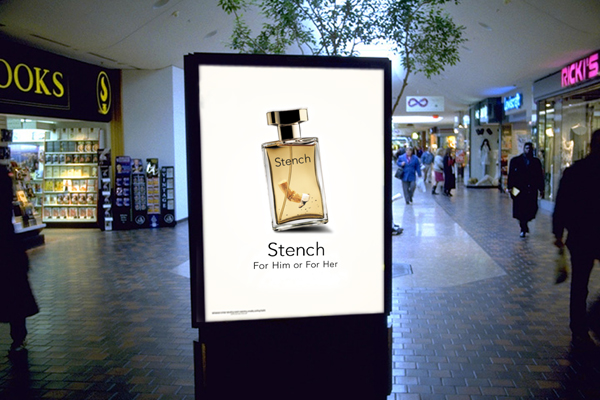
Or even in the streets…

Interestingly, the notable Sprite TVC campaign that mocked the exaggerated claims of all advertising in general and their rivals in particular (referred to as "bakwaas" - our equivalent to "bullshit"), was perhaps the first instance of a critical parody - though its effect was considerably diluted by virtue of plugging their own product (of dubious merit) in the stereotyped format.
For years, serious artists and activists tended to regard advertising or commercial art as an illegitimate and impure pariah. However, in the last decade, they have begun to accept and adopt the rich creativity and diversity of this form, and are using it to create meaningful messages that are actually reaching out to wider audiences.
The historical divide between fine art and commercial or applied art education in art/design school is slowly but inexorably getting blurred, in part also thanks to the trend towards new media, events and installations in contemporary art. At Srishti, where I teach, the earliest breakthrough came in 2002, when faculty and students conceived the theme exhibit for an international conference on technological innovation for social development, hosted by Infosys at their state-of-the-art convention facility. Their exhibit comprised an 8-foot papîer-maché globe representing the Earth, and a giant tap attached to it that slowly trickled away water, accompanied by appropriate dripping sounds.
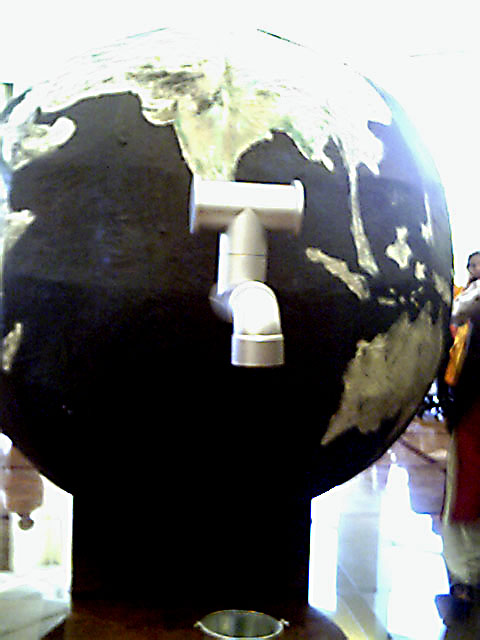
Surrounding it were eight panels, each showing what seemed to be blow-ups of typical corporate advertisements. In fact, many delegates at first assumed they were sponsor panels. The 'spoof ads' became very popular with the participants, who had come from over a dozen countries from five continents. The post-card versions of the ads were soon all distributed, and more had to be printed to cope with the demand. Evidently, a chord had been struck that cut across disciplinary histories and cultural geographies, and the much-maligned 'global' aesthetic of advertising had actually succeeded in appealing to a global audience, and deliver a pithy critique of globalisation. What was fascinating is that the elusive 'viral' quality that turns some ads and brands into cults is being far more effectively invoked in 'anti-advertising' - perhaps because of its intrinsically subversive and mischievous characteristic. This is strongly reminiscent of Italian scholar Umberto Eco's idea of "semiological guerilla warfare" in his book 'Travels in Hyperreality'. The gist of his argument was that traditionally, if you wanted to seize power in a country, you had to control the army and police. Today, a country belongs to the person (or group) that controls communication. Reactive advertising succeeds in inverting or distorting the meaning created via typical devices of advertising design by inserting a clever "twist".
For years, artists and activists alike have felt frustrated by the seeming hegemony of unbridled consumerism and rampant unsustainability, and their relative impotence in countering the relentless deluge of corporate spin, propaganda and PR. Now, they have discovered the "jujitsu" potential of reactive advertising and are finding that socially responsible corporates are quite open to supporting this form of art - a win/win combination of strategic visibility and responsible messaging, presented in a humourous, attractive and engaging way that is familiar to most consumers.
The last exhibit for this piece is an elaborate fictitious 'campaign' devised by Srishti student Ekta Manchanda as her final thesis project in Communication Design. Seeking to counter the unrelenting media imagery that extols slimness (to the point of anorexia) and 'the perfect figure' as the generic ideal for all women, her project involved creation of an 'anti-brand' called 'Fuss', and a multi-touch campaign covering advertising, packaging, outdoors and other formats. Her work was featured at the prestigious 2004 Design Biennale at St.Étienne in France.
Finally, apologies for my rather sensational title. Advertisers have no reason to fear reactive advertising so far (these days, their worst enemy is PR!), but if it succeeds in capturing the public imagination as it appears to be doing, they will be forced to find new ways of conveying credibility and meaning.
Arvind Lodaya, 2004
Any material on this website may not be used for non-academic purposes without my explicit permission.