 Eastern Edge
"Aikido has made me a better cop", claims Sgt. William Verna. "Being a cop is a learning experience; you never seem to master the profession, just like I'm not a complete aikido student. But I'm on the right path." Short and wiry, Verna is a frenetic 28-year-old native New Yorker. He lives as though life won't allow enough time for all he wants to cram into it, and for him perhaps it doesn't.
Verna, along with four other police officers, have adapted the principles of aikido into the framework of their police work. Just recently, the five of them purchased a century-old, one-story building to use as their training center. Remodeled with natural cypress siding and Japanese garden, the inside is furnished with lattice ceilings, original Japanese block prints dating as far as 1735, and other elements of Far Eastern decor...hardly the traditional police training academy.
The atmosphere is warmly aesthetic and upon walking in one is overcome by a sense of serenity and antiquity. "Traditional Japanese architecture is said to 'integrate man and nature,'" explains Verna. "When I practice in these surroundings, I become one with myself and a general harmony pervades me and my opponent. There is no duality between him and I, it is us - a unity that makes it simply impossible for my opponent to defeat me for he and I are one."
This tranquility and philosophy sharply contrasts conventional police hand-to-hand combat techniques. An attacker is not subdued buy rather placed in harmony with himself and controlled to prevent him from harming others. Verna and his associates approach their day-to-day police work with an almost religious reverence and because of this they do not receive official attention. Though the aikido program continues without their department's, endorsement, they do not let this deter them from their cause.
"I don't expect the department to simply jump into aikido head first," explains Sam Kercher, an aikido black belt and traffic officer. "It's not something that everyone can adapt to, especially on a department-wide basis. Aikido is almost a religious fighting art - not that it is a religion mind you - but it stresses a philosophy of brotherhood, in that everyone is to be respected whether they are attacking me or not. It is our job as police officers to stop and control crime in a peaceful manner."
Verna and his followers first became interested in aikido when they met instructor George Tamura. They watched a demonstration where Tamura set down half-a-dozen attackers at one time without harming them but still controlling them. "We were looking for some exercise," says Verna, "and we thought that aikido would help us stay in shape and teach us some self-defense at the same time. We weren't interested in karate or judo, since we felt that they could cause severe damage to the opponent, and the aikido seemed like it would help me to better my performance while on duty. Since I began training I'm better able to take criticism and control myself in tense situations without loosing my cool."
Verna rejects the approach many of his contemporaries use when confronted with a one-on-one situation. Too many reach for their gun, tell the attacker to desist and, if he doesn't, won't hesitate to blow him away.
"This is wrong," says Verna. "Attacker or not, that person isn't a hunk of meat. Don't get me wrong. I'm no martyr. If a person is using deadly force, I will retaliate with deadly force. But all too often an officer mistakes an attacker's intention because the individual officer does not have enough confidence in himself to handle encounters without his sidearm. Through aikido I've learned to dissipate any fear in me; bring my ki (inner power) in harmony with my attacker's ki and ultimately subdue him without permanent harm. If this sounds like a bunch of bull, be advised that there are dozens of official police records on file validating my claims."
|
|
|
|
|
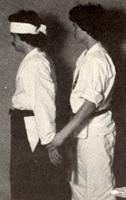
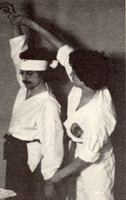
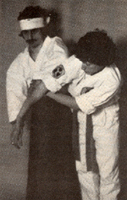
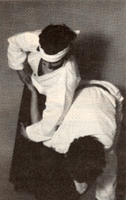
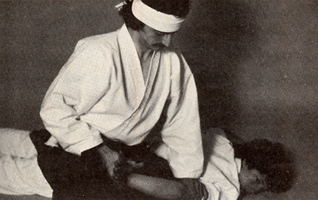
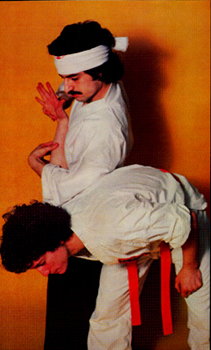
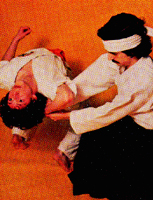
| (Sequence) Victim (officer) is accosted by assailant. Using the force of the attack, he ducks beneath assailants arm and takes advantage. | ||||
Aikido, which translates from Japanese to English as "The Way of Spiritual Harmony" was founded by Master Ueshiba during the middle of this century. Like many martial arts, aikido strives to overcome an opponent with very little physical effort. This is accomplished with a combination of relaxation and controlling of one’s ki or inner energy. When the student lets go of his own strength he can yield to his opponent's, making the opponent in essence defeat himself.
Aikido stresses that a student must remain relaxed even when applying techniques. With this in mind, one can see that aikido techniques can be performed by anyone regardless of size.
Since the application of aikido techniques does not require strength, they are not difficult to learn. Ueshiba, when creating aikido, wanted techniques that could be applied with natural movements. A natural movement is instinctive and requires no special training to develop.
Aikido prides itself in its ability to control an attacker without doing him harm. In fact, aikido expounds the theory that it is a mark of refinement to control an assailant without injury to him. Verna explains: "Aikido techniques are specifically designed to enable refined humanitarians to defend without injury. Aikido techniques are designed to only discourage or capture assailants or offenders. To the police community this is essential. No more cries of brutality, no more excessive injury law suits. Sure, deadly force for deadly force, but peaceful control for simple non-deadly attacks."
 Like any system of hand-tohand combat, there are a handful of techniques or fundamental principles that make up the system. Important to aikido are ma-ai, ai, and ki.
M-ai, or distance, is necessary to accomplish the proper timing required to control an opponent. When combined with taisabaki, or body movement, the aikido master is able to overcome any type of attack.
Ai, or harmony, is essential to use your opponent's strength against himself. Mastery of ai includes knowledge of balance which is vital in aikido throwing techniques.
Ki, or vital energy, makes up the foundation of aikido philosophy. Looked at by some as a psycho-physical power, ki adds an almost super-strength to aikido techniques - sort of like the turning on and off of adrenalin.
All of these fundamentals lay down the foundation for various controlling techniques which involve wrist and arm locks, holds, throws, and when necessary, striking and kicking techniques. However, all of these techniques are governed by the proper state of mind. In Verna's style of aikido, these states are referred to as mizu no kokoro ("mind like water") and tsuki no kokoro ("mind like moon").
"In both mizu no kokoro and tsuki no kororo you are dealing with esoteric principles very much in kin with Zen Buddhism'" explains Verna. "In mizu you are taught that when facing a suspect or attempting anything dangerous - like a high speed chase - the mind must remain calm like the surface of an undisturbed pool of water that reflects everything around it clearly and precisely. However, if something enters the water, like disturbing thoughts entering the mind, the water can no accurately reflect what is around it. When this happens in the mind, actions become disjointed"
"In tsuki," continues Verna, "you are taught that when facing a suspect you must at all times be aware of the totality of the task. You must understand the aims and objectives of both yourself and your oppenent. As the moon shines equally on everything, so must you see."
Although aikido is just now coming to the attention of a handful of American police, in Japan aikido's benefits have long been known. Especially for women!
Tokyo police have always recognized the value of extensive martial arts training. Official training tactics include judo, kendo (Japanese swordsmanship) and for the past seven years female officers have been formally trained in aikido.
The program, although small at first, caught on almost immediately. Today the women train regularly in a wing of the department's headquarters under Kyoichi Inouye, a chief aikido instructor for the MPD (Metropolitan Police). Inouye, an aikido instructor with over 20-years of experience, first introduced aikido to the police's riot division. Seeing the value of aikido's gentleness, MPD was quick to institute a formal schedule of instruction.
Aikido, according to Inouye, is an ideal method of self-defense for policewomen to practice. "We know," he explains, "that women are different from men both physically and mentally. Considering these and other important factors, it was believed that aikido was ideally suited to women officers. The constant practice of aikido techniques tends to develop a quick mind along with a supple body, both of which are very important in police work today."
Not surprisingly, the program has met with substantial success among the women. Shigeko Takeuch, an officer with the traffic division, first studied kendo and judo at the police academy, then switched to aikido and is now a black belt. "I have found that aikido has helped me both spiritually and mentally," she explains. "I believe that it has enabled me to face my official tasks and personal responsibilities with confidence."
It has helped in other ways too. "Like the men," she explains, "we must work different duty hours. Once, when it was quite late, I was on my way home from work. By chance, I was accosted by a drunk. Without thinking, I utilized my knowledge of aikido. I did not want to injure the harmless drunk, by merly discourage him. The upshot of the whole affair was that he gave up and staggered away rubbing his painful arm."
Actually, few policewomen have been forced to use aikido tactics in job-related situations. Kakuko Takahashi, who's currently connected with the department's foreign division and is herself an aikido black belt, told Black Belt Magazine (March, 1975): "I believe aikido has given me a sense of confidence in dealing with and understanding people. Since it has no form of competition, you concentrate continually on technique. This leads to perfection of mind and body and ultimately to one's spirit."
Toshiko Taikara, an MPD policewoman, took up several martial arts but gave them up to concentrate on aikido. "It's more suited to the female's structure and strength than, say, judo or karate," she says. "What I mean is I find it to my personal liking. All the arts taught through the MPD have good points, but aikido has taught me to have a clear mind, especially when I'm on duty."
The overwhelming acceptance of aikido by the Tokyo Police and the religious reverence given the art by American police officers like Verna, suggests a need for a practical effective means of non-violent fighting for non-violent situations. "I believe that someday aikido will become synonymous with police training," says Verna. "But this will only come about when police officers will admit to their lack of non-violent combat knowledge and accept the fact that something new can also be something good."