
SRI VEERA ANJANEYAR TEMPLE, BHAWA SWAMI AGRAHARAM, THIRUVIYARU, T NADU
gk kaushik
Thiruviyaru
Thiruviyaru kshethra got its name because there are five rivers namely Kaveri, Kudamuruti, Vennaru, Vettaru, Vadavaru are flowing through this place. Iy means five and aarru means river in Tamil, hence the name Thiruviyaru. This place is very popular among the lovers of carnatic music since it is in this kshethra the Saint Thyagaraja spent most of time and obtained moksha. Saint Thyagaraja is devoted to Lord Rama and many of his composition are in praise of Lord Rama, and it said that he had been graced by the dharshan of the Lord himself. Every year on the Bagula Panchami day the saint's aradhana day is observed, and the entire leading musician finds it a privilege to participate in the function and sing the Pancharathna kriti in front of the samathi of this great saint. It is almost a pilgrimage to all the music lovers to this place during this time.
Thiruviyaru is thirteen kilometers north of Thanjavur, and 33 kilometers west of Kumbakonam and can be reached by bus or car.
Iyyarappan temple
The main temple of this kshethra is that of Lord Siva presiding over as Iyyarappan (Tamil name) or Panchanathiswar (Sanskrit name) and the Sakthi is known by the name Dharmasamvarthini. The temple built during Cholas period is very huge. There are many Nayanmargals who had sung in praise of this Lord. Lord is Swayambhu and is of mud, hence there is no abishekam for the Lord. From the southwest corner of the third prakaram if you spell 'Iyaara' you will be astonish to hear the same echoing seven times.
Uniqueness of Dharmasamvarthini temple
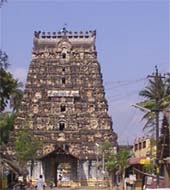 As in the case of other Siva temples the sannathi for the Ambal is not in the same compound. Ambal of this kshethra is Dharmasamvarthini and Her sannathi is in a separate compound abetting the main temple hence known as Dharmasamvarthini temple. Another unique point to note is that while in all the Siva temple the Ambal is seen facing Southwards here in this kshethra she seen facing eastwards.
From these uniqueness of the present Dharmasamvarthini (Dharmambal) temple and the difference in the construction style and the materials used with that of the Iyearrapan temple it is said that Dharmasamvarthini Sannathi was shifted to the present place. Godess Dharmambal is worshiped as a Vishnu amsa since she holds changu and chakram and on her upper two hands.
Sri Rama Temple
It is said that Sri Rama temple was in existence at this place where present Dharmasamvarthini temple is in existence. Small temple for Sri Anjaneya facing the Lord, in the middle of the Agraharam opposite to this temple is the testimony for this claim. When Thanjavur was under the Maratha rule, then queen by name Mohanambal feel in love at the striking beauty of the Sri Rama and his parivara, of this Sri Rama temple. She decided to shift this temple to the new town on the southern bank of Kaveri named after her as 'Panchanatha mohanambal puram'.
Pratapah Simhan and Tulaja II
Thanjavur was under the rule of Maratha king Sri Pratapah Simha during the period 1739-1763, subsequently by his son Sri Tulaja II. The capital town of Thajavur was expanding and Pratapah Simha had then taken up development of the town in a systematic way. During his regime he had built temples and chatrams (wayside rest houses). Sri Sethu Bhawa Swami was his Guru. He is instrumental in establishing the Moolai Anjaneyar temple in Thanjavur the capital town of Sri Pratapah Simha. It is said that Sri Sethu Bhawa Swami was living in Thiruviyaru, near Iyarappan temple. The street where the Guruji was staying had been named after him as "Bhawa Swami Agraharam". The street is opposite to the Dharmasamvarthini temple. Though it is not known for sure as to who had built the Sri Rama temple, but the Bhawa Swami Agraharam and the temple for Sri Veera Anjaneya even now exist.
Sri Veera Anjaneya Temple
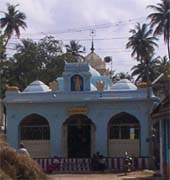 The Veera Anjaneya temple in the Bhawa Swami Agraharam is facing northwest direction, which is known as Vayu moolai and represented by wind God Vayu. Sri Anjaneya son of Vayu is seen welcoming His father. In front of the main sannathi there is a mandapam, which is known as navagraha mandapam. The arrangement of the mandapam is done in the same style as the case of positioning of navagrahas. Devotee can offer his prayer standing below the position of his rasiathipati. There is a bali peedam and a kodi maram (flag post) in front of the main sanctum sanatoriums. The kodi maram is covered and there is embossing of Sri Rama parivar and Sri Anjaneya on each of the sides. Unlike in other temples there are "naga" installed in all the three sides of the main temple known as gosta pirai. Another unusual feature is deer had been installed in the top corners of the temple as dikpalkas.
Sri Veera Anjaneya
The lord stands on a pedestal in the sanctum and could be seen from any corner of the navagraha mandapam. The idol had been brought from the banks of river Thungabhadra and is made out of a green stone. The lord here is seen giving Abhaya to the devotees through His right hand, while the left hand is seen resting on his left thigh and holding a arrow. His hip adores a small knife. His eyes are directly glancing the devotees and bestowing his ever-loving kadaksham on the devotee.
Experience:
Many devotees had benefited with job, child, and marriage by worshipping the lord. A visit to the temple and dharshan of the Lord is sure to bring peace of mind in our life.
CONTRIBUTE INFO
Information
In the "Notice Board" we intend to publish the appeal for contribution, by the old ancient Anjaneya temples for their renovation. The temple authorities or devotee of the Lord may give the full details for publication.
Your Town temple Festivals
In the "Notice Board" we intend to publish the details about the functions in ancient Anjaneya temples, like ashtabandhana maha samprokshanam, kumbabhishekam, laksharchanai, mandalabeshakam etc.. Also programme about the festivals like Rama Navami, Hanumath Jayanthi, car festival, vasanthosavam etc. The temple authorities or devotee of the Lord may give the full details for publication.