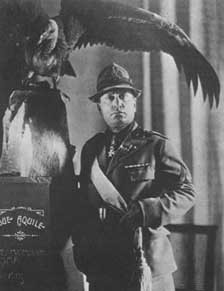
THE FOUNDER OF FASCISM: BENITO MUSSOLINI
Mussolini was a socialist before and during the first world war, but soon afterward the war he began to call for "national regeneration" -- through fire and destruction if need be. All loyal Italians, he argued, should subordinate their personal desires for the welfare of the state. All must work together, like a bundle of independent sticks tied together ("fasces" in Italian), for the good of the state. Only in this way, Mussolini claimed, could the problems of Italian society -- including the quest for overseas colonies and the frustrations of World War I -- be solved.
Fascism was a doctrine that appealed to human emotions and passions. It rejected the claims of the Enlightenment, which had largely directed the intellectual life of the nineteenth century, that the application of reason would lead to an increase in civilization. This focus on emotion naturally led charismatic leaders like Mussolini and Adolf Hitler to incorporate elements of theater into political life.
In this image, Mussolini poses heroically and dramatically in front of a bird of prey.
Do you think that the dramatic emotionalism of Fascism contributed to its acceptance on the part of many European peoples? Why would this be so?
(Click on the image of Mussolini to see Hitler at a mass rally.)
Source: BBC Hulton Picture Library