
| |
NANOPARTICLES - Internet of Everything | |
| Engineering precision nanoparticles for drug delivery (PDF) https://pmc.ncbi.nlm.nih.gov/articles/PMC7717100/pdf/41573_2020_Article_90.pdf Nanoparticles have been developed to overcome the limitations of freetherapeutics and navigate biological barriers — systemic, microenvironmental and cellular —that are heterogeneous across patient populations and diseases. nanoparticle development continuesto focus on optimizing delivery platforms with a one-size-fits-all solution. As lipid-based,polymeric and inorganic nanoparticles are engineered in increasingly specified ways, theycan begin to be optimized for drug delivery in a more personalized manner, entering the eraof precision medicine. We focus on advances in nanoparticle design that overcome heterogeneous barriersto delivery, arguing that intelligent nanoparticle design can improve efficacy in general deliveryapplications while enabling tailored designs for precision applications, thereby ultimatelyimproving patient outcome overall. 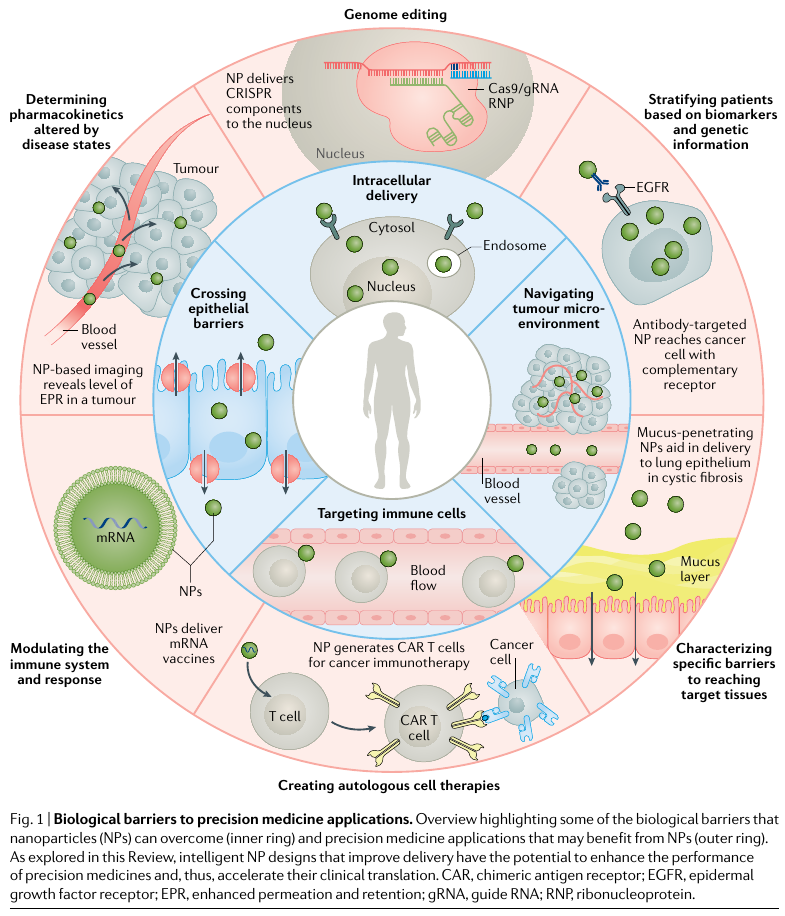
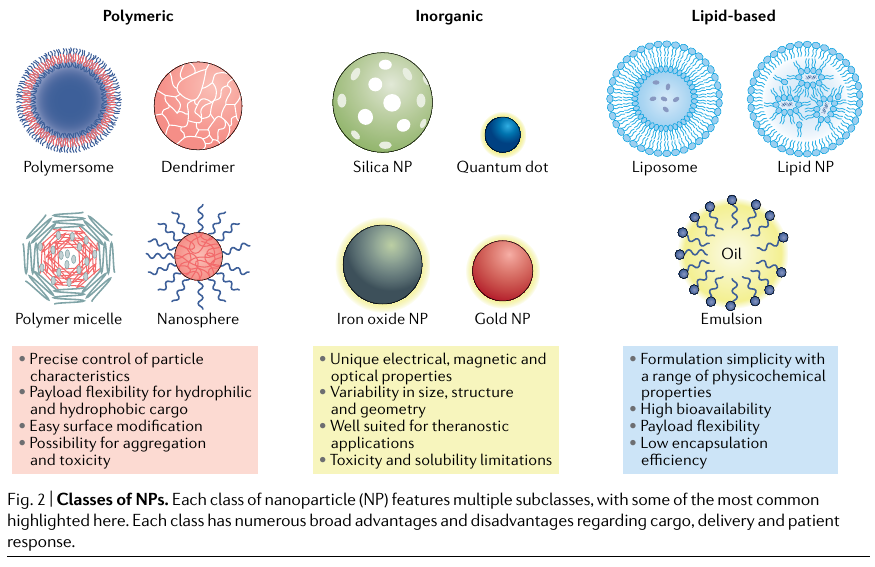
NP classes Lipid-based NPs Lipid-based NPs include various subset structures butare most typically spherical platforms comprising atleast one lipid bilayer surrounding at least one internalaqueous compartment (Fig. 2). As a delivery system,lipid-based NPs offer many advantages including for-mulation simplicity, self-assembly, biocompatibility, highbioavailability, ability to carry large payloads and a rangeof physicochemical properties that can be controlled tomodulate their biological characteristics14,15. For thesereasons, lipid-based NPs are the most common class ofFDA-approved nanomedicines. Liposomes — one of the subsets of lipid-basedNPs that has the most members — the NPs are typicallycomposed of phospholipids, which can form unilamellarand multilamellar vesicular structures. This allows theliposome to carry and deliver hydrophilic, hydrophobicand lipophilic drugs, and they can even entrap hydro-philic and lipophilic compounds in the same system,thereby expanding their use. Another notable subset of lipid-based NPs is commonly referred to as lipid nanoparticles (LNPs) —liposome-like structures widely used for the deliveryof nucleic acids. They differ from traditional liposomesprimarily because they form micellar structures withinthe particle core, a morphology that can be altered basedon formulation and synthesis parameters. LNPs are typically composed of four major components: cationicor ionizable lipids that complex with negatively chargedgenetic material and aid endosomal escape, phospho-lipids for particle structure, cholesterol for stability andmembrane fusion, and PEGylated lipids to improve sta-bility and circulation. Polymeric NPs Polymeric NPs can be synthesized from natural or syn-thetic materials, as well as monomers or preformedpolymers — allowing for a wide variety of possiblestructures and characteristics (Fig. 2). They can be for-mulated to enable precise control of multiple NP featuresand are generally good delivery vehicles because they are biocompatible and have simple formulation parameters. Polymeric NPs also have variable drug deliv-ery capabilities. Therapeutics can be encapsulatedwithin the NP core, entrapped in the polymer matrix,chemically conjugated to the polymer or bound to theNP surface. This enables delivery of various payloadsincluding hydrophobic and hydrophilic compounds,as well as cargos with different molecular weightssuch as small molecules, biological macromolecules,proteins and vaccines30–35, making polymeric NPs idealfor co-delivery applications. The most common forms of polymeric NPs arenanocapsules (cavities surrounded by a polymeric mem-brane or shell) and nanospheres (solid matrix systems). Dendrimers Dendrimers are hyperbranched polymers with com-plex three-dimensional architectures for which the mass,size, shape and surface chemistry can be highly con-trolled. Inorganic NPs Inorganic materials such as gold, iron and silica havebeen used to synthesize nanostructured materials for various drug delivery and imaging applications (Fig. 2). These inorganic NPs are precisely formulated and canbe engineered to have a wide variety of sizes, struc-tures and geometries. Gold NPs (AuNPs), which arethe most well studied, are used in various forms suchas nanospheres, nanorods, nanostars, nanoshells and nanocages. Additionally, inorganic NPs have unique physical, electrical, magnetic and optical properties, due to the properties of the base material itself. For example, AuNPs possess free electrons at their surface that contin-ually oscillate at a frequency dependent on their size andshape, giving them photothermal properties. AuNPs are also easily functionalized, granting them additional properties and delivery capabilities. Due to their magnetic, radioactive or plasmonicproperties, inorganic NPs are uniquely qualified forapplications such as diagnostics, imaging and photo-thermal therapies. Quantum Dots Quantum dots are typically made of semiconducting materials such as silicon — are unique NPs used primarily in in vitro imaging applications, but they show promise for in vivo diagnostics. 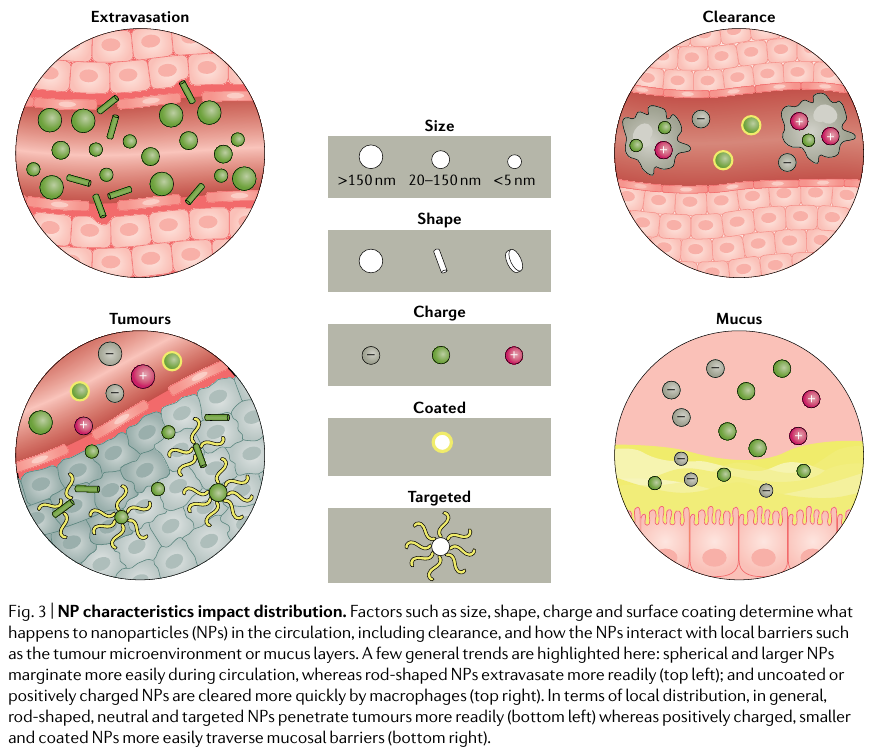
Quantum Dots and Multifunctional Nanoparticles: New Contrast Agents for Tumor Imaging (PDF) https://www.researchgate.net/publication/6124151_Quantum_dots_and_multifunctional_nanoparticles_New_contrast_agents_for_tumor_imaging
 |

