The 2000 Atlantic Hurricane Season
2000 Hurricane Season
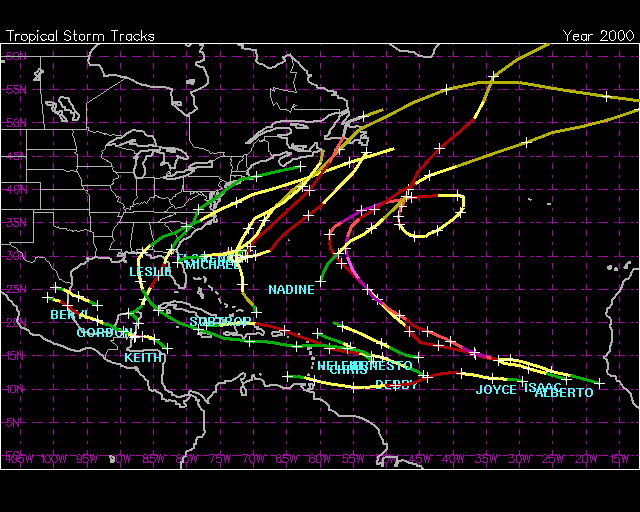
Choose a Storm:
Alberto was a long-lived Cape Verde hurricane that remained at sea through its lifetime. It is the longest-lived Atlantic tropical cyclone to form in August, and the third-longest-lived of record in the Atlantic. Alberto's track included intensifying into a hurricane three times, a large anticyclonic loop that took five days, and extratropical transition near 53�N.
Beryl was a weak tropical storm that moved over the southwest Gulf of Mexico and across the northeast coast of Mexico, and eventually dissipated inland over the mountains of northern Mexico.
Chris was a short-lived tropical storm which was quickly torn apart by strong vertical wind-shear.
Debby struck the islands of the northeast Caribbean as a 65-knot hurricane, but the impact was not very significant. It appeared that Debby was going to be a significant threat to south Florida, but the system dissipated rather unexpectedly.
Tropical Storm Ernesto (35 kts)
Ernesto was a minimal tropical storm that moved across the tropical Atlantic Ocean for a few days without affecting land.
Hurricane Florence (70 kts)
Hurricane Florence was a category one hurricane (on the Saffir-Simpson Hurricane Scale) of subtropical origins that passed within about 65 n mi of Bermuda.
Gordon became a category one hurricane on the Saffir-Simpson Hurricane Scale over the eastern Gulf of Mexico, but eventually made landfall in the Florida Big Bend area as a weakening tropical storm.
Tropical Storm Helene (60 kts)
Helene made landfall as a minimal tropical storm near Fort Walton Beach, Florida and redeveloped into a strong tropical storm over the North Atlantic.
Hurricane Isaac (120 kts)
Isaac was a Cape Verde hurricane that followed a long, parabolic path over the eastern half of the Atlantic. Its maximum sustained winds reached an estimated 120 kt, tying it with Keith for the strongest hurricane of the season.
Hurricane Joyce (80 kts)
Joyce was an 80-knot hurricane east of the Windward Islands, but was weakening from a tropical storm to a depression when it passed through the Windward Islands.
Hurricane Keith (120 kts)
Keith was a rapidly-intensifying tropical cyclone over the northwestern Caribbean Sea, reaching Category 4 on the Saffir-Simpson Hurricane Scale as it stalled just off the coast of Belize. Keith affected the coastal islands of Belize as a Category 3 hurricane, but weakened to a tropical storm before actually making landfall in mainland Belize. After weakening to a tropical depression while crossing the Yucatan Peninsula, Keith re-intensified over the southwestern Gulf of Mexico and made landfall in northeastern Mexico as a Category 1 hurricane.
Tropical Storm Leslie (60 kts)
Leslie was a short-lived tropical storm that developed from Subtropical Depression One off the east coast of Florida, and subsequently moved northeastward over the western Atlantic. Although neither Leslie nor the subtropical depression was responsible for any damage or casualties, a precursor disturbance combined with a stalled frontal boundary to produce very heavy rainfall, and flood damage estimated at $700 million in southeast Florida on 2-3 October. Three deaths in south Florida were indirectly attributable to the flooding.
Hurricane Michael (85 kts)
Michael was a short-lived category two hurricane (on the Saffir-Simpson Hurricane Scale) that developed from subtropical origins off the northeast coast of Florida. Michael moved northeastward over the western and northern Atlantic as a tropical cyclone and eventually crossed Newfoundland as a strong extratropical low pressure system.
Tropical Storm Nadine (50 kts)

Go back to the Hurricane Page
Go back to the Weather Page
Go back to Page 1