




History of LED:
In the early 1900s a process, later to be called electroluminescence, was discovered when a researcher noticed how applying a current to a specific type of crystal diode created a faint light, and the material was not heating up.This phenomenon sat idle until it was applied to the creation of the first LED lights in the 1950s. At that time they were called semiconductor radiant diodes. From there, over the next 60 years, scientists and engineers have learned to harness this light and we've arrived at the LED lighting technology of today.
What is LED?
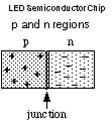
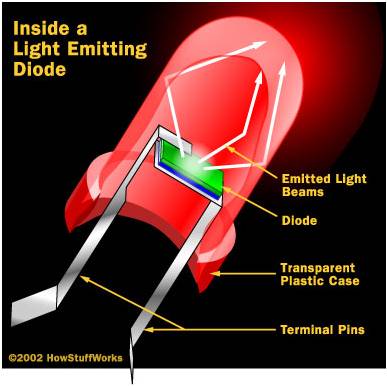
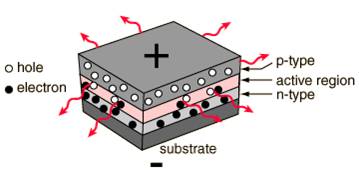
Basically LEDs, or light-emitting diodes,are small semiconductor chips that produce visible light when an electrical current is passed through them. LEDs are a type of Solid State Lighting (SSL), They are made of two layers, each treated with different materials to give each their own property. One layer contains a lot of high-energy electrons that it wants to give away, this is called the n-type layer. The other layer has spaces for these electrons that it really wants to fill at a lower energy level, this is the p-type layer. The combination of these two layers creates what is called a pn-junction. These two layers form a diode, from the Greek di (two) and ode (way, or path).
How do LEDs work?
To the electrons, this junction creates a waterfall like effect: they can flow one way but can't go back up the other way. When the negative end of a circuit is applied to the n-type layer, the electrons flow between the two layers easily. If you apply the negative end of the circuit to the p-type layer the flow is blocked. So, like a waterfall the flow can only travel one way and not another.Unlike a waterfall, which creates noise, the electrons flowing across the pn-junction of an LED release light. As the electrons flow from the n-layer to the p-layer the energy levels of the electrons falls. This creates the release of energy in the form of photons, which we see as light.
All light is made of photons, which are tiny particles of light that are too small to see individually.How much light this creates depends on the difference of the energy levels of the two layers. This is called the band gap. By learning to control the band gap engineers figured out new ways to make LEDs and create light across the spectrum.
What is the Result?
The result is we've now moved to an extremely energy efficient method of producing light. Now, we have LEDs that consume less than 20% of the energy of traditional incandescent and halogen bulbs. Because there is no heated filament or unusual gasses required, these LED lights last far longer. LEDs do break down over time, but this takes a very long time. We're now seeing commercial LED luminaries with 50,000 hours and even 100000 hours life expectancies.
How is LED lighting different than other light sources?
LED lighting differs from incandescent and compact fluorescent lighting in several ways. When designed well, LED lighting can be more efficient, durable, versatile and longer lasting.
How much light?
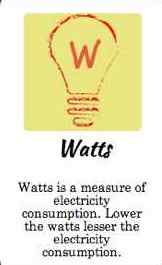
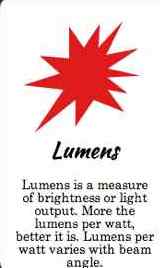
Light is measured in lumens, but this is too complicated to work out every time you buy a bulb. So as rough guide, if you want the equivalent of an 'old school' 100w light bulb, go for 10w, 60w – 6w, 40w – 4w. The mathematicians among you will spot a rough 10% rule.
Light Output/ Lumens
Measures light output. The higher the number, the more light is emitted. Reported as "Total Integrated Flux (Lumens)" on LM-79 test report
Which colour?
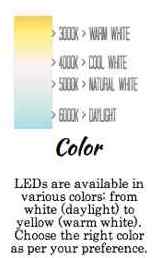
Light temperature (colour) is measured in Kelvin (K). The lower the number, the warmer the light. Warm light, 2700K – it's like the light from an old-fashioned bulb. 3000K is less warm, and then as you go up the light becomes cooler and whiter – anything approaching 5000k will be nearly blue. Sometimes these are called 'warm white' or 'cool white'. So, depending on your preference, check the packet to make sure have the right colour for you.
Common LED colors include amber, red, green, and blue. There is actually no such thing as a "white" LED. To get white light the kind we use for lighting our homes and offices, different color LEDs are mixed or covered with a phosphor material that converts the color of the light.The phosphor is the yellow material you can see on some LED products. Colored LEDs are widely used as signal lights and indicator lights, like the power button on a computer.
Color of the lamp
Color of the lamp : Is specified by the CCT Values in Degree Kelvin.
2700-3000K Warm White
3500-4000K Neutral White
4500-5500K Cool White
LEDs are now being incorporated into bulbs and fixtures for general lighting applications. LEDs are small and provide unique design opportunities.Some LED bulb solutions may look like familiar light bulbs and some may not but can better match the performance of traditional light bulbs. Some LED light fixtures may have LEDs built–in as a permanent light source.
Benefits of LED Lighting:
LED Lighting Systems provide significant savings, typically the energy reduction on a lighting circuit can exceed 50%.It has an average life span of 50,000 hours with minimal Lumen Depreciation, this means the output of the LED does not deteriorate with time. Therefore giving a maintenance free lighting system and heavily reduced maintenance and re-lamping costs.
LED Lighting provides instant full output light, unlike fluorescent and Discharge lighting that takes time to "warm" up to full light output. LED Technology is not susceptible to switching cycles and does not deteriorate when switched constantly.
The above two key points mean that the LED Lighting is the perfect technology to be used in conjunction with lighting controls
Why LED?
LED is Solid State Lamp (SSL) and Life is more. There is no hazardous substances like mercury and is environment friendly. It is made out of solid state and epoxy is used, which can not Break and Is most robust.
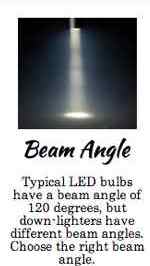
The Size occupied by the LED, source is small and lamp can be made LED Lamps are possible from automobile bulbs to High bay Lights There is no need of complicated Fitting design and reflectors are not required. The Led Efficiency is very high up to 120Lumen/Watt. Any color is possible with LED LLD- Lamp lumen depreciation time is very high compared to any Lamp and is 60000Hrs.The Directional property of the LED Light is excellent and unwanted light in unwanted direction is eliminated and this property saves Light to the tune of 40%. Combining the Efficiency and The Directional Light Property saves Huge amount of Energy than any other Light source. This compels to replace all other lamps with LED.