


Great Bear
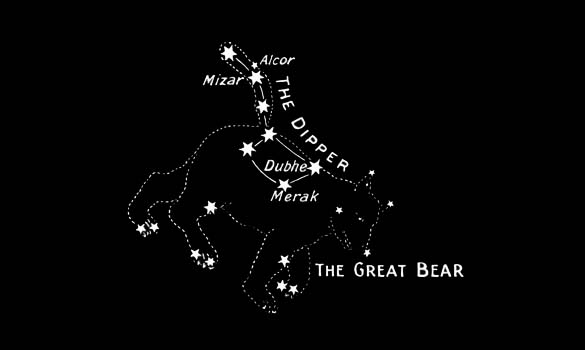
In Latin Ursa Major means “greater she-bear.” In Greek Arktos is the word for bear, hence the name Arctic, which means bearish and describes the far northern parts of the earth where the Great Bear constellation dominates the heavens even more than in the northern hemisphere. A very large constellation, Ursa Major is best known for its famous asterism or star grouping, the Big Dipper.
Ursa Major is highest in the sky in the spring and lowest in the autumn, when, according to Indian legends, the Bear is looking for a place to lie down for its winter hibernation. This constellation is a circumpolar constellation, which means it travels closely around the North Star; it is always above the horizon never rising or setting; it can be seen any time of the year, high or low in the sky.
In the spring the bowl is high above and inverted, pouring water upon the new flowers. In summer the bowl looks as if it is ready to scoop up some cool water with its handle above and its bowl below. In autumn the bowl is right-side-up, ready to catch the falling leaves. In winter the handle points down like an icicle.
To find the Great Bear in the Spring night sky, look high overhead and locate the Dipper first, then the three pairs of stars which form the Bear’s paws ... this works for the ancient or new way of viewing the Great Bear. The bowl of the Dipper is inverted as if pouring the contents.
Cassiopeia
Cassiopeia is a constellation in the northern sky, named after the vain queen Cassiopeia in Greek mythology, who boasted about her unrivalled beauty. Cassiopeia was one of the 48 constellations listed by the 2nd century Greek astronomer Ptolemy, and it remains one of the 88 modern constellations today. It is easily recognizable due to its distinctive 'W' shape, formed by five bright stars. It is bordered by Andromeda to the south, Perseus to the southeast, and Cepheus to the north. It is opposite the Big Dipper, and from northern latitudes can be seen at its clearest in early November.
Mythology
The constellation is named after Cassiopeia, the queen of Aethiopia. Cassiopeia was the wife of Cepheus, King of Aethiopia and mother of Princess Andromeda. Cepheus and Cassiopeia were placed next to each other among the stars, along with Andromeda. She was placed in the sky as a punishment for her boast that her daughter Andromeda was more beautiful than the Nereids or, alternatively, that she herself was more beautiful than the sea nymphs. As punishment, she was forced to wheel around the North Celestial Pole on her throne, spending half of her time clinging to it so she does not fall off, and Poseidon decreed that Andromeda should be bound to a rock as prey for the monster Cetus, who was ravishing the Ethiopian coast.
Great Dog
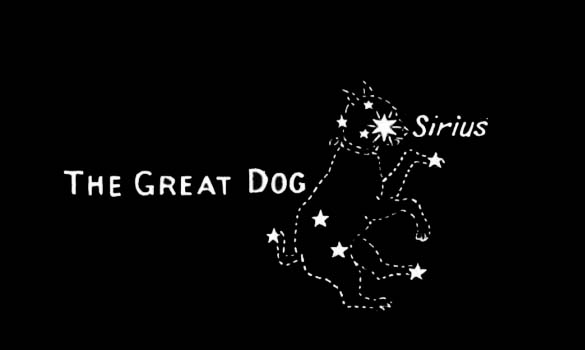
The brightest star in Canis Major also is the brightest in the entire night sky — brilliant Sirius, which is just 8.6 light-years away. That's only twice as far as our closest stellar neighbor. Because it is the brightest star of the Great Dog, Sirius is known as the Dog Star. Its first appearance in the dawn sky in August heralds the "dog days" of summer.
Sirius is actually a double star. The star that we see as Sirius is about 20 times brighter than the Sun. It is also hotter and more massive than the Sun. Its companion is known as Sirius B, and is nicknamed The Pup. It is a white dwarf -- the hot, dense core of a star that was once like Sirius itself. At the end of its life, the star blew its outer layers into space, leaving only the core. Sirius B is as massive as the Sun but less than one percent as bright. It shines simply because it's still hot.
Canis Major's second-brightest star is Adhara. It is well below Sirius, in one of the dog's legs. It is about 425 light-years away. It emits about a thousand times more visible light than Sirius does, so if it were moved to the same distance as Sirius, it would look about 200 times brighter than Sirius does. Because the surface of Adhara is extremely hot, the star emits more ultraviolet energy than visible light. If our eyes were tuned to the ultraviolet, Adhara would outshine every other star in the night sky.
One interesting sight in Canis Major is a star cluster known as M41, which is about 2,300 light-years away. It's visible to the unaided eye as a faint smudge of light below Sirius.
Little Bear
Ursa Minor means little bear in Latin, but this circumpolar constellation resembles a dipper more than a bear and is therefore commonly called the Little Dipper. It is much less conspicuous than the Big Dipper, but it contains the most important navigational star in our sky, Polaris, the Pole or North Star. From our perspective Polaris appears to remain in the same location, while all the other stars seem to rotate around it, as if it is the center of the universe. Since you will always see Polaris in the same northern location, whenever you look at it and extend your arms out to the side, the front of your body is facing north, and south is behind you; your extended right arm points east and your extended left arm points west. Give it a try! When you experience this, you can understand why the North Star has been of great navigational value down through the ages.
The celestial North Pole is the point where the imaginary polar axis of the earth would touch the sky, if it were extended. Polaris, for all practical purposes, is this celestial North Pole, being only one degree off this point. It is not the brightest of stars, nor was it or will it always be the star closest to the pole. Because of the earth’s wobble the celestial pole shifts as the centuries go by, and different stars become pole stars at different times.
Most of the Little Dipper’s stars are faint. Only the two at the end of the bowl are fairly bright. They are called Guardians of the Pole as they march around the pole like sentries. The brighter one of the pair, seen at the upper end of the bowl, was the Pole Star in the time of Plato.
Orion
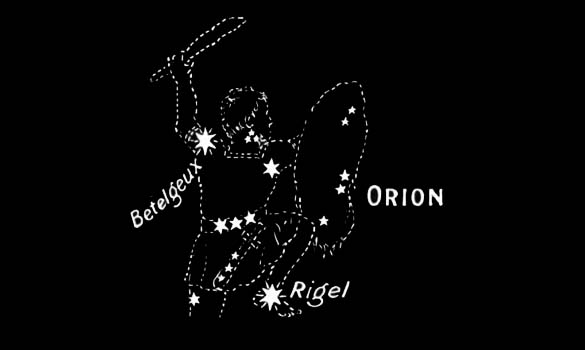
Orion is a prominent constellation located on the celestial equator and visible throughout the world. It is one of the most conspicuous and recognizable constellations in the night sky.[1] It was named after Orion, a hunter in Greek mythology. Its brightest stars are Rigel (Beta Orionis) and Betelgeuse (Alpha Orionis), a blue-white and a red supergiant respectively. Many of the other brighter stars in the constellation are hot, blue supergiant stars. The three stars in the middle of the constellation form an asterism known as Orion's belt. The Orion Nebula is located south of Orion's belt.
Orion's current name derives from Greek mythology, in which Orion was a gigantic, supernaturally strong hunter of ancient times, born to Euryale, a nymph, and Poseidon (Neptune), god of the sea in the Greco-Roman tradition. One myth recounts Gaia's rage at Orion, who dared to say that he would kill every animal on the planet. The angry goddess tried to dispatch Orion with a scorpion. This is given as the reason that the constellations of Scorpius and Orion are never in the sky at the same time. However, Ophiuchus, the Serpent Bearer, revived Orion with an antidote. This is said to be the reason that the constellation of Ophiuchus stands midway between the Scorpion and the Hunter in the sky.
The constellation is mentioned in Horace's Odes (Ode 3.27.18), Homer's Odyssey (Book 5, line 283) and Iliad, and Virgil's Aeneid (Book 1, line 535)