
Spectral Types
In astronomy, stellar classification is the classification of stars based on their spectral characteristics. Light from the star is analyzed by splitting it with a prism or diffraction grating into a spectrum exhibiting the rainbow of colours interspersed with absorption lines. Each line indicates an ion of a certain chemical element, with the line strength indicating the abundance of that ion. The relative abundance of the different ions varies with the temperature of the photosphere. The spectral class of a star is a short code summarising the ionization state, giving an objective measure of the photosphere's temperature and density.
Most stars are currently classified under the Morgan–Keenan (MKK) system using the letters O, B, A, F, G, K, and M, a sequence from hottest (O) to coolest (M). Useful mnemonics for remembering the spectral type letters are "Oh, Be A Fine Guy/Girl, Kiss Me" or "Oh Boy, An F Grade Kills Me". To also include the colder spectral classes L, T and Y, the first mnemonic can be extended to "Oh, Be A Fine Guy/Girl, Kiss Me Later Today, Yolo". Each letter class is then subdivided using a numeric digit with 0 being hottest and 9 being coolest (e.g. A8, A9, F0, F1 form a sequence from hotter to cooler).
In the MKK system a luminosity class is added to the spectral class using Roman numerals. This is based on the width of certain absorption lines in the star's spectrum which vary with the density of the atmosphere and so distinguish giant stars from dwarfs. Luminosity class I stars are supergiants, class III regular giants, and class V dwarfs or main-sequence stars, with II for bright giants, IV for sub-giants, and VI for sub-dwarfs. The full spectral class for the Sun is then G2V, indicating a main-sequence star with a temperature around 5,800K.
Class O |
||
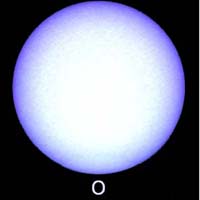
Class O stars are very hot and extremely luminous, with most of their radiated output in the ultraviolet range. These are the rarest of all main-sequence stars. About 1 in 3,000,000 (0.00003%) of the main-sequence stars in the solar neighborhood are class O stars. Some of the most massive stars lie within this spectral class. Class O stars frequently have complicated surroundings which make measurement of their spectra difficult. Spectrum of an O5 V star O stars have dominant lines of absorption and sometimes emission for He II lines, prominent ionized (Si IV, O III, N III, and C III) and |
neutral helium lines, strengthening from O5 to O9, and prominent hydrogen Balmer lines, although not as strong as in later types. Because they are so massive, class O stars have very hot cores and burn through their hydrogen fuel very quickly, so they are the first stars to leave the main sequence. When the MKK classification scheme was first described in 1943, the only subtypes of class O used were O5 to O9.5. The MKK scheme was extended to O9.7 in 1971 and O4 in 1978,[ and new classification schemes have subsequently been introduced which add types O2, O3 and O3.5 |
examples:
|
Class B |
||
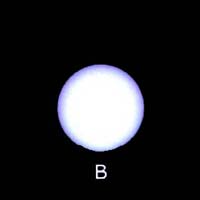
Class B stars are very luminous and blue. Their spectra have neutral helium, which are most prominent at the B2 subclass, and moderate hydrogen lines. Ionized metal lines include Mg II and Si II. As O and B stars are so powerful, they only live for a relatively short time, and thus they do not stray far from the area in which they were formed. These stars tend to be found in their originating OB associations, which are associated with giant molecular clouds. The Orion OB1 association occupies a large portion of a spiral arm of our galaxy and contains many of the brighter stars of the constellation Orion. |
About 1 in 800 (0.125%) of the main-sequence stars in the solar neighborhood are class B stars.[nb 1] Blue-white stars with surface temperatures of about 15000K. The ionized helium (HeII) lines of the O-type stars have disappeared and neutral helium (HeI) lines are strongest at B2. The neutral hydrogen (HI) lines are getting stronger and singly ionized OII, SiII and Mg II are visible. A significant rise of the blackbody spectrum toward the blue is still evident.
|
examples:
|
Class A |
||
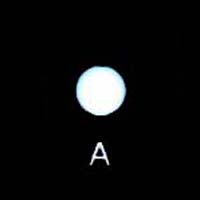
Class A stars are among the more common naked eye stars, and are white or bluish-white. They have strong hydrogen lines, at a maximum by A0, and also lines of ionized metals (Fe II, Mg II, Si II) at a maximum at A5. The presence of Ca II lines is notably strengthening by this point. About 1 in 160 (0.625%) of the main-sequence stars in the solar neighborhood are class A stars. Spectrum of an O5 V star O stars have dominant lines of absorption and sometimes emission for He II lines, prominent ionized (Si IV, O III, N III, and C III) and |
neutral helium lines, strengthening from O5 to O9, and prominent hydrogen Balmer lines, although not as strong as in later types. Because they are so massive, class O stars have very hot cores and burn through their hydrogen fuel very quickly, so they are the first stars to leave the main sequence. When the MKK classification scheme was first described in 1943, the only subtypes of class O used were O5 to O9.5. The MKK scheme was extended to O9.7 in 1971 and O4 in 1978,[ and new classification schemes have subsequently been introduced which add types O2, O3 and O3.5 |
examples:
|
Class F |
||
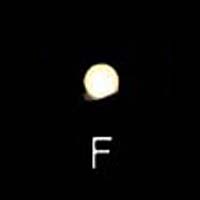
Class F stars are very hot and extremely luminous, with most of their radiated output in the ultraviolet range. These are the rarest of all main-sequence stars. About 1 in 3,000,000 (0.00003%) of the main-sequence stars in the solar neighborhood are class O stars. Some of the most massive stars lie within this spectral class. Class O stars frequently have complicated surroundings which make measurement of their spectra difficult. Spectrum of an O5 V star O stars have dominant lines of absorption and sometimes emission for He II lines, prominent ionized (Si IV, O III, N III, and C III) and |
neutral helium lines, strengthening from O5 to O9, and prominent hydrogen Balmer lines, although not as strong as in later types. Because they are so massive, class O stars have very hot cores and burn through their hydrogen fuel very quickly, so they are the first stars to leave the main sequence. When the MKK classification scheme was first described in 1943, the only subtypes of class O used were O5 to O9.5. The MKK scheme was extended to O9.7 in 1971 and O4 in 1978,[ and new classification schemes have subsequently been introduced which add types O2, O3 and O3.5 |
examples:
|
Class G |
||
Class G stars are very hot and extremely luminous, with most of their radiated output in the ultraviolet range. These are the rarest of all main-sequence stars. About 1 in 3,000,000 (0.00003%) of the main-sequence stars in the solar neighborhood are class O stars. Some of the most massive stars lie within this spectral class. Class O stars frequently have complicated surroundings which make measurement of their spectra difficult. Spectrum of an O5 V star O stars have dominant lines of absorption and sometimes emission for He II lines, prominent ionized (Si IV, O III, N III, and C III) and |
neutral helium lines, strengthening from O5 to O9, and prominent hydrogen Balmer lines, although not as strong as in later types. Because they are so massive, class O stars have very hot cores and burn through their hydrogen fuel very quickly, so they are the first stars to leave the main sequence. When the MKK classification scheme was first described in 1943, the only subtypes of class O used were O5 to O9.5. The MKK scheme was extended to O9.7 in 1971 and O4 in 1978,[ and new classification schemes have subsequently been introduced which add types O2, O3 and O3.5 |
examples:
|
Class K |
||
Class K stars are very hot and extremely luminous, with most of their radiated output in the ultraviolet range. These are the rarest of all main-sequence stars. About 1 in 3,000,000 (0.00003%) of the main-sequence stars in the solar neighborhood are class O stars. Some of the most massive stars lie within this spectral class. Class O stars frequently have complicated surroundings which make measurement of their spectra difficult. Spectrum of an O5 V star O stars have dominant lines of absorption and sometimes emission for He II lines, prominent ionized (Si IV, O III, N III, and C III) and |
neutral helium lines, strengthening from O5 to O9, and prominent hydrogen Balmer lines, although not as strong as in later types. Because they are so massive, class O stars have very hot cores and burn through their hydrogen fuel very quickly, so they are the first stars to leave the main sequence. When the MKK classification scheme was first described in 1943, the only subtypes of class O used were O5 to O9.5. The MKK scheme was extended to O9.7 in 1971 and O4 in 1978,[ and new classification schemes have subsequently been introduced which add types O2, O3 and O3.5 |
examples:
|
Class M |
||
Class M stars are very hot and extremely luminous, with most of their radiated output in the ultraviolet range. These are the rarest of all main-sequence stars. About 1 in 3,000,000 (0.00003%) of the main-sequence stars in the solar neighborhood are class O stars. Some of the most massive stars lie within this spectral class. Class O stars frequently have complicated surroundings which make measurement of their spectra difficult. Spectrum of an O5 V star O stars have dominant lines of absorption and sometimes emission for He II lines, prominent ionized (Si IV, O III, N III, and C III) and |
neutral helium lines, strengthening from O5 to O9, and prominent hydrogen Balmer lines, although not as strong as in later types. Because they are so massive, class O stars have very hot cores and burn through their hydrogen fuel very quickly, so they are the first stars to leave the main sequence. When the MKK classification scheme was first described in 1943, the only subtypes of class O used were O5 to O9.5. The MKK scheme was extended to O9.7 in 1971 and O4 in 1978,[ and new classification schemes have subsequently been introduced which add types O2, O3 and O3.5 |
examples:

|