
Chinese cuisine is an important part of Chinese culture, which includes cuisine originating from the diverse regions of China, as well as from Chinese people in other parts of the world. Because of the Chinese diaspora and historical power of the country, Chinese cuisine has influenced many other cuisines in Asia, with modifications made to cater to local palates.
The preference for seasoning and cooking techniques of Chinese provinces depend on differences in historical background and ethnic groups. Geographic features including mountains, rivers, forests and deserts also have a strong effect on the local available ingredients, considering climate of China varies from tropical in the south to subarctic in the northeast. Imperial, royal and noble preference also plays a role in the change of Chinese cuisines. Because of imperial expansion and trading, ingredients and cooking techniques from other cultures are integrated into Chinese cuisines over time.
The most praised "Four Major Cuisines" are Chuan, Lu, Yue and Huaiyang, representing West, North, South and East China cuisine correspondingly.Modern "Eight Cuisines" of China are Anhui, Cantonese, Fujian, Hunan, Jiangsu, Shandong, Sichuan, and Zhejiang cuisines.
Color, smell and taste are the three traditional aspects used to describe Chinese food, as well as the meaning, appearance and nutrition of the food. Cooking should be appraised from ingredients used, cuttings, cooking time and seasoning.
It is considered inappropriate to use knives on the dining table. Chopsticks are the main eating utensils for Chinese food, which can be used to cut and pick up food.
| Example | Description | Picture |
| Dumpling |
broad classification for a dish that consists of small pieces of dough (made from a variety of starch sources) wrapped around a filling. The dough can be based on bread, flour, or potatoes, and may be filled with meat, fish, cheese, vegetables, fruits, or sweets. Dumplings may be prepared using a variety of methods, including baking, boiling, frying, simmering, or steaming. | 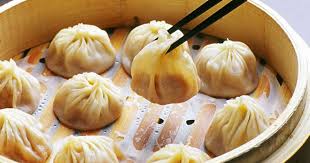 |
| Mee Pok |
noodle dish with Chinese noodle characterized by its flat and yellow appearance, varying in thickness and width. The dish is of Teochew origin and is commonly served in a number of countries such as Chaoshan (China), Singapore, Malaysia and Thailand. Mee Pok is commonly served tossed in a sauce (often referred to as "dry", or tah in Hokkien (Pe̍h-ōe-jī: ta)), though sometimes served in a soup (where it is referred to as "soup", or terng). Meat and vegetables are added on top. | 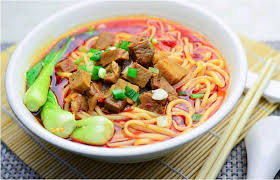 |
| Ma Po Tofu |
a popular Chinese dish from Sichuan province. It consists of tofu set in a spicy sauce, typically a thin, oily, and bright red suspension, based on douban 豆瓣 (fermented broadbean and chili paste) and douchi 豆豉 (fermented black beans), along with minced meat, usually pork or beef. Variations exist with other ingredients such as water chestnuts, onions, other vegetables, or wood ear fungus. | 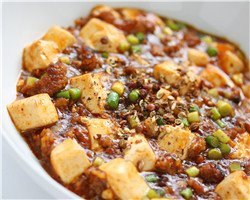 |
Regional cuisines
A number of different styles contribute to Chinese cuisine but perhaps the best known and most influential are Cantonese cuisine, Shandong cuisine, Jiangsu cuisine (specifically Huaiyang cuisine) and Sichuan cuisine.[27][28][29] These styles are distinctive from one another due to factors such as availability of resources, climate, geography, history, cooking techniques and lifestyle. One style may favour the use of garlic and shallots over chili and spices, while another may favour preparing seafood over other meats and fowl. Jiangsu cuisine favours cooking techniques such as braising and stewing, while Sichuan cuisine employs baking.
Based on the raw materials and ingredients used, the method of preparation and cultural differences, a variety of foods with different flavors and textures are prepared in different regions of the country. Many traditional regional cuisines rely on basic methods of preservation such as drying, salting, pickling and fermentation.