IB Philosophy Programme - Year 2
Index
Daimon and Eros
Useful
docs:
Read Guthrie: Chapter on Socrates
Virtue (arete) is knowledge (epsteme)
Apology discussion
* http://www.geocities.ws/john_russey/philosophy/Plato-apology.html
* http://www.geocities.ws/john_russey/philosophy/Gadfly_on_Trial.htm
**************************************************************************************
Focus on “Social Contract” in Crito
* Analysis
of Plato's Crito: Why does
Socrates Accept Execution? Or: The beginning of Polical Philosophy.
Borrowed from: http://www.philosophy.ucsb.edu/websites/phil4/Crito.pdf
Questions to prepare:
**************************************************************************************
Discuss Plato’s “Meno”
--- discuss elements that Plato has added to Socrates:
Questions to prepare:
**************************************************************************************
Plato’s “Phaedo”
... discuss Pythagorean elements...
Questions to prepare:
Essay Assignment:
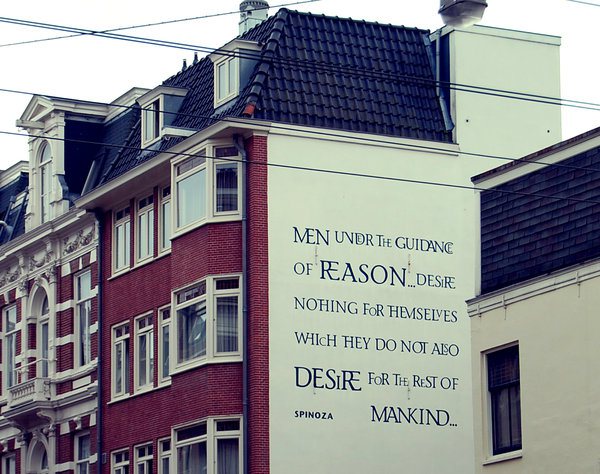
Another Proof.— (51:2) He, who lives under the guidance of reason, desires for others the good which he seeks for himself (IV:xxxvii.); wherefore from seeing someone doing good to his fellow his own endeavour to do good is aided; in other words, he will feel pleasure (III:xi.Note) accompanied by the idea of the benefactor. (3) Therefore {loves}he approves of him. Q.E.D.

1. There is one world, which means that when you and I are talking about it, or reacting to it, we are talking about and reacting to the same thing.
2. Things may change in that world, but it is still the same world.
3. We are part of that world, and being part of it is what allows us to communicate and be.
4. Through imagination we helpfully separate out one part of that world from the rest.
5. Through rationality we connect the separated out parts, which are not really separate.
6. Intuition is the flash of this connection. We all experience it.
7. We have very little control over ourselves (much less than we think), and the control we do have comes from thinking clearly.
9. Blaming (and overly praising) things external to us is largely a mistake.
10. Our salvation – in the grand sense, and the daily sense – depends on the salvation of things/persons external to us.
11. No soul can be freed without the body.
12. At any moment you can achieve greater freedom by changing the way that you think.
13. Any thorough embrace of “I” in the most selfish sense, undermines the sense of what an “I” is.
14. Understanding how something works is key to freedom.
15. We are our machines and techniques.
16. Nothing is completely unreal.
17. Everything outside of us has an explanation (causes), but an explanation which we can never be completely clear about.
18. Eternity is just the term for something that is not bounded, but is merely and entirely expressive.
19. The more we become like eternity, even in the most pragmatic situations, the freer and more powerful we are.
20. Gaining control involves separating out yourself from that which is outside of you, then reconnecting yourself by realizing that you were always connected but not in the way that you thought.
21. Things could not have been different than they have been, a thought that makes things very different in the future.
22. Everything thinks, however dimly. Which is another way of saying that things are all to some degree organizing, and not merely passively organized.
23. Thinking involves starting from the widest and working in.
24. I necessarily feel and see the world through others.
25. When we’re wrong, we’re only partially wrong.
Political Theorist, and at one time imprisoned Spinozist, Antonio Negri calls it the Caliban Question. And I think it is perhaps the greatest question of all, in regards to the full applicability of Spinoza to modern times. What is the Caliban Question?
For Negri, the Caliban Question is the search for the positive role of the imagination in the architecture of Being which Spinoza presents....Spinoza begins by telling Balling that his prophetic experience of his son’s groans were merely of the imagination:
With regard to Omens, of which you make mention in telling me that, while your child was still healthy and strong, you heard groans like those he uttered when he was ill and shortly afterwards died, I should judge that these were not real groans, but only the effect of your imagination; (tran. Elwes)
We might at this point see that Spinoza is going to say that these hallucinated groans are to Spinoza merely imagination, a confused play of the mind upon itself. But this will not be the case. For really Spinoza finds degrees of truth in all knowing, even imaginary knowing. And here he will a distinction which says something in particular about kinds of imaginary influences. First Spinoza cements his conclusion that indeed these were imaginary effects. They were not direct perceptions gained through the senses:
for you say that, when you got up and composed yourself to listen, you did not hear them so clearly either as before or as afterwards, when you had fallen asleep again. This, I think, shows that the groans were purely due to the imagination, which, when it was unfettered and free, could imagine groans more forcibly and vividly than when you sat up in order to listen in a particular direction.
A Brazilian Caliban: the dream opens itself up
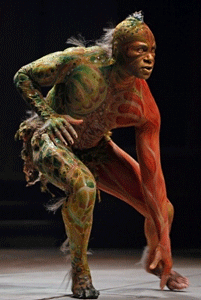
Spinoza then makes a rather interesting, if discordant, diversion. He means at the surface of it to explain that he too had experienced a play of the imagination which forcefully maintained itself, superimposed upon the world, when one thing or another was not being stared at. But the content of this dream, and its persistence, the jutting presence it seems to have in the letter, makes of it for the psychologically minded, a cypher:
I think I can both illustrate and confirm what I say by another occurrence, which befell me at Rhijnsburg last winter. When one morning, after the day had dawned, I woke up from a very unpleasant dream, the images, which had presented themselves to me in sleep, remained before my eyes just as vividly as though the things had been real, especially the image of a certain black and scabrous Brazilian whom I had never seen before. This image disappeared for the most part when, in order to divert my thoughts, I cast my eyes on a boot, or something else. But, as soon as I lifted my eyes again without fixing my attention on any particular object, the same image of this same negro appeared with the same vividness again and again, until the head of it gradually vanished (translation modified).
We can see the imposition of the black and scabby Brazilian negro. It is easy now in our time of critical reflection to understand that the figure, though Spinoza had “never seen” him before, embodies much that is projective in the wealth and organization of Amsterdam and European crisis. (Spinoza is from merchant’s family which traded primarily with colonial Brazil.) The Brazil. The locus of some of the lost tribes of Israel, the slavery of humanity on whose trade fuels a new and possibly democratic liberation in the United Provinces, a diseased figure which speaks to the plague, a persistent intruder in Sense itself. Spinoza turns to this memory in empathy with, and not just an illustration of, Peter Balling’s premonition. There suggests a grand kind of synthesis here. The most personal and the most economic and cultural. A son one has always known, slave one has never met. But how is it to gain footing?
Spinoza makes an important distinction, one that I think is requisite by the very nature of his bi-Attributive metaphysics (perhaps though in violation of a postulate of an infinite number of Attributes):
Effects of imagination either from the constitution of a body or of a mind, originate (translation own).
Effectus imaginationis ex constitutione vel coporis vel mentis oriuntur.
Spinoza wants to have Balling see that the dream of the Brazilian Caliban is perhaps somehow fundamentally different than his own premonition of his son’s illness and death. At this point in the letter to this effect Spinoza brings up the kind of hallucinations which characterize the effects of the imagination brought on by the condition of the body. First he mentions the delirium caused by fevers. Next he mentions how a constitutionally “tenacious” man or woman tenacem imagines “nothing but quarrels, brawls, slaughterings, and the like”. These are effects that are supposed to flow from physical effects. In contrast to this physical arisal, there is the logic of imaginary progressions, spreading out in a web of expanding associations and tracings:
We also see that the imagination is to a certain extent determined by the character of the constitution of the soul [ab animae constitutione ], for, as we know by experience, it follows the traces of the Intellect in all things, and arranges its images and words, just as the Intellect arranges its demonstrations and connects one with another; so that we are hardly at all able to say, what will not serve the imagination as a basis for some image or other.
Spinoza, in his dichotomy of causes, will set up a distinction as to which effects of the imagination are possibly prophetic of the future, and those which are not. The distinction is simple, if ever impossible to support as pure. Effects which proceed from the body can have no prophetic glimpse, those that proceed from the mind/soul, can, in a confused way, have a presentament of the future:
This being so, I say that no effects of imagination springing from physical causes can ever be omens of future events; inasmuch as their causes do not involve any future events. But the effects of imagination, or images originating in the mental constitution, may be omens of some future event; inasmuch as the mind may have a confused presentiment of the future.
He goes further, characterizing just what it was about Peter Balling’s hallucination what may have made it prophetic, and it is based on the concept of union and love:
It may, therefore, imagine a future event as forcibly and vividly, as though it were present; for instance a father (to take an example resembling your own) loves his child so much, that he and the beloved child are, as it were, one and the same. And since (like that which I demonstrated on another occasion) there must necessarily exist in thought the idea of the essence of the child’s states and their results, and since the father, through his union with his child, is a part of the said child, the soul of the father must necessarily participate in the ideal essence of the child and his states, and in their results, as I have shown at greater length elsewhere.
The prophetic capacities of Peter Balling causally stem from his loving and shared essence with his son. There is for Spinoza a very real sense in which participation in another person’s force of existing can make of you both One Thing, and by virtue of this synthetic and truly cybernetic understanding of shared essence, the imagination can operate as an, albeit confused, but still forceful and productive means of understanding and liberation. Just how Spinoza aims to delineate that his own hallucination of the Brazilian Caliban, wanting of freedom, as a participant in the forces which helped enslave him, as a merely bodily effect of the imagination, one does not know. Perhaps this distinction only is a residue of his need to privilege his friend’s intimate hallucination. Or perhaps he himself could not fathom the ideational sharing he might have with a distant and dark figure whom “he had never met”. The question remains open.
[...]
The Reality of the Imagination, the constitutive partaking it has with the essences of things, the fact that all of the social Real is shot through with imaginary forces, and that these forces concretely and causally make up the forms of our social domain, is the hinge-point on which Negri turns Spinoza’s critique of imagination, to a imaginative project of liberation. It is possible, indeed historically necessary, to imagine, and perhaps phenomenologically experience, a liberation in order to bring it about.
But even if substances that share an attribute are not individuated by their modes, perhaps such substances are individuated by attributes they do not share. Spinoza does allow, after all, that a substance can have more than one attribute. So why can’t we have the following scenario: substance 1 has attributes X and Y and substance 2 has attributes Y and Z. On this scenario, while the two substances share an attribute (i.e. Y) they differ with regard to other attributes and can thus be individuated after all. So perhaps then, contrary to 1p5, there can be some sharing of attributes by different substances. This objection was first raised by Leibniz, one of the most acute readers of Spinoza.
This objection is harder to answer than the charge that substances that share an attribute can be individuated by their modes, but Spinoza clearly has the resources to handle this objection too. To see why, let’s assume that Leibniz’s scenario is possible. If so, then attribute Y would not enable us to pick out or conceive of one substance in particular. The thought “the substance with attribute Y” would not be a thought of one substance in particular, and thus attribute Y would not by itself enable us conceive of any particular substance. For Spinoza, such a result would contradict the clause in the definition of attribute according to which each attribute constitutes the essence of substance. As Spinoza says in 1p10s, a claim that he clearly sees as following form the definition of attribute, “each [attribute of a substance] expresses the reality or being of substance.” So for Spinoza, if a substance has more than one attribute, each attribute by itself must enable us to conceive of the substance, and this can by the case only if each attribute that a substance has is unique to that substance. Thus Leibniz’s scenario is ruled out (46-48)
The Coldness of Spinoza: Was He Really a Spock?
Understanding the IS-OUGHT gap...
[A very general] history of the gap...
the "gap" begins "hypothetically" with the move from "Panpsychism" (Milesians) --> Pythagoras and Plato (with "separation" of soul (psyche) from body (hyle))
Hume's fork...
Kant's (very in-depth & complex) solution...
[an excellent text by Stephen Hicks] ... http://www.stephenhicks.org/tag/is-ought-gap/
SL:
Group Discussion: Locke’s
idea of Natural Rights: Focus on Property – (precedes
consent & Social
Contract)
Libertarian view... Corporatism Is Not the Free Market
A
view from an "Other" (American Indian) perspective
Consequentialist vs. Categorical Ethics -- Sandel: Justice: What's The Right Thing To Do? Episode 01
(Introduction to Morality and Justice with case studies comparing two common strains of Ethics:
Consequentialism (Utilitarianism) vs. Categorical (Deontological) Ethics)
http://geocities.ws/john_russey/philosophy/Ethics_Questions_for_HL_Philosophy.html
*****************************************************
Utilitarianism
-- Sandel:
Justice:
What's The Right Thing To Do? Episode
02
Questions
http://geocities.ws/john_russey/philosophy/Justice(2).html
http://geocities.ws/john_russey/philosophy/Justice_Sandel-Episode2-ANSWERS.htm
*****************************************************
Libertarians
-- Sandel: Justice:
What's The Right Thing To Do? Episode 03: "FREE TO CHOOSE"
QUESTIONS
http://geocities.ws/john_russey/philosophy/Sandel_3-questions.html
Summary
of episode 03:
http://geocities.ws/john_russey/philosophy/Sandel_Justice-Episode3.html
*****************************************************
John Locke – Sandel:
Justice: Episode 4
QUESTIONS
http://geocities.ws/john_russey/philosophy/John_Locke_questions.htm
Summary:
http://geocities.ws/john_russey/philosophy/Sandel_4-questions.htm
*****************************************************
John Locke – Sandel:
Justice: Episode 5
QUESTIONS
http://geocities.ws/john_russey/philosophy/Sandel-Justice-Episode5_QUESTIONS.html
Summary:
http://geocities.ws/john_russey/philosophy/Sandel-Justice-Episode5.html
*****************************************************
Immanuel Kant – Sandel: Justice: Episode 6
( Kant offers an account of why we have a categorical duty to respect the dignity of persons... not to use people as a means, merely, even for good ends. )
Questions:
http://geocities.ws/john_russey/philosophy/Sandel-Justice-Episode6_QUESTIONS.html
Summary:
http://geocities.ws/john_russey/philosophy/Sandel-Justice-Episode6.html
*****************************************************
Immanuel Kant and John Rawls – Sandel: Justice: Episode 7
( Part I: Within Kant's stringent account of morality, is there a way that you could avoid telling a lie, (i.e., without selling out your friend)?
Part II: Kant says that just laws arise from a certain sort of social contract; not an actual contract . Thus, Sandel asks, what is the moral force of a hypothetical contract – a contract that never happened?
Rawls, [perhaps] similar to Kant, offers idea that principles of social justice can be founded on a hypothetical contract... )
Questions:
http://geocities.ws/john_russey/philosophy/Sandel-Justice-Episode7_QUESTIONS.html
Summary:
http://geocities.ws/john_russey/philosophy/Justice-Sandel-Episode07.html
the guide (in full) - if you want to check something...
Suggestions from IB Philosophy Guide
Doing
philosophy—an independent
approach
Learning
philosophy can be achieved through a study of the history of philosophy
or by
doing philosophy.
The
emphasis of the Diploma Programme philosophy course is on doing
philosophy
within an international context. The aim is to encourage students to
develop
the ability to reason and argue and to take a personal and independent
position
on philosophical issues. Below is a suggested approach that will enable
students to study themes or texts in a consistent way. It is not the
only
approach available, but it provides a starting point from which
students can
develop into independent thinkers. This approach is suitable for all
the tasks
included in the syllabus.
Formulating
arguments
The
philosophy course does not include logic as a specific topic for study.
However, students should be familiar with the basic features of
reasoning necessary
to formulate their own philosophical arguments and to develop and
evaluate
those of others. Teachers should develop their students’ skills so that
they
are able to construct personal philosophical arguments.
When
formulating philosophical arguments students should:
Students
should adopt the same approach when they examine a classic
philosophical issue
or use a philosophical argument presented in a text. They should always
be
careful not to refer to the text or the author as an authority. In
addition,
students are expected to:
This
approach goes beyond the mere presentation of arguments and
counter-arguments
from philosophers’ texts, and insists on students developing their own
line of
reasoning. Students must always demonstrate how their own personal
reasoning
underpins their argument.
Some
common mistakes made by
students include:
CoreTheme:
What is a Human Being?
(This theme includes EVERYTHING that we will
cover - including the Republic,
Ethics and Political Philosophy)
Optional Theme 1: Political Philosophy
Optional Theme 2: Ethics
-----------------------------------------------------
For Paper 1 students will be required to write 800 words on each applicable theme
SL
- There
will be two
themes covered during the next two years (Core Theme and Political
Philosophy)
HL -
There
will be three
themes covered during the next two years (Core Theme,
Political Philosophy and Ethics)
-----------------------------------------------------
Plato's "Republic" is the philosophical text that will be analyzed in detail and students will be required to write 800 words on this during the IB exam.
SL and HL
-----------------------------------------------------
HL Students only - will be required to write 800 words over "doing philosophy"
SL and HL
Internal
Assessment Assignment – give examples,
criteria and requirements
Example
A – student commentary
***********************
Example
B - student commentary
Introducing Philosophy: A text with Integrated Readings, by Robert Solomon, International 9th ed., Oxford: Oxford U. Press, 2009, pp. 551-605.
Student Resources
Chapter
8: Political
Philosophy
http://global.oup.com/us/companion.websites/9780199764860/student/chapt8/
Introducing Philosophy: A text with Integrated Readings, by Robert Solomon, International 9th ed., Oxford: Oxford U. Press, 2009, pp. 551-605.
Student Resources
Chapter 7: Ethics
http://global.oup.com/us/companion.websites/9780199764860/student/chapt7/
SL: Discuss Plato’s “Republic” – in relation to Socrates, Greek history and what we have discussed so far...
--- Plato's Republic: Kinds of State or Person
IB Exam Examples
Paper
3 (HL): Unseen
Text - Exploring Philosophical Activity
+ criteria for marking
Paper
3 (HL): Unseen Text - Example 1
Paper
3 (HL): Unseen Text - Example 2
IB Exam Dates
Wednesday, 6 May (Afternoon examinations -- must start after 1200 hours and finish by 1800 hours local time.) :
Philosophy
HL paper 1 -- 2h 30m
Philosophy SL paper 1 -- 1h 45m
Thursday, 7 May (Morning examinations -- must start after 0700 hours and finish by 1300 hours local time.):
Philosophy HL/SL paper 2 -- 1h
Philosophy HL paper 3 -- 1h
30m
http://www.ibo.org/diploma/exams/documents/May-2015-exam-en.pdf