Introduction to Atoms
The atom is a basic unit of matter that consists of a dense central nucleus surrounded by a cloud of negatively charged electrons. The atomic nucleus contains a mix of positively charged protons and electrically neutral neutrons. An atom is classified according to the number of protons and neutrons in its nucleus: the number of protons determines the chemical element, and the number of neutrons determines the isotope of the element.Atomic theory Timeline
Subatomic Particles
The Bohr Model is out-dated but depicts the three basic subatomic particles in a comprehendible way. Electron clouds (in the figure shown below) are better representations of where electrons are found. The darker areas represent where the electrons will have a higher probability of being located and the lighter areas represent where they are less likely to be found. 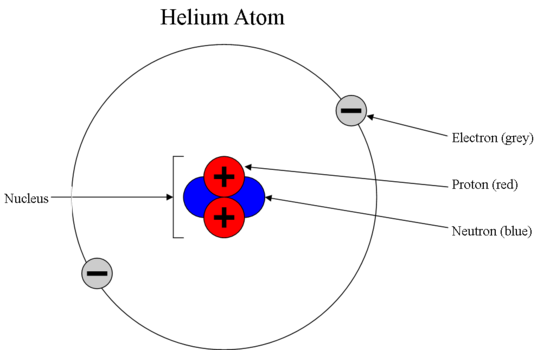

Protons
Protons were discovered by Earnest Rutherford in the year 1919, when he performed his gold foil experiment. He projected alpha particles (aka Helium nuclei) at gold foil and the positive alpha particles were deflected. He concluded that protons exist in a nucleus and have a positive nuclear charge. The atomic number or proton number is the number of protons present in an atom. The atomic number determines an element (e.g., the element of atomic number 6 is Carbon).

Electrons
Electrons were discovered by Sir John Joseph Thomson in 1897. After many experiments of cathode-rays, J.J. Thomson demonstrated the ratio of mass to electric charge of cathode-rays. He confirmed that cathode-rays are fundamental particles that have a negative charge. Cathode-rays became known as electrons. Robert Millikan, through oil-drop experiments, found the value of the electronic charge.

Neutrons
Neutrons were discovered by James Chadwick in 1932, when he demonstrated that penetrating radiation incorporated beams of neutral particles. Neutrons are located in the nucleus with the protons. Along with protons, they make up almost all of the mass of the atom. The number of neutrons is called the neutron number and can be found by subtracting the proton number from the atomic mass number. The neutrons in an element affect which isotope the atom is of, and often times, its stability. The number of neutrons does not have to equal that of the protons.