= HF8V = / = SP8WJT = / = SP0106RZ =
HF-60269
PROJECT: HF-60269
DESCRIPTION: Extension board for uC module HF-12269 or HF-12268
STATUS: 1u 1q 1z
PROJECT START DATE: 2024
LOCALISATION: HF-6169
DOCUMENTATION: TM, DVC
PCB: TPD52919
DIMENSIONS: 70 x 50 mm
SUPPLY VOLTAGE: 2.7 - 5.5 V
HARDWARE VERSION: 2.1
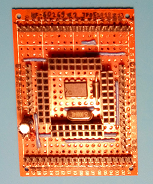
Extender board HF-60269#2
Modules:
| PROJECT | STATUS | PCB | REMARKS |
|---|
| HF-60269#1 | q z | TPD52919#9 | version 1 -> version 2, deleted because 2 soldering fields on TPD52919#9 destroyed |
| HF-60269#2 | u | TPD52919#13 | version 2 |
Project Info
Idea behind this extension board is highly simplified system. For that reason there is almost nothing on extension board and all 53 ports are available for user (only connectors, XTAL and EEPROM are present). Beacuse of lack of HF-10060 programming interface it is expected that microprocessor module will be programmed in HF-6128 system.
Microprocessor module HF-12269 together with HF-60269#2 extension board has been registered as Digital System HF-6169. It is currently used as secondary controller for system HF-6100.
This board has the following features:
53 I/O pins available as external ports
3 I/O pins for extension board resources
EEPROM 24C16 (DRIVE2)
XTAL
Protection against reversed supply polarity
Hardware changes
Version 1: Microcontroller module was placed unsimmetrically to make some room fo additional equipment
Version 2: I realized that this is fixed extension board and no additional equipment will be mounted. So I resoldered uC module to the central position, but I made some errors and I needed to unsolder connectors 3-rd time. This cheap chinese univesal boards cannot handle 3 unsoldering and 2 soldering points were destroyed. So I swapped TPD52919#9 with TPD52919#13 from test project HF-90261 where it is no problem.
Version 2.1: I was thinking about automatic detection of extension boards by uC module. First thoughts was about 1 input pin placed on high/low level by extension boards, but there is better idea, small 24C16 EEPROM with digital signature which can be read on boostrap. There is a lot of free memory in HF-12268 and HF-12269, so separate software can be independently written and switched by extension board. This idea later goes into standard DRIVE2 on board. Identification and configuration data is stored in system segment on this drive.
Automatic motherboard recognision system
Extension boards HF-60269 and HF-60268 are first systems where automatic recognision of main board by microprocessor module are introduced. Thus microprocessor modules HF-12268 and HF-12269 can read digital signatures from EEPROM (DRIVE2) of extension boards HF-60268 and HF-60269 and apply "BIOS" software specific to hardware on these boards. This system will be introduced also in other systems with multiple microprocessor modules and motherboards.
Sources:
[1] Datasheet ATMEGA64
[2] ATMEGA64 Product Page
[3] Datasheet ATMEGA128
[4] ATMEGA128 Product Page
[5] HF-12268 Microprocessor module ATMEGA128
[6] HF-12269 Microprocessor module ATMEGA64
[7] Programator AVR ISP HF-6003
[8] Programator AVR ISP HF-60101
[9] HF-10060 Standard for AVR programming interface
Prefix 60
HF Register
Microcontrollers in my constructions and external equipment
UC Database - my CPU collection
Electronics
Main Page